- Phone
-
Address
www.shklsw.com
Product Categories
Shanghai Kanglang Biotechnology Co., Ltd

Porcine Circovirus Type 1 Fluorescent Quantitative PCR Kit Using Dye Method
NegotiableUpdate on 05/06
- Model
- Nature of the Manufacturer
- Producers
- Product Category
- Place of Origin
Overview
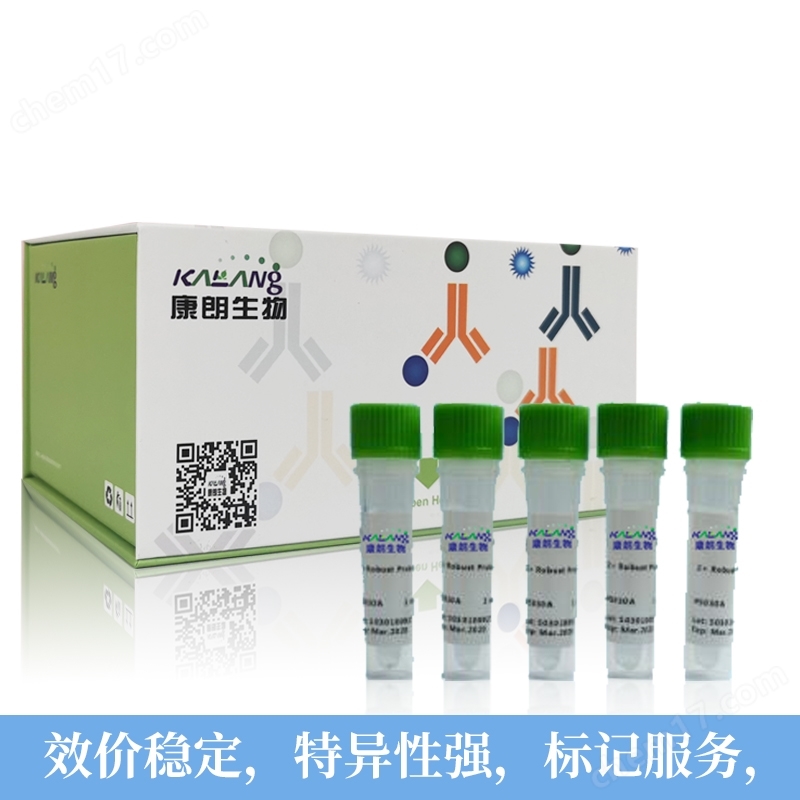
The fluorescent quantitative PCR kit for porcine circovirus type 1 dye method is ready to use, and users only need to provide virus samples. Specific primers designed based on the conserved sequence of porcine circovirus type 1 dye method have no cross reactivity with related viruses. This product is only suitable for scientific research and cannot be used for clinical diagnosis.
Product Details
Porcine circovirusType 1 dye based fluorescence quantitative PCR kit
Porcine Circovirus 1 (PCV-1)
Product and Features:
Porcine Circovirus Type 1 Fluorescent Quantitative PCR Kit Using Dye MethodHas the following characteristics:
1. Ready to use, users only need to provide virus samples.
2. Specific primers designed based on the conserved sequence of porcine circovirus type 1 dye method, with no cross reactivity with related viruses.
3. Sensitivity can reach several hundred copies per reaction.
4. One tube fluorescent quantitative PCR detection to avoid subsequent contamination.
5. This kit is sufficient for 50 times of fluorescence quantitative PCR with 20 μ L reaction system.
6. This product is only suitable for scientific research and cannot be used for clinical diagnosis.
| number | component | specification |
| Reagent 1 | 2×qPCR MagicMix | 500 μ L (brown tube) |
| Reagent 2 | Fluorescent PCR specific template diluent | 1 mL (yellow cap) |
| Reagent Three | Porcine circovirus1型染料法PCRPrimer mixture | 100 μ L (white cap) |
| Reagent 4 | Porcine circovirus1型染料法PCRPositive for photo(1×10E8copy/μL) | 50 μ L (red cap) |
| Reagent 5 | DNAVirus lysis buffer (trial set) | 15 times (9 mL) |
| User Manual | 1 copy |
Transportation and storage: Low temperature transportation-Stored at 20 ℃, valid for one year.
Self provided reagents: DNA template, 10 × ROX (depending on the model, please refer to the usage instructions for details).
Usage 1dilutePCR positive control(With)Taking 10E2-10E7 copies/μ L as an example, these 6 10 fold dilutions
1. Attention: Due to the high concentration of the standard, the following dilution operations must be carried out in a separate area and must not contaminate the sample or other components of this kit. To increase product stability and avoid the spread of infectious pathogens, this product does not provide live samples as positive controls, only DNA fragments that can be directly used as positive controls.
2. Mark 6 centrifuge tubes, namely 7, 6, 5, 4, 3, and 2.
3. Add 45 μ L of fluorescent PCR specific template diluent using a core gun tip (preferably using a core gun tip, the same below).
4. Add 5 μ L of 1 × 10E8 copy/μ L positive control to tube 7, shake thoroughly for 1 minute, and obtain 1 × 10E7 copy/μ L positive control. Put it on ice for later use.
5. Change the gun head and add 5 μ L of 1 × 10E7 copy/μ L positive control (diluted in the previous step) to tube 6. Shake thoroughly for 1 minute to obtain 1 × 10E6 copy/μ L positive control. Put it on ice for later use.
6. Change the gun head and add 5 μ L of 1 × 10E6 copy/μ L positive control to tube 5. Shake thoroughly for 1 minute to obtain 1 × 10E5 copy/μ L positive control. Put it on ice for later use.
7. Repeat the above operation until 6 dilutions of positive control are obtained. Put it on ice for later use.
2、 SamplePreparation of DNA:
If there are N samples, N+2 extractions must be set, and the extra one is PC (positive control for sample preparation),
one isNC (negative control for sample preparation). You can use 10 μ L of the PCR positive control prepared in the previous step, either No. 4 (concentration of 1 × 10E4 copies/μ L, 10 μ L is equivalent to 10000 copies) or No. 5 (concentration of 1 × 10E5 copies/μ L, 10 μ L is equivalent to 100000 copies), plus a certain amount of water to make the total volume the same as the required volume for each preparation, as PC. In addition, water is used as NC. If 200 μ L of sample is required for each preparation, the volume of PC and NC must also be 200 μ L.
9. Purification of samples using self selected methodsDNA, This kit is compatible with most virus DNA retrieval kits on the market. You can also choose our company's one tube virus DNAout or its upgraded column virus DNAout. This test kit comes with 15 free tube shaped virus DNAouts.
3、 Setting upQPCR reaction (20 μ L system, conducted in the sample preparation room):
10. If only doOnce repeated, label N+9 PCR tubes, of which N+2 are used for the N+2 obtained in the previous step
sample1 for PCR negative control and 6 for PCR positive control. If repeated 2-3 times, the number of reaction settings will correspondingly increase by 2 or 3 times.
11. Add each component to the labeled tube according to the table below (this table only lists one repetition. The positive control is only set after the sample tube and negative control are set, and the positive control sample should be added after all tubes are covered and stored):
| component | N+2 sample tubes | PCR negative control tube | PCR positive control tubes (2-7 tubes) |
| 2×qPCR MagicMix (棕色管) | 10μL | 10 μL | 10 μ L each |
| Porcine circovirus1型染料法PCR Primer Mix (White Cap) | 2 μL | 2 μL | 2 μ L each |
| Bring your own 10 x ROX (see note) | 2 μL | 2 μL | 2 μ L each |
| N+2 test sample DNA template | 6 μL | not add | not add |
| Step 7 PCR positive control obtained Dilution solution (No. 2-7) | not add | not add | 6 μ L each (sample 2 to tube 2, sample 3 to tube 3...) |
noteOnly ABI7500, 7700, and 7900 instruments require ROX as a control, while other fluorescent PCR instruments (such as...) iCycler IQ、MJ Option、MJ Chromo4、MX3000、MX4000、RotorGene3000、RotorGene 6000 If ROX is not required for LightCycler480, use water instead.
12. After covering the machine, perform PCR according to the following parameters (specific PCR parameters can be optimized according to different instruments).
| process | temperature | time |
| Pre denaturation | 92℃ | 5 minutes |
|
PCR reaction (30 cycles) | 94℃ | 60 seconds |
| 50℃ | 60 seconds | |
| 72℃ | 60 seconds |
13. Data collection
The specific operation should be carried out according to the recommended process of the instrument used. The fluorescent dyes contained in this product do not bindWhen DNA is present, the maximum absorption spectrum is at 471 nm, when DNA is bound, the maximum absorption spectrum is at 500 nm, and the maximum emission spectrum is at 530 nm. Signal acquisition can be set during the refolding or extension step.
4、 Data processing:
If this reagent kit is used for quantitative detection, plot a standard curve with the log value of the positive control concentration as the horizontal axis and Ct value as the vertical axis. Calculate the log value of the DNA concentration of the sample from the standard curve based on the Ct value of the sample to be tested, and then calculate its concentration.
If this kit is used for qualitative testing and only determines positive or negative, the negative control Ct must be greater than or equal to 40. The positive control must have fluorescence logarithmic growth, typical amplification curve, and Ct value should be less than or equal to 30. For the test sample, if its Ct is greater than or equal to 40, it is negative; if it is less than or equal to 35, it is positive. If it is between 35-40, repeat once. If the Ct value of the repeated experiment is greater than or equal to 40, it is negative; if it is less than 40, it is positive.
For scientific research purposes only, not for clinical testing or therapeutic use.