-
E-mail
416183088@qq.com
-
Phone
13461341555
-
Address
2nd Floor, Building 3, No. 1-1 Huayi Road, Yuhangxing Street, Yuhang District, Hangzhou City, Zhejiang Province
Product Categories
Hangzhou Dawei Science and Education Instrument Co., Ltd

Molecular distillation device
NegotiableUpdate on 02/08
- Model
- Nature of the Manufacturer
- Producers
- Product Category
- Place of Origin
Overview
Molecular distillation of molecular distillation equipment is a special distillation technology based on the theory of molecular motion. Its core lies in reducing the boiling point of substances through high vacuum environment (usually pressure ≤ 0.01Pa), achieving low-temperature separation of thermosensitive, high boiling point or high viscosity substances.
Product Details
Molecular distillation is a special distillation technique based on the theory of molecular motion. Its core lies in reducing the boiling point of substances through a high vacuum environment (usually pressure ≤ 0.01Pa), achieving low-temperature separation of thermosensitive, high boiling point, or high viscosity substances. Unlike traditional distillation that relies on boiling point differences, molecular distillation achieves separation through differences in molecular free paths: under vacuum, molecules of different substances evaporate from the liquid phase and separate before condensing on the condenser surface due to differences in average free paths, avoiding the limitation of vaporization condensation equilibrium in traditional distillation.
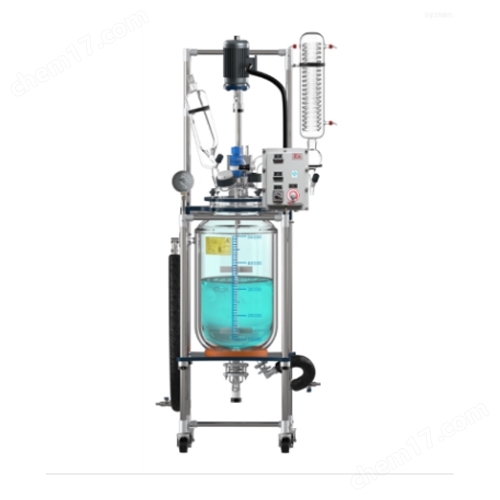
Molecular distillation deviceComposed of four core modules: evaporation system, condensation system, vacuum system, and control system, each module collaborates to achieve precise separation
1. Evaporation system
Evaporator: Adopting scraping film, centrifugal or falling film design to ensure uniform distribution of materials and rapid evaporation. The scraper evaporator uses a rotating scraper to coat the material into a thin liquid film (thickness 0.1-1mm), increasing the evaporation area; Centrifugal evaporators use centrifugal force to throw materials towards the heating wall, forming a liquid film.
Heating method: Electric heating, thermal oil heating, or infrared heating are usually used, and the heating temperature needs to be precisely controlled (± 1 ℃) to avoid local overheating.
2. Condensation system
Built in condenser: located inside the evaporator, directly capturing evaporated molecules. The condensation surface needs to maintain high cleanliness to avoid impurities affecting the condensation efficiency.
External condenser: used to separate components with different boiling points, achieving multi-stage separation by adjusting the condensation temperature.
Condensation medium: commonly used liquid nitrogen, low-temperature coolant (such as ethylene glycol solution) or refrigerant, ensure that the condensation surface temperature is lower than the evaporating molecule temperature.
3. Vacuum system
Vacuum pump group: usually uses a multi-stage pump combination, such as mechanical pump+Roots pump+diffusion pump, to ensure that the system vacuum degree reaches the required range.
Vacuum measurement and control: Real time monitoring of vacuum degree through vacuum gauges (such as ionization gauges and thin film gauges), combined with automatic control systems to adjust pump speed or valve opening, to maintain a stable vacuum environment.
4. Control system
Temperature control: PID algorithm is used to accurately adjust the evaporation temperature and condensation temperature, ensuring temperature fluctuations of ≤± 0.5 ℃.
Vacuum degree control: Adjust the speed of the vacuum pump through a frequency converter or adjust the pumping rate through a valve to maintain the target vacuum degree.
Automated operation: Integrate PLC or DCS system to achieve full process automation control of feeding, heating, vacuuming, condensation, and discharging, supporting data recording and remote monitoring.
Product parameters
| parameter model | DWMD-60 | DWMD-80 | DWMD-100 | DWMD-150 | DWMD-200 | DWMD-230 |
| Evaporator diameter (mm) | 60 | 80 | 100 | 150 | 200 | 230 |
| Evaporation area m ² | 0.06 | 0.1 | 0.15 | 0.25 | 0.35 | 0.5 |
| Condensation area m ² | 0.15 | 0.2 | 0.3 | 0.4 | 0.5 | 0.7 |
| Capacity of feeding tank (L) | 1 | 1 | 2 | 2 | 5 | 5 |
| Feed flow rate L/h | 0.5-2 | 0.5-4 | 0.5-6 | 1-8 | 3-15 | 8-25 |
| Light component collection bottle (L) | 1 | 1 | 2 | 3 | 5 | 5 |
| Recombinant fraction collection bottle (L) | 1 | 1 | 2 | 3 | 5 | 5 |
| Vacuum degree (Pa) | ≤10 | |||||
| Mixing motor power (W) | 120 | |||||
| Speed range r/min | 50-500 | |||||
| Working temperature range (℃) | -90-280 | |||||
| Working voltage (V) | 220V/50Hz voltage can be customized according to requirements | |||||
The molecular distillation device has a complex structure and high precision requirements. Proper daily maintenance is the key to ensuring stable operation and extending the service life of the equipment, mainly including the following aspects:
Vacuum system maintenance:
Regularly check the liquid level and condition of the vacuum pump oil. If the liquid level is below the scale line, it should be replenished in a timely manner. If the oil color becomes darker, turbid, or has an odor, it should be replaced in a timely manner (diffusion pump oil should be replaced every 3-6 months, and rotary vane pump oil should be replaced every 1-2 months).
Clean the vacuum pipeline and valves, remove residual materials and impurities, and avoid pipeline blockage that affects the vacuum degree; Regularly check the wear of seals (such as O-rings and flange gaskets), and replace them promptly if they are aged or damaged.
Regularly calibrate the vacuum gauge (once every 6-12 months) to ensure accurate pressure measurement; When shutting down for a long time, it is necessary to close the vacuum system valve and fill it with dry nitrogen to prevent air and moisture from entering the equipment.
Evaporation system maintenance:
After each use, wait for the equipment to cool to room temperature and clean the evaporation surface and scraper with neutral cleaning agents (such as ethanol, acetone) to remove residual materials and avoid material coking that affects heat transfer efficiency and liquid film uniformity.
Regularly check the gap between the scraper and the evaporation surface. If the gap is too large (>0.5mm), adjust or replace the scraper; Check the wear of the scraper material, and replace it promptly if the PTFE scraper is severely worn.
Regularly clean the heating jacket to remove scale or material residue, ensuring even heating; The temperature sensor is calibrated regularly (once every 6 months) to ensure accurate temperature measurement.
Maintenance of condensing system:
Regularly check the liquid level and purity of condensing media (such as ethylene glycol aqueous solution, liquid nitrogen), replenish or replace them in a timely manner, and avoid a decrease in condensing effect.
Clean the condensation surface, remove residual condensation, ensure a smooth condensation surface, and improve condensation efficiency; Check if the condensation pipeline is blocked. If there is any blockage, it needs to be flushed with solvent or blown with high-pressure gas.
Control system maintenance:
Regularly check the connection status of control components such as PLC, touch screen, sensors, etc., to ensure that there is no looseness or malfunction; Backup control programs to prevent program loss.
Keep the control system clean and dry to prevent dust and moisture from entering and affecting the lifespan of electrical components; Regularly test safety protection functions (such as over temperature and over pressure protection) to ensure normal operation.
Overall maintenance:
The operating environment of the equipment should be kept clean, dry, and well ventilated to prevent dust and corrosive gases from entering; Regularly check the levelness of the equipment, and adjust the anchor bolts if there is any deviation.
When the equipment is shut down for a long time, it is necessary to empty the materials inside, clean all components, turn off the power and water sources, cover it with a dust cover, and run it regularly for 30 minutes to ensure that the equipment is in good condition.
Common troubleshooting
Vacuum degree cannot reach the set value:
Reasons: Vacuum system leakage, vacuum pump failure (such as pump oil deterioration, pump body wear), pipeline blockage, aging of seals, and contamination of the vacuum system by volatile materials.
Exclusion method: Use a helium mass spectrometer leak detector to detect the leak point and repair the leak site; Replace the vacuum pump oil, repair or replace the faulty vacuum pump; Clean up blockages in pipelines; Replace aging seals; Clean the vacuum system with solvent to remove residual volatile substances from the material.
Low separation efficiency and substandard product purity:
Reasons: high or low evaporation temperature, high condensation temperature, insufficient vacuum degree, improper scraper speed (too thick or too thin liquid film), excessive feed flow rate, insufficient material pretreatment (such as containing a large amount of solid impurities).
Exclusion method: Adjust the evaporation temperature to the optimal range (determined based on material characteristics); Reduce the condensation temperature to ensure the condensation of light components; Troubleshooting the vacuum system and improving the vacuum level; Adjust the speed of the scraper to optimize the thickness of the liquid film; Reduce the feed flow rate to ensure sufficient separation; Filter and preprocess the materials to remove solid impurities.
Excessive material retention time and decomposition of thermosensitive components:
Reason: The scraper speed is too low (due to thick liquid film), the evaporation surface temperature is too high, and the feed flow rate is too low.
Exclusion method: Increase the speed of the scraper and reduce the thickness of the liquid film; Reduce the evaporation temperature; Appropriately increase the feed flow rate and shorten the material residence time.
Abnormal noise or vibration during equipment operation:
Reason: Friction between the scraper and the evaporation surface (too small gap), motor failure, bearing wear, equipment horizontal deviation.
Exclusion method: Adjust the gap between the scraper and the evaporation surface; Repair or replace faulty motors; Replace worn bearings; Adjust the level of the equipment to ensure smooth operation.
Control system malfunction (such as abnormal parameter display, inability to automatically adjust):
Reason: Sensor malfunction, loose wiring, PLC program error, power failure.
Exclusion method: calibrate or replace the sensor; Check the wiring and re fix it; Restore PLC default program or reload program; Check if the power supply is normal and repair the power failure.