-
E-mail
416183088@qq.com
-
Phone
13461341555
-
Address
2nd Floor, Building 3, No. 1-1 Huayi Road, Yuhangxing Street, Yuhang District, Hangzhou City, Zhejiang Province
Product Categories
Hangzhou Dawei Science and Education Instrument Co., Ltd

Distillation Glass Reactor
NegotiableUpdate on 02/08
- Model
- Nature of the Manufacturer
- Producers
- Product Category
- Place of Origin
Overview
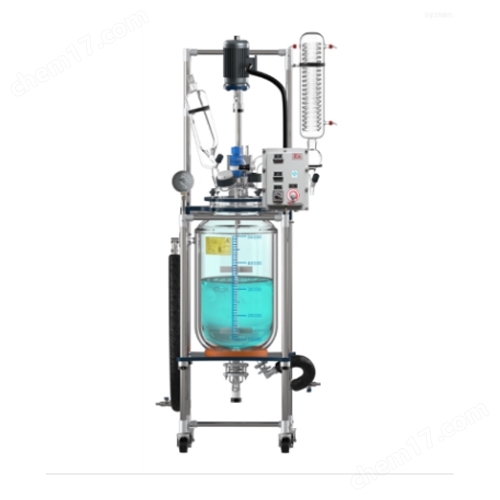
Distillation glass reaction kettle is a multifunctional experimental equipment that integrates chemical reaction and separation purification functions, widely used in fine chemical engineering, pharmaceuticals, new material research and development, university scientific research and other fields. Its core advantage lies in utilizing the transparency, corrosion resistance, and good thermal stability of high borosilicate glass material to achieve visual monitoring of the reaction process, and efficient separation of products through built-in or external distillation columns.
Product Details
Distillation Glass ReactorIt is a multifunctional experimental equipment that integrates chemical reaction and separation purification functions, widely used in fields such as fine chemical engineering, pharmaceuticals, new material research and development, and university scientific research. Its core advantage lies in utilizing the transparency, corrosion resistance, and good thermal stability of high borosilicate glass material to achieve visual monitoring of the reaction process, and efficient separation of products through built-in or external distillation columns.
Usually composed of the following main components:
Reactor body: Made of high borosilicate 3.3 glass, it has excellent heat shock resistance (can withstand a temperature difference of about 200 ℃) and chemical inertness, suitable for most organic solvents and acid-base systems. The volume commonly ranges from 50mL to 20L, and the laboratory commonly uses specifications of 1-5L
Distillation column: installed above the reaction vessel, filled with fillers (such as stainless steel θ ring, glass spring, ceramic Raschii ring, etc.) or equipped with a tray structure, used to provide gas-liquid contact interface and achieve component separation. The height of the distillation column and the type of packing are selected based on the separation difficulty and the theoretical number of trays required.
Condenser: usually a serpentine or spherical condenser tube, through which cooling water is passed to condense the rising steam for reflux or extraction. Some systems are equipped with fractionation heads that can adjust the reflux ratio.
Heating device: Oil bath, electric heating jacket or water bath pot are often used, combined with a temperature controller to achieve precise temperature control. It is strictly prohibited to directly heat the glass kettle with an open flame.
Mixing system: including motor, mixing blade (anchor, propeller or propulsion) and sealing interface. Stirring can promote heat and mass transfer, prevent local overheating or reactant deposition.
Temperature and pressure monitoring: equipped with thermometer sleeves, digital temperature sensors, and pressure or vacuum gauges to monitor the reaction status in real time.
Inlet/outlet: equipped with standard grinding ports (such as 24/29, 29/32) for easy connection of accessories such as drip funnels, gas inlet pipes, and receiving bottles.
Vacuum/inert gas interface: used for vacuuming and deoxygenation or introducing protective atmospheres such as nitrogen and argon to prevent oxidation or control the reaction environment.
The operation of a distillation glass reactor is based on two core processes: chemical reaction and distillation separation.
Chemical reaction stage: The reactants undergo the target chemical reaction under heating and stirring conditions inside the kettle, generating a product mixture (which may include unreacted raw materials, by-products, solvents, etc.).
Distillation separation stage: When the reaction reaches a certain level or when continuous removal of low boiling point products is required, the distillation function is activated. The mixture is heated and vaporized, and the steam rises along the distillation column, undergoing multiple gas-liquid equilibrium exchanges with the downstream condensate on the surface of the packing. Due to the different volatilities of each component, low boiling point components are enriched at the top of the tower, while high boiling point components reflux to the bottom of the kettle, thus achieving separation.
This process follows Raoult's law and Dalton's law of partial pressure, and the separation efficiency depends on the relative volatility, reflux ratio, theoretical number of trays, and operating pressure.
Standard Operating Procedure for Distillation Glass Reactor
(1) Preliminary preparation
Equipment inspection:
Check the glass components for cracks, scratches, or stress concentration points;
Confirm that all grinding interfaces are matched and well lubricated (using vacuum grease);
Check that the mixing blade is securely installed and the motor is running normally;
The condensate circuit is unobstructed and there is no leakage.
Material preparation:
Weigh the reactants, catalysts, solvents, etc. and add them to the kettle in the order required by the process;
If dripping is required, place some of the material in a constant pressure dripping funnel.
System assembly:
Assemble the device according to the principle of "bottom-up, left to right": reaction kettle → distillation column → condenser → receiving bottle;
Connect thermometers, pressure gauges, and inert gas/vacuum pipelines;
Connect the cooling water (bottom in and top out) and start stirring.
(2) Reaction and Distillation Operations
Inert atmosphere replacement (if necessary):
Close all outlets, introduce nitrogen gas for 5-10 minutes, repeat 2-3 times to eliminate air.
Heating and reaction initiation:
Turn on the heating device and slowly raise the temperature to the set reaction temperature;
Start stirring and adjust the speed according to the viscosity of the material (usually 200-600rpm);
If there is a drip process, control the drip rate to maintain a mild reaction.
Distillation start-up:
When the temperature inside the kettle approaches the boiling point of the target component, the steam begins to rise;
Adjust the heating power to stabilize the reflux (which can be determined by observing the droplet velocity of the condensate);
Set reflux ratio according to process requirements (such as full reflux, partial extraction);
Collect different fractions into different receiving bottles and record the distillation temperature range.
Process monitoring:
Real time recording of parameters such as kettle temperature, column top temperature, pressure, stirring current, etc;
Observe physical changes such as color, viscosity, and bubbles in the reaction solution;
Sampling analysis (such as GC, HPLC) is necessary to determine the reaction endpoint or separation effect.
(3) Ending and post-processing
Stop heating and cooling:
After the reaction is complete, turn off the heating source first;
Continue stirring and pass cooling water to allow the system to naturally cool to room temperature.
Unloading and dismantling:
If the system is under negative or positive pressure, it needs to be slowly depressurized to atmospheric pressure;
Turn off the cooling water and mixing power supply;
Carefully disassemble the device in reverse order to avoid glass collision.
Cleaning and maintenance:
Clean the kettle body and distillation column with appropriate solvents (such as acetone, ethanol, dilute acid);
The filler can be cleaned by ultrasonic cleaning and dried for later use;
Store in a dry and dark place, grind the mouth and apply a small amount of Vaseline to prevent adhesion.
Safety precautions
Explosion proof and crack prevention: It is strictly prohibited to operate under excessive temperature and pressure; The heating/cooling rate should not be too fast (recommended ≤ 5 ℃/min).
Leak prevention: Ensure that all interfaces are well sealed, especially during depressurization or pressurization operations.
Poison prevention: When handling toxic and flammable materials, one should operate in a fume hood and wear protective equipment.
Electrical safety: The mixing motor and heating sleeve need to be grounded to avoid use in humid environments.
Emergency measures: equipped with fire extinguishers, eye wash stations, and emergency stop buttons; Develop emergency plans for leaks and fires.