- Phone
-
Address
Dafengdui Village, Dafeng Town, Jinghai County, Tianjin City
Product Categories
Tianjin Jinda Zhengtong Environmental Protection Technology Co., Ltd


Yin Yang mixed resin electronic grade polishing resin
NegotiableUpdate on 05/06
- Model
- Nature of the Manufacturer
- Producers
- Product Category
- Place of Origin
Overview
Yin Yang mixed resin electronic grade polishing resin $n5.1 This system should use RO membrane effluent from cleaning the resin tank to filling the resin and operating water, with a conductivity of less than 10us/cm. The lower the better, which can improve the effluent quality and increase the water production capacity Do not use water with poor water quality, otherwise it may result in substandard effluent quality, reduced water production capacity, or even ineffective resin transmission Losing the ability to produce water.
Product Details
Yin Yang mixed resin electronic grade polishing resin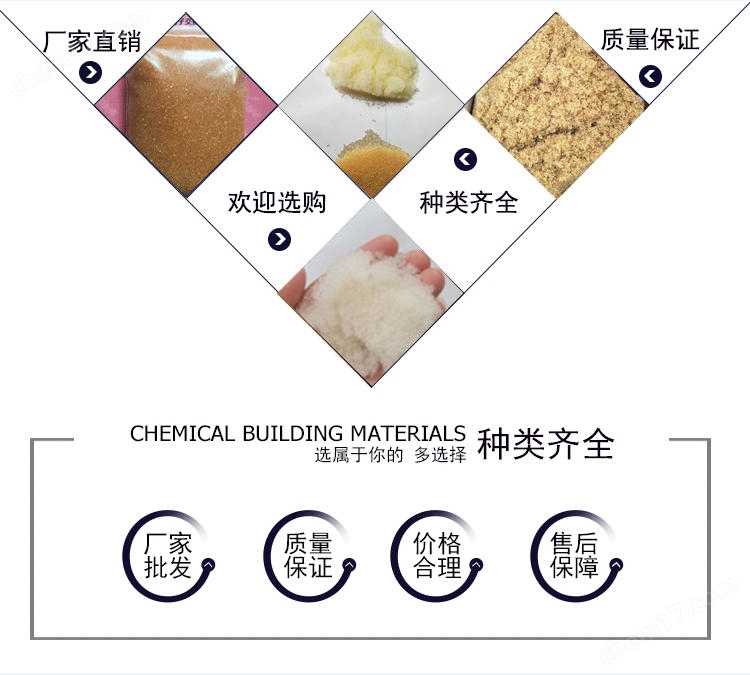
Professional production: anion and cation exchange resin, macroporous adsorption resin, softened water resin, mixed bed MB resin, 18 megaohm ultra pure water polishing resin, wire cutting slow wire resin, sewage decolorization resin, electroplating wastewater nickel and chromium removal resin, iron, copper, phosphorus, boron, and heavy metal removal resin, acid recovery resin, chelating resin, food grade resin, alum extraction resin, gold absorption resin, silver extraction resin, strong acid, strong alkali, weak acid, weak alkali, with dozens of models including 001 × 7, 001 × 8, 732, 717, 201 × 7, 201 × 4, D001, D201, D301, D113, D101, H103, D403, D408, etc
At present, domestic high and ultra pure water users are not very familiar with the application of this product, so there is a widespread blind pursuit of expensive imported polishing mixed bed resins. Some small resin production enterprises in China, in order to obtain *, participate in vicious low price competition in the market with unqualified and low-priced products, which has also led to some users not recognizing domestic polishing resins. It is hoped that through communication, end users can understand the physical and chemical properties and application methods of the products.
What is polishing resin?
The polishing resin commonly used by people is generally used at the end of ultra pure water treatment systems to ensure that the effluent quality of the system can maintain water standards. Generally, the effluent quality can reach over 18 megaohms and has a certain control ability over TOC and SIO2. The ion forms of polishing resin that leave the factory are H and OH types, which can be used immediately after loading without the need for regeneration.
Polishing resin application: Suitable for use as a terminal refined mixed bed in ultra pure water systems with RO and EDI as pre-processing equipment to produce ultra pure water. Widely used in semiconductor production in the electronics industry, laboratory production of ultrapure water, laser cutting, medical systems, slow wire cutting, mechanical equipment circulating internal cooling water, some optical materials and electronic product production water, solar production line water (excluding polycrystalline silicon production) and other industry applications!
Precautions for Polishing Resin
1. Polishing resin (pre mixed from highly purified and transformed H-type cation resin and OH type anion resin, if loaded and operated properly, ultrapure water with a resistivity greater than 18.0 M Ω. cm and TOC less than 10 ppb can be prepared in the initial cycle.
2. After opening, resin exposed to air for a long time will absorb carbon dioxide, so it should be used as soon as possible when unpacking. The unused parts must be carefully sealed and stored in a dark and cool place, with an appropriate ambient temperature of 5-40 ℃.
During transportation, storage, and loading, any contact with inorganic or organic substances can contaminate the resin, thereby reducing the quality of the effluent; Affects operating conditions. Therefore, it is necessary to ensure that all equipment and water used for loading and operation do not contaminate the resin. All water in contact with the resin must use high-purity water (referred to in this article as' high-purity water ', meaning water with a resistivity greater than or equal to 10M Ω· cm and a TOC as low as 30ppb), and all equipment or appliances in contact with the resin must be cleaned with high-purity water before use.
If replacing resin, the old resin in the equipment must be removed from the resin container, and the interior of the resin container must be clean and free of impurities.
Storage and usage instructions for mixed bed polishing resin
1. Precautions before use: 1.1 After opening, resin exposed to air for a long time will absorb carbon dioxide, which will affect the performance and use of the product. Therefore, once unpacked, it should be used as soon as possible. The unused parts must be carefully sealed and stored in a dark and cool place, with an appropriate ambient temperature of 5-30 ℃.
During transportation, storage, and loading, any contact with inorganic or organic substances can contaminate the resin, thereby reducing the quality of the effluent; Affects operating conditions. Therefore, it is necessary to ensure that all equipment and water used for loading and operation do not contaminate the resin. All water in contact with resin must be pure water, and all equipment or appliances in contact with resin must be cleaned with pure water before use. The pure water standard is equivalent to or lower than the RO membrane effluent )
1.3 If replacing resin, the old resin in the equipment must be removed from the resin container, and the interior of the resin container must be clean and free of impurities.
2. Loading program:
2.1 Resin filling amount: About 70% of the effective volume of the resin tank, and the height of the resin layer should be greater than or equal to 700mm.
2.2 After filling the resin tank with resin, slowly add water until the water level is at least 300mm higher than the resin high-speed, and let it soak for more than 10 hours to facilitate the release of air from the resin layer. However, if the equipment size is small and resin is intended to be filled by mixing it with slurry and water, it is also acceptable.
2.3 Load the resin into the resin tank. The resin can be directly added from the original packaging bag or some water can be added to the original packaging container to form a slurry and loaded into the resin container.
Pay attention to the following during the loading process:
2.3.1 It is prohibited to use any mechanical pump to transfer resin, as many types of pumps can cause damage or pollution to the resin.
During the resin filling process, do not open more than two bags of resin at the same time. To reduce the time the resin comes into contact with air and also decrease the possibility of foreign impurities contaminating the resin.
During the filling process, as the filling position increases, the water above the resin layer will gradually increase. If the water level is higher than the resin layer by more than 50mm, the excess water must be extracted or drained to avoid slow settling of the resin in the water and delamination. But at the same time, it is also necessary to avoid the situation of liquid level draining, which can cause air to form air plugs in the resin layer and affect the outflow of water.
After the resin is filled in place, inject pure water to fill the tank. Cover the package and connect the pipeline in place.
After the resin filling is completed, it should be soaked in water for less than 4 hours. If possible, soak overnight.
2.5. After checking that all components and pipeline connections are correct, the valve can be opened to collect water. The newly filled resin undergoes a flushing process during its initial operation, during which the electrical resistivity of the effluent gradually increases. Depending on the on-site situation, the flushing time may last from tens of minutes to several hours.
3. Operating parameters for water production:
3.1 Inlet water quality requirements: The conductivity of the RO membrane effluent should be less than 10US/cm and should not exceed 20 US/cm.
3.2 Water production flow rate: 10BV-20BV (10 to 20 times the resin volume per hour).
After starting up and running, the flushing time is about several tens of minutes to several hours, and the resistivity gradually increases.
After 2-3 shutdowns and startups, the resin achieves optimal water output.
4. Shutdown and startup steps:
4.1 Close the inlet valve
4.2 Close the water outlet valve to prevent water loss in the resin tank, ensuring that the resin does not lose water inside.
4.3 When reusing, slowly open the water outlet valve first.
4.4 Open the inlet valve, with the valve opening roughly the same as the outlet valve,
After normal outflow operation, gradually open the outflow valve and inlet valve to achieve normal outflow flow rate.
5 Precautions:
5.1 From cleaning the resin tank to filling the resin and using water for operation, this system should use RO membrane effluent with a conductivity of less than 10us/cm. The lower the better, which can improve the effluent quality and increase the water production capacity Do not use water with poor water quality, otherwise it may result in substandard effluent quality, reduced water production capacity, or even ineffective resin transmission Losing the ability to produce water.
5.2 The upper layer of resin should maintain a certain water level, with the principle of not causing resin surging when water enters Maintain the static state of the resin layer.
5.3 During use, it is important to avoid water shortage in the resin layer, which may cause the resin layer to enter the air.
During use, it is prohibited to introduce air or water from the bottom of the resin layer, which may cause resin delamination and affect the water production efficiency and cycle. In severe cases, it loses its ability to produce water.


Yin Yang mixed resin electronic grade polishing resin
High quality product quality, satisfactory service requirements, sincere cooperation consciousness, and low sales prices are the principles that our company flatters. We welcome cooperation from all walks of life and are willing to create a better tomorrow with you.
Since its inception, the company has adhered to the corporate philosophy of honesty and trustworthiness, putting people first, promoting technology, and exploring innovation. We sincerely work with new and old friends from all walks of life to keep up with the times! Collaborative development!
Ion exchange resin is also such a substance, which is usually reflected in some equipment used in factories. Basic content and technology of resin/
According to research analysis, the ability of water softening resin is related to the chemical composition of the resin. If you want to purify water, you should choose strong acid resin, which can remove calcium and magnesium ions from water. In other words, the acidity will also decrease to PH3.
In terms of implementation, DOWEX resin cation exchange resin from the United States has a soft water function after regeneration treatment with 3L of water and 300G of salt; Adding 0.5L hydrochloric acid to 3L of water has the function of reducing acidity. Anion exchange resin can be regenerated with 50G caustic soda and 150G sodium carbonate (Na2CO3) to remove nitrate and maintain a pH value between 8.2-8.4. Generally, anion exchange resins are commonly used in seawater tanks. When used together with anion and cation exchange resins, anions and cations in water can be removed to produce salt free pure water. The cation exchange resin commonly available on the market (RO exclusive) is sodium type cation exchange resin, which theoretically has the function of reducing acidity in addition to softening water, but it is not obvious.
Softened water resin
However, the softening of water quality is mainly due to the displacement of calcium and magnesium ions in the water, which is the function of cation exchange resin. Anion exchange resin should not have this function. In theory, 1L of sodium type cation exchange resin can treat 6000L of soft water. Based on a 3-foot cylinder with a water volume of 150L, using RO filtration to change 1/3=50L of water per week, about 120 weeks=two years. But if the resin is soaked in water and used normally, it depends on the water quality of the fish tank, after all, the environment in each tank is different, so it should be regenerated every 3-6 months. The regeneration method is to soak 10L of pure water (or reverse osmosis water) and 300G of salt per liter of resin. The soaking process takes about 15 minutes for each unit of salt water to flow slowly through the resin, and the entire process takes about 45 minutes.
Softened water resin
For example, 10L is divided into three parts, each time soaking 1L of resin in 3.3L saline solution, with a flow rate of 15MIN * passing through the resin, and then performing the second and third soaking procedures in 3.3L saline solution. After processing, the resin needs to be rinsed with clean water to remove the saline solution. Using sodium type cationic resin will increase the pH from 7.4 to 8.4 (replacing ppm of magnesium and calcium ions). Using hydrogen type cationic resin will decrease the pH from 7.4 to 5.5 (replacing 100ppm of magnesium and calcium ions). Therefore, using sodium type cations will increase the pH value. Even if CO2 is added to the water tank, it can only decrease to pH 7.3. However, using hydrogen type cations will lower the pH value. Even without CO2 injection, the pH value can be maintained at pH 6.6 in the water tank.
Softened water resin
It should be emphasized that if it is used in a grass tank, it is not recommended to directly place it in the filter, because the elements in the tank, such as iron and other water plants, must be exchanged by the resin before exchanging elements that cause hard water, such as calcium and magnesium. Therefore, tap water should be first made into soft water with a pH value of about 4.5 using hydrogen type DOWEX resin in the water tank before adding black water.
Similar Product Recommend


