- Phone
-
Address
Dafengdui Village, Dafeng Town, Jinghai County, Tianjin City
Product Categories
Tianjin Jinda Zhengtong Environmental Protection Technology Co., Ltd


Macroporous imine diacetate chelating resin for heavy metal adsorption
NegotiableUpdate on 05/06
- Model
- Nature of the Manufacturer
- Producers
- Product Category
- Place of Origin
Overview
The resin $r $nD401 for heavy metal adsorption using macroporous imine diacetate based chelating resin is a chelating resin with weakly acidic thiourea groups (- CH2-S-C-NHNH2) on a special macroporous styrene divinylbenzene copolymer. This product can fix or chelate one or several specific cations over a wide range, even from high concentration solutions. Mainly used for the separation and purification of free mercury and precious metals, it has the characteristics of uniform particle size and good mechanical strength.
Product Details
Macroporous imine diacetate chelating resin for heavy metal adsorption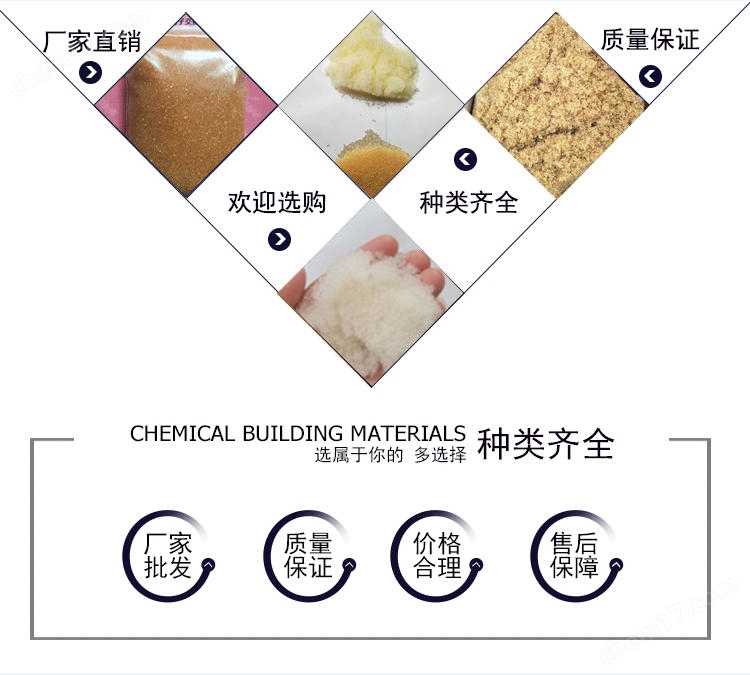
Professional production: anion and cation exchange resin, macroporous adsorption resin, softened water resin, mixed bed MB resin, 18 megaohm ultra pure water polishing resin, wire cutting slow wire resin, sewage decolorization resin, electroplating wastewater nickel and chromium removal resin, iron, copper, phosphorus, boron, and heavy metal removal resin, acid recovery resin, chelating resin, food grade resin, alum extraction resin, gold absorption resin, silver extraction resin, strong acid, strong alkali, weak acid, weak alkali, with dozens of models including 001 × 7, 001 × 8, 732, 717, 201 × 7, 201 × 4, D001, D201, D301, D113, D101, H103, D403, D408, etc
1、 Product Introduction:
D401 is a styrene divinylbenzene copolymer with a weakly acidic thiourea group (- CH) on a special macroporous structure2S-C-NHNH2)Chelating resin. This product can fix or chelate one or several specific cations over a wide range, even from high concentration solutions. Mainly used for the separation and purification of free mercury and precious metals, it has the characteristics of uniform particle size and good mechanical strength.
2、 Physical and chemical performance indicators:
indicator name |
indicator |
skeleton |
Macroporous styrene divinylbenzene copolymer |
functional group |
Thiourea group |
Factory form |
Na type |
Penetrating and grinding ball rate% |
≥90.0 |
Volume full exchange capacity mmol/mL |
≥1.20 |
Moisture content% |
48.00-58.00 |
Wet visual density g/mL |
0.70-0.74 |
Wet true density g/mL |
1.10-1.16 |
Range granularity% |
(0.450mm-1.250mm)≥95.0 |
Operating temperature ℃ |
90.0 |
solubility |
Insoluble in water, acid, alkali, and organic solvents |


Macroporous imine diacetate chelating resin for heavy metal adsorption
Tianjin Jinda Chemical Co., Ltd. specializes in the production of cation and anion exchange resins, macroporous adsorption resins, industrial boiler softened water resins, mixed bed MB resins, polishing resins, special resins, sewage treatment resins, strong acids, strong bases, weak acids, and weak bases. The models include 001 × 7 (732) 201 × 7 (717) D001, D003, D201, D202, D301, D113, D354, D296.JK008, as well as boiler descaling agents, boiler antiscalants, algaecides, adhesive stripping agents, slow-release antiscalants, sewage decolorizers, anti water odor agents, reverse osmosis agents, and other water treatment agents
Of course, there are many types of ion exchange resins that we often use, which can exhibit different values in different situations. Process and hardening regulations for resin/
1、 Hardening process
Hardening method: There are two hardening methods for ion exchange resin bonded grinding tools: primary hardening method and secondary hardening method. The grinding tool is heated and hardened on a hot press for 30-40 minutes to become a finished product, which is called one-time hardening method. It is suitable for small, thin, and irregular grinding wheels. In order to obtain hardened products, some large-scale and thick grinding wheels undergo initial hardening on a hot press, but still need to undergo secondary supplementary hardening in an electric oven. This method is called secondary hardening.
resin
2、 Hardening regulations
1. Hardening temperature:
The optimal curing temperature for phenolic resin bonded grinding tools is between 180-190 ℃. Below 170 ℃, it does not harden properly and has poor chemical stability. Above 200 ℃, it will damage the mechanical properties of the grinding tool, resulting in a decrease in its strength, hardness, and water resistance. The hardening of polyimide resin bonded diamond grinding tools requires the formation of cyclic polyimide chains at high temperatures to increase molecular stiffness and transform them into non melting plastics. Therefore, its hardening temperature is relatively high, up to 230 ℃. If the temperature is too low, the cyclization reaction is not easy to proceed, and the strength of the product is low.
resin
2. Heating rate:
The heating rate is related to various factors such as the type of binder, the hardening time on the hot press, the shape of the grinding tool, and the particle size.
① The polymerization temperature of thermoplastic phenolic resin is 100 ℃, while the pre polymerization temperature of polyimide is higher. The former can be freely heated before 100 ℃, while the latter can be freely heated before 180 ℃. The former undergoes a curing reaction with the hardener after 140 ℃, while the latter undergoes pre polymerization after 180 ℃, so both should be heated slowly.
② The grinding tools that have been hardened for a long time on the hot press have basically discharged the volatiles and can be quickly heated up; On the contrary, secondary hardening should be slowly heated up.
③ Grinding tools with complex beginning and fine particle size should be heated slowly; On the contrary, it can quickly heat up.
resin
3. Insulation time
The insulation time is related to the hardening temperature. High hardening temperature and short hardening time; On the contrary, it is longer. Phenolic resin grinding tools can be insulated at 180 ℃ for 2-3 hours, while polyimide resin grinding tools generally need to be insulated at 230 ℃ for 4-5 hours. The softened water device saves salt, has high efficiency, low cost for air conditioning softened water device, and good effect for heat exchange station softened water device. As the name suggests, a water softening device is a device that reduces the hardness of water, mainly removing calcium and magnesium ions from the water. During the process of softening water, the water softening device cannot reduce the total salt content in the water.
Similar Product Recommend


