- Phone
-
Address
Dafengdui Village, Dafeng Town, Jinghai County, Tianjin City
Product Categories
Tianjin Jinda Zhengtong Environmental Protection Technology Co., Ltd


Mixed bed anion cation resin ultra pure water equipment polishing resin
NegotiableUpdate on 05/06
- Model
- Nature of the Manufacturer
- Producers
- Product Category
- Place of Origin
Overview
Polishing resin $r $n1.2 for mixed bed anion cation resin ultrapure water equipment. During transportation, storage, and loading, any contact with inorganic or organic substances can contaminate the resin, thereby reducing the quality of the effluent water; Affects operating conditions. Therefore, it is necessary to ensure that all equipment and water used for loading and operation do not contaminate the resin. All water in contact with resin must be pure water, and all equipment or appliances in contact with resin must be cleaned with pure water before use. (The pure water standard is equivalent to or lower than the RO membrane effluent.)
Product Details
Mixed bed anion cation resin ultra pure water equipment polishing resin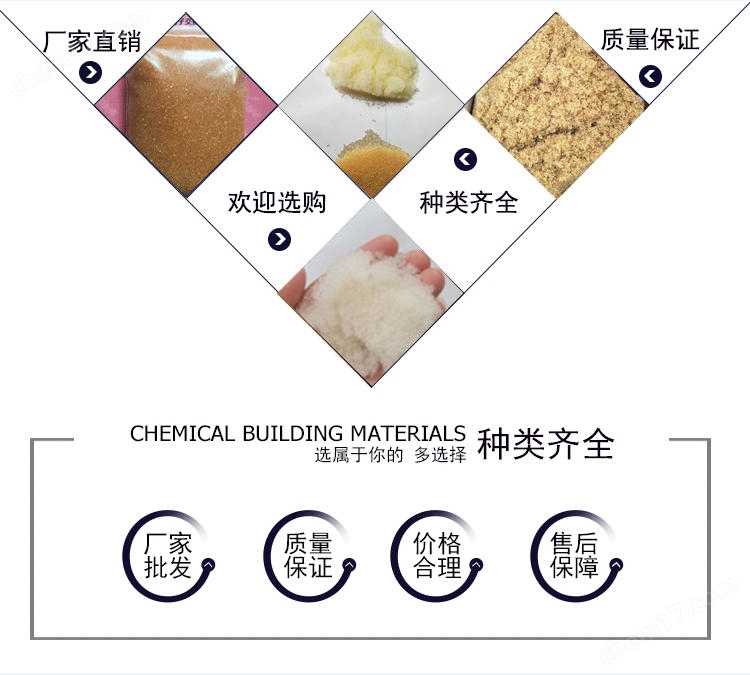

Professional production: anion and cation exchange resin, macroporous adsorption resin, softened water resin, mixed bed MB resin, 18 megaohm ultra pure water polishing resin, wire cutting slow wire resin, sewage decolorization resin, electroplating wastewater nickel and chromium removal resin, iron, copper, phosphorus, boron, and heavy metal removal resin, acid recovery resin, chelating resin, food grade resin, alum extraction resin, gold absorption resin, silver extraction resin, strong acid, strong alkali, weak acid, weak alkali, with dozens of models including 001 × 7, 001 × 8, 732, 717, 201 × 7, 201 × 4, D001, D201, D301, D113, D101, H103, D403, D408, etc
Precautions for Polishing Resin
1. Polishing resin (pre mixed from highly purified and transformed H-type cation resin and OH type anion resin, if loaded and operated properly, ultrapure water with a resistivity greater than 18.0 M Ω. cm and TOC less than 10 ppb can be prepared in the initial cycle.
2. After opening, resin exposed to air for a long time will absorb carbon dioxide, so it should be used as soon as possible when unpacking. The unused parts must be carefully sealed and stored in a dark and cool place, with an appropriate ambient temperature of 5-40 ℃.
During transportation, storage, and loading, any contact with inorganic or organic substances can contaminate the resin, thereby reducing the quality of the effluent; Affects operating conditions. Therefore, it is necessary to ensure that all equipment and water used for loading and operation do not contaminate the resin. All water in contact with the resin must use high-purity water (referred to in this article as' high-purity water ', meaning water with a resistivity greater than or equal to 10M Ω· cm and a TOC as low as 30ppb), and all equipment or appliances in contact with the resin must be cleaned with high-purity water before use.
If replacing resin, the old resin in the equipment must be removed from the resin container, and the interior of the resin container must be clean and free of impurities.


Mixed bed anion cation resin ultra pure water equipment polishing resin
The company is a group backbone enterprise involved in chemical, petroleum, power, metallurgy, steel, construction materials and other fields. Our company has accumulated rich experience in the development, research, application, and practice of water treatment technology for many years. Our company is a group unit of the Industrial Water Treatment Professional Committee of the Chinese Chemical Society, a network unit of the Ministry of Electric Power and the China Petrochemical Industrial Water Treatment Evaluation Center, and has now formed a specialized enterprise unit integrating production, sales, and supporting services!
Perhaps you are not familiar with ion exchange resin factories, but whenever you ask some companies, they will say that they have a good relationship with resin factories because these companies need to solve some pollution problems, so ion exchange resins are needed to deal with these manufacturers and handle their own pollution problems. Key points to note in resin backwashing program/
1. The recommended backwash speed and time in the product data are only reference standard values. At runtime, parameters need to be adjusted according to the specific situation of the user.
2. The backwash water needs to be discharged through the pipe at the upper end of the resin column. To remove broken resin particles and dirt, do not cover the pipe opening with a sieve. To prevent resin loss, a cutoff bend (curved neck pipe) can be installed on the outside of the pipe.
3. During the backwashing process, the volume of the resin bed expands by approximately>^ fen ^ 45% compared to the original volume.
4. During the backwashing process, the resin bed must be in a fluid state. This can be confirmed through observation through a window. In a fluidized resin bed, resin particles move around. But the surface of the resin bed should be calm or lightly microwaved. It cannot be due to severe local resin agitation in the resin bed.
5. When the resin bed expands to a large state, its surface should be>^ fen ^ 400mm away from the outlet. The window should be located between the expanded resin bed surface and the outlet, so that the state of the resin bed surface can be well observed.
ion exchange resin
6. The fluidization of the resin bed starts from the upper layer of resin and then flows downwards at a uniform velocity.
7. A highly compacted resin bed may take several hours to achieve fluidization, while a loose resin bed may only take a few minutes.
8. At the beginning of backwashing, there may be local resin eruption on the surface of the resin bed, resulting in a large number of resin particles suspended in the empty bed volume area, and even being flushed out of the outlet. This phenomenon will disappear with further backwashing and resin loosening.
9. Sometimes the resin bed is lifted as a compacted whole and then squeezed to the top of the water separator, resulting in damage to the water separator and/or loss of resin. To avoid this phenomenon, we recommend using a low flow rate at the beginning of the backwashing process, and gradually increasing the flow rate until the resin bed * expands.
10. The backwashing process requires the operator or process engineer to observe from time to time to adjust the operating parameters appropriately.
ion exchange resin
11. At the beginning of the backwash process, suspended fine particles are first washed out of the resin tank. Suggest regular observation of fine particulate matter appearing on the resin bed. This helps to determine whether the pre-treatment of incoming water (such as filtration) is functioning properly.
12. It is easier to observe the situation inside the resin tank through the window at night than during the day. The reflected light on the daytime window makes observation difficult. Black baffles can be used to block the light source to prevent the influence of reflected light. If a glass window is installed next to or opposite the window, it can allow light to enter the interior of the resin tank, which can better observe the situation inside the resin column.
13. During the backwashing process, it is necessary to take samples of the backwashed water from time to time. Perform chemical analysis on the fine particles washed out by backwashing. At the same time, it is also necessary to analyze the appearance of other impurities and broken resin particles.
14. The temperature of the backwash water has a significant impact on the expansion of the resin bed. This is because the viscosity of water varies with temperature. When the water temperature changes from 15 ℃ to 40 ℃, the expansion of the resin bed needs to be reduced by half.
15. In areas with large temperature differences (such as temperatures<^ fen ^ 10 ℃ in winter and>^ fen ^ 30 ℃ in summer), the water temperature can affect the expansion of the resin bed, so the backwash water flow rate must be adjusted according to seasonal conditions.
ion exchange resin
16. After backwashing, the resin bed should be left to settle and then compacted by its own gravity (settling time of about 5 minutes) to form a uniform resin bed structure.
17. During the regular backwashing process, do not use the auxiliary method of inflating. Blowing is only used when the bottom distributor (filter plate or filter) is severely clogged. The intensity of the aeration should be adjusted appropriately, without damaging any sensitive components inside the distributor. High intensity airflow may cause significant pressure on the internal components of the distributor, leading to damage.
18. When an accident occurs where a large amount of impurities are carried into the resin bed abnormally, the backwash procedure should be extended accordingly.
Similar Product Recommend


