- Phone
-
Address
Dafengdui Village, Dafeng Town, Jinghai County, Tianjin City
Product Categories
Tianjin Jinda Zhengtong Environmental Protection Technology Co., Ltd


Wholesale sales of cobalt ion chelating resin for wastewater treatment adsorption resin
NegotiableUpdate on 05/06
- Model
- Nature of the Manufacturer
- Producers
- Product Category
- Place of Origin
Overview
Wholesale sales of cobalt ion chelating resin for wastewater treatment adsorption resin $r $nD401 is a chelating resin with weakly acidic thiourea groups (- CH2-S-C-NHNH2) on a special macroporous styrene divinylbenzene copolymer. This product can fix or chelate one or several specific cations over a wide range, even from high concentration solutions. Mainly used for the separation and purification of free mercury and precious metals, it has the characteristics of uniform particle size and good mechanical strength.
Product Details
Wholesale sales of cobalt ion chelating resin for wastewater treatment adsorption resin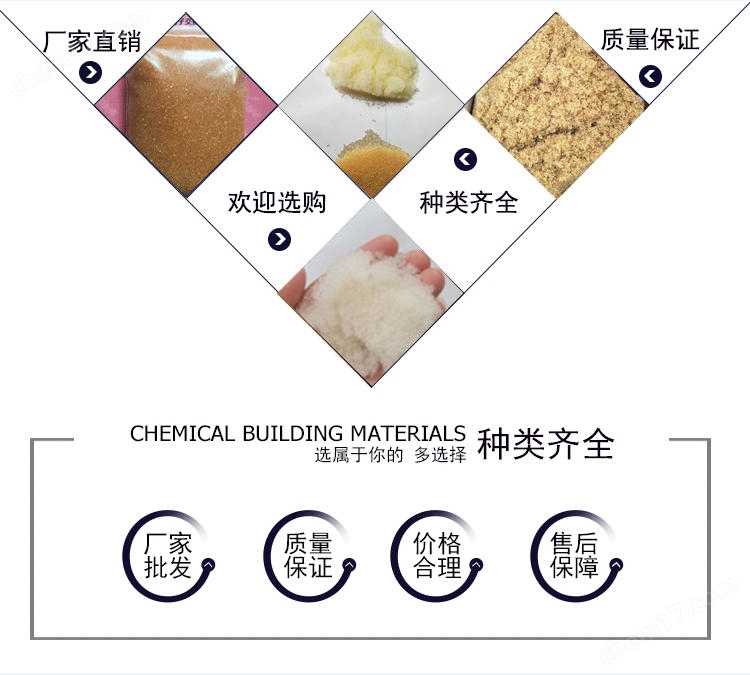
Professional production: anion and cation exchange resin, macroporous adsorption resin, softened water resin, mixed bed MB resin, 18 megaohm ultra pure water polishing resin, wire cutting slow wire resin, sewage decolorization resin, electroplating wastewater nickel and chromium removal resin, iron, copper, phosphorus, boron, and heavy metal removal resin, acid recovery resin, chelating resin, food grade resin, alum extraction resin, gold absorption resin, silver extraction resin, strong acid, strong alkali, weak acid, weak alkali, with dozens of models including 001 × 7, 001 × 8, 732, 717, 201 × 7, 201 × 4, D001, D201, D301, D113, D101, H103, D403, D408, etc
1、 Product Introduction:
D401 is a styrene divinylbenzene copolymer with a weakly acidic thiourea group (- CH) on a special macroporous structure2S-C-NHNH2)Chelating resin. This product can fix or chelate one or several specific cations over a wide range, even from high concentration solutions. Mainly used for the separation and purification of free mercury and precious metals, it has the characteristics of uniform particle size and good mechanical strength.
2、 Physical and chemical performance indicators:
indicator name |
indicator |
skeleton |
Macroporous styrene divinylbenzene copolymer |
functional group |
Thiourea group |
Factory form |
Na type |
Penetrating and grinding ball rate% |
≥90.0 |
Volume full exchange capacity mmol/mL |
≥1.20 |
Moisture content% |
48.00-58.00 |
Wet visual density g/mL |
0.70-0.74 |
Wet true density g/mL |
1.10-1.16 |
Range granularity% |
(0.450mm-1.250mm)≥95.0 |
Operating temperature ℃ |
90.0 |
solubility |
Insoluble in water, acid, alkali, and organic solvents |


Wholesale sales of cobalt ion chelating resin for wastewater treatment adsorption resin
Our company's equipment, excellent production technology, high-quality connotation with a high starting point, scientific management mode, and good after-sales service have created a corporate image and brand culture. The company adheres to the corporate philosophy of "survival through quality and development through reputation", constantly exploring and advancing, and providing high-quality and affordable water treatment products for friends from all walks of life.
Ultimately, it is the process of ion capacity exchange, which helps the equipment achieve the transfer of ion dynamics. Technical description and storage of resin/
Ion exchange resin is a polymer with corresponding functional groups. In general, conventional sodium ion exchange resins carry a large amount of sodium ions. When the content of calcium and magnesium ions in water is high, ion exchange resin can release sodium ions, and functional groups can bind with calcium and magnesium ions, resulting in a decrease in the content of calcium and magnesium ions in water and a decrease in water hardness. Hard water becomes soft water, which is the working process of water softening equipment.
ion exchange resin
When a large number of functional groups on the resin combine with calcium and magnesium ions, the softening ability of the resin decreases. A sodium chloride solution can be used to flow through the resin. At this time, the sodium ion content in the solution is high, and the functional groups will release calcium and magnesium ions to combine with the sodium ions, thus restoring the exchange ability of the resin. This process is called "regeneration".
Due to practical work requirements, the standard workflow of softened water equipment mainly includes five processes: working (sometimes called water production, the same below), backwashing, salt absorption (regeneration), slow flushing (replacement), and fast flushing. All processes of different softening water equipment are very similar, but there may be some additional processes due to differences in actual processes or control needs. Any softening water equipment based on sodium ion exchange is developed on the basis of these five processes (among which, the fully automatic softening water equipment will increase the saltwater re injection process).
ion exchange resin
Storage of ion exchange resin
Ion exchange resin contains a certain amount of moisture, which should be kept as much as possible during transportation and storage. If the resin is dehydrated during storage, it should be soaked in 10% concentrated saline water first, and then gradually diluted. It should not be directly placed in water to avoid rapid expansion and breakage of the resin. In long-term storage, strong type resins should be transformed into salt type, weak type resins can be transformed into corresponding hydrogen type or free amine type, or salt type, and then soaked in clean water. During storage or transportation, the resin should be kept in a temperature environment of 5-40 ℃ to avoid being too cold or too hot and affecting its quality. If there is no insulation facility in winter, the resin can be stored in saline solution, and the concentration of saline solution can be determined according to the temperature.
ion exchange resin
Pollution, poisoning, and activation of ion exchange resins
Ion exchange resins are susceptible to pollution from suspended substances, colloidal substances, organic matter, algae, iron, manganese, and other pollutants during long-term use, which can reduce or even lose their ion exchange capacity. Therefore, the resin needs to be activated irregularly according to the situation. The activation method can be determined according to the pollution situation and conditions. Generally, cation resins are susceptible to Fe3+pollution in softened water, and can be soaked in hydrochloric acid and gradually diluted. Yin resin is easily contaminated by organic matter and can be soaked or rinsed with a mixture of 10% NaCl and 2-5% NaOH solution. If necessary, soak in a 1% hydrogen peroxide solution for a few minutes. Alternatively, acid alkali alternating treatment, bleaching treatment, alcohol treatment, and various other methods can be used for treatment.
Similar Product Recommend


