- Phone
-
Address
Room 3002, 3003, 3011, Dongshan Square, No. 69 Xianlie Middle Road, Yuexiu District, Guangzhou City
Product Categories
Fujifilm and Light (Guangzhou) Trading Co., Ltd

RiboNAT™ Rapid Aseptic Testing Kit
NegotiableUpdate on 05/06
- Model
- Nature of the Manufacturer
- Producers
- Product Category
- Place of Origin
Overview
RiboNAT Rapid aseptic testing kit. In the safety testing of injectable drugs, the sterile testing method specified in multiple pharmacopoeias requires at least 14 days of cultivation. However, certain cell therapies must be administered to patients within a few days after production, making it difficult to complete sterile testing before administration. This has also led to an increasing demand for sterile testing methods that can provide faster results to improve patient safety.
Product Details
RiboNAT ™ Rapid Aseptic Testing Kit
In the safety testing of injectable drugs, the sterile testing method specified in multiple pharmacopoeias requires at least 14 days of cultivation. However, certain cell therapies must be administered to patients within a few days after production, making it difficult to complete sterile testing before administration. This has also led to an increasing demand for sterile testing methods that can provide faster results to improve patient safety.
RiboNAT ™ It is a rapid and sterile testing kit using nucleic acid amplification testing (NAT) technology, which can complete the test in just 7 hours, significantly reducing the testing time compared to traditional methods. Unlike traditional NAT detection that only targets microbial genomic DNA, RiboNAT ™ The detection is ribosomal RNA (rRNA). Due to the high content of rRNA in microorganisms, this makes the detection more sensitive. Meanwhile, traditional methods are prone to false positives due to residual DNA from dead bacteria or contaminated DNA in the environment and materials, while RiboNAT ™ Effectively reducing this issue and improving the accuracy of detection.
◆ Characteristics
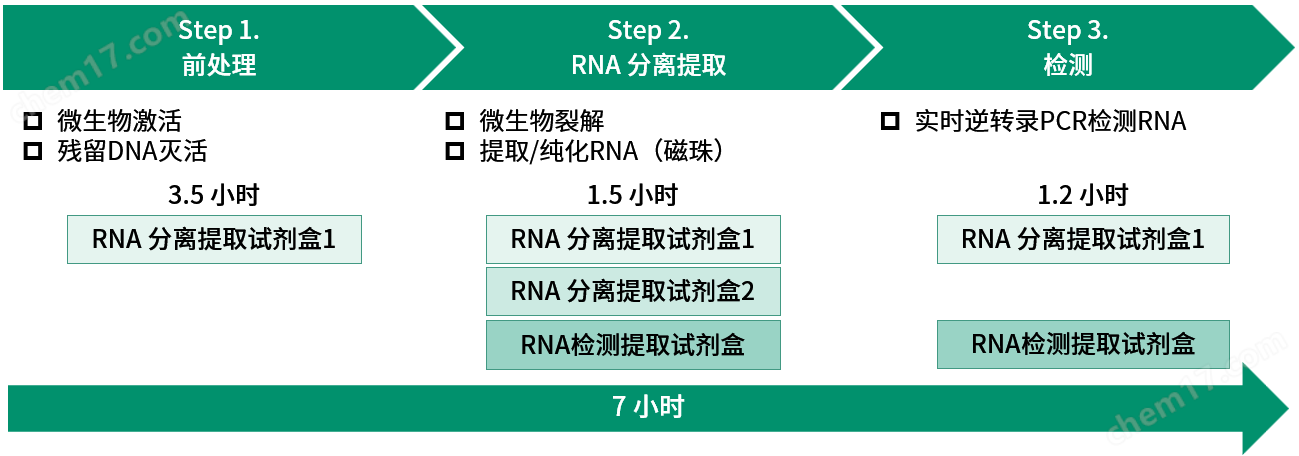
Results can be obtained on the same day of testing (approximately 7 hours)
Using rRNA real-time reverse transcription PCR (RT rt PCR) for detection, the sensitivity (9 CFU/mL) is higher than that of gDNA detection
Reduce false positives caused by dead bacteria and residual DNA
● Multiple bacteria (aerobic and anaerobic) and fungi can be detected simultaneously in a single test
◆ Experimental process
◆ Test kit specifications

◆ Composition of reagent kit

◆ Sensitivity testing
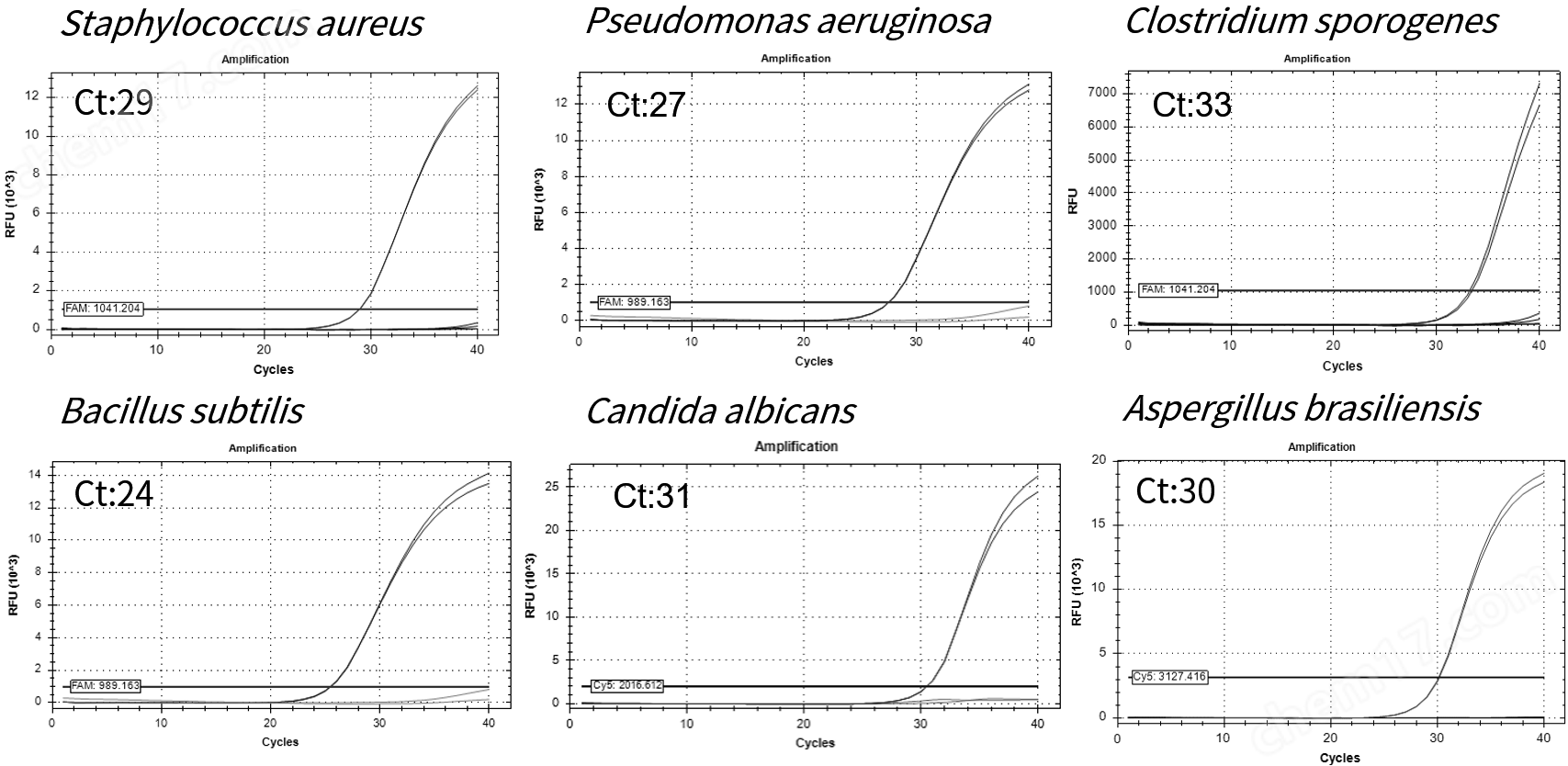
Figure 1. Detection sensitivity
A microbial suspension with a concentration of 9 CFU/mL was prepared for the six microorganisms specified in the pharmacopoeia. Utilizing RiboNAT ™ Extract RNA from these suspensions and detect ribosomal RNA (rRNA). All rRNA of microorganisms were successfully detected, with Ct values below 35.


Figure 2. Detection sensitivity in cell suspension samples
A microbial suspension with a concentration of 9 CFU/mL was prepared for the six microorganisms specified in the pharmacopoeia, and was mixed with 0.25 × 10⁶ HEK293 cells mixed in cells/mL. Utilizing RiboNAT ™ Extract RNA from the mixed suspension and detect rRNA. All rRNA of microorganisms were successfully detected, with Ct values below 35.
In addition, all six strains were detected under the following conditions (data not shown):
·Mesenchymal stem cells (MSCs): 0.5 × 10⁶cells/mL
· T-cell:1.0×10⁶cells/mL

◆ Higher sensitivity detection method
■ Bacterial concentration: 2 CFU/mL
Incubation time: 3-15 hours


Figure 3. Detection methods with higher sensitivity
A concentration of was prepared for Aspergillus brasiliensis, Clostridium sporogenes, and Cutibacterium acnes2 CFUMicrobial suspension. Although RiboNAT ™ The conventional operating procedure stipulates an incubation time of 3 hours, but this experiment delays the incubation time to 3-15 hours. After incubation, use RiboNAT ™ Extract RNA and detect rRNA. The results showed that three strains, including strict anaerobic bacteria (Clostridium sporogenes) and slow growing bacteria (Propionibacterium acnes), were successfully detected after 14 hours or longer incubation, with Ct values below 35.

◆ Reduce false positives
RiboNAT ™ Containing dead DNA inactivation reagents and DNase treatment steps, it can effectively reduce the risk of false positives caused by residual DNA in the sample.
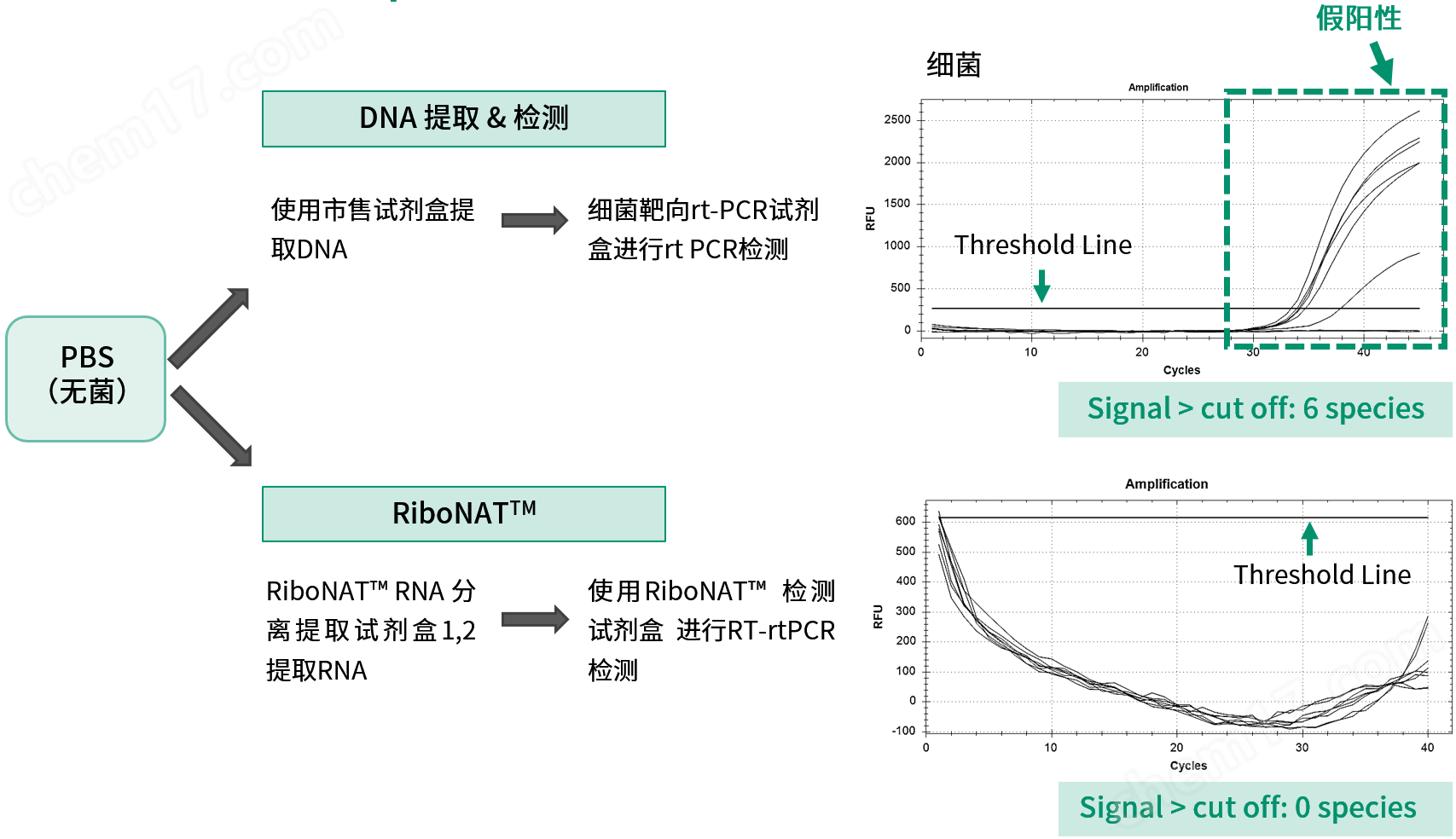
Figure 4. Reducing false positives
Use commercially available sterile PBS as the test sample for bacterial nucleic acid testing (NAT). One of the experiments (as shown in the figure above) used commercially available reagent kits to extract DNA, followed by bacterial targeted real-time fluorescence quantitative PCR detection. Another experiment (as shown in the figure below) was conducted using RiboNAT ™ Extract RNA and then perform real-time reverse transcription fluorescence quantitative PCR detection. Six amplification curves were observed in the DNA based method, while RiboNAT was used ™ No amplification signal was detected.

◆ Product List

Similar Product Recommend