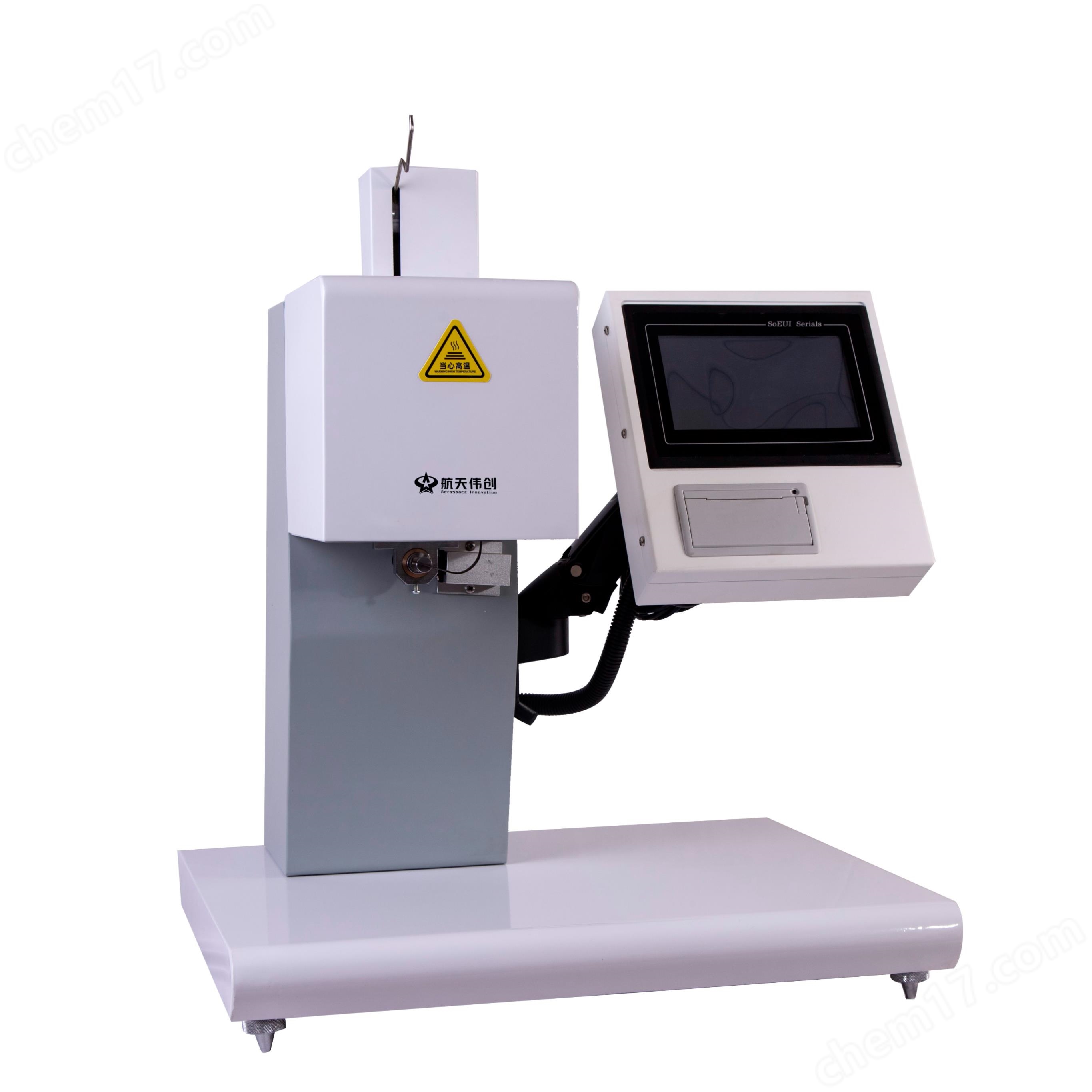
The XNR-400H Melt Flow Rate Tester MFI is a professional equipment used to evaluate the flowability of thermoplastic materials at high temperatures. Its core function is to calculate the melt index (MFR/MVR) by measuring the mass or volume of the melt passing through a capillary under standard conditions.
XNR-400HMelt Flow Rate Tester Melt Index MFIIt is a professional equipment used to evaluate the flowability of thermoplastic materials at high temperatures. Its core function is to calculate the melt index (MFR/MVR) by measuring the mass or volume of the melt passing through a capillary under standard conditions.
Measurement range and accuracy
Quality Law (MFR):0.1~3000.00g/10min, Suitable for full range testing of low viscosity (such as melt blown materials) to high viscosity (such as engineering plastics).
Volume Method (MVR):0.1~3000.00cm³/10min, It can directly reflect the volume flow characteristics of the melt, especially suitable for materials containing fillers.
temperature control accuracy± 0.2 ℃ (PID closed-loop control), temperature fluctuation ≤ ± 0.01 ℃, supports 450 ℃ ultra-high temperature testing (such as fluoroplastics).
Load optionsLevel 8 standard load (0.325kg to 21.6kg), covering testing requirements for materials such as polyethylene (PE), polypropylene (PP), nylon (PA), etc.
Hardware design and standard compatibility
Mouth mold and material cylinderTungsten carbide material mouth mold (Φ 2.095mm × 8mm), wear-resistant and corrosion-resistant; The inner diameter of the barrel is 9.55mm, which complies with international standards such as GB/T 3682, ISO 1133, ASTM D1238, etc.
Intelligent operation7-inch full-color touch screen, supporting manual, time controlled, and automatic cutting methods, automatically calculating MFR/MVR and generating a report with formula (MFR=600 × m/t).
data managementBuilt in storage module, supports USB data export, and can be integrated with Laboratory Information Systems (LIMS).
Pre-test preparation
temperature calibrationUse a standard thermometer to verify 7 reference points including 50 ℃, 100 ℃, and 150 ℃, with an error of ≤± 0.2 ℃.
Displacement calibrationAfter the piston rod moves down 30mm, input the measured displacement value through software to ensure that the displacement accuracy is ≤ 0.01mm.
Granular materials need to be dried (such as PP dried at 80 ℃ for 2 hours), and powder materials need to be sieved (to avoid testing deviation caused by particle size differences).
The sample size is adjusted based on the estimated MFR: 3-5g is taken when MFR ≤ 1g/10min, and 6-8g is taken when MFR>10g/10min.
Sample processing:
instrument calibration:
Test steps
Quality Law (MFR):
Volume Method (MVR):
Set the displacement interval (e.g. 30mm) and automatically record the piston movement time.
Enter the melt density (which can be measured by a density gradient tube), and the system automatically converts the MFR value.
Preheat to the set temperature (e.g. 190 ℃ for PE) and maintain constant temperature for 30 minutes.
Add the sample and compact it, install the piston rod and load (e.g. 2.16kg).
After the piston descends to the marking line, cut sampling strips at set time intervals (such as 30 seconds) and collect at least 3 valid samples.
Weigh the spline mass (with an accuracy of 0.1mg), calculate the average value, and substitute it into the formula.
Cleaning and maintenance
Clean while hotImmediately after the experiment, wrap the cleaning rod with gauze to wipe the material cylinder, and use a dedicated cleaning rod to remove residual material from the mouth mold.
anti-corrosion treatmentAfter testing highly corrosive materials such as polytetrafluoroethylene, it is necessary to lubricate the contact surface between the piston and the barrel with silicone oil.
Plastic Production and Quality Control
Raw material batch testingA certain PP pellet production enterprise monitors MFR fluctuations through XNR-400H and requires MFR deviation of the same batch of products to be ≤ ± 5% to avoid unstable injection molded part dimensions due to differences in fluidity.
Specialized testing for melt blown materialsThe meltblown fabric production enterprise uses XNR-400H to test the MFR of the stationary masterbatch (usually requiring ≥ 1500g/10min) to ensure that the meltblown fiber diameter meets the standard.
Research and development of modified materials
Analysis of the impact of fillersAfter adding 30% glass fiber to PA6, the MFR decreased from 30g/10min to 8g/10min, and the decrease in fluidity needs to be compensated for by adjusting the screw speed.
Evaluation of molecular weight distributionThe repeatability of MFR test values for narrow distribution PE is better than that for wide distribution PE, and the uniformity of molecular weight can be determined by the standard deviation (SD) of multiple test results.
Research and Teaching
Research on Polymer RheologyWhen studying the degradation behavior of polylactic acid (PLA), Sun Yat sen University established a degradation kinetics model by monitoring the changes in MFR at different temperatures using XNR-400H.
teaching experimentIn the Materials Science course, students compare the MFR values of PE at different temperatures (190 ℃ vs 230 ℃) to understand the impact of temperature on fluidity.
Abnormal test results
The residual old material on the inner wall of the mouth mold needs to be soaked in acetone and cleaned by ultrasonic cleaning.
The material was not compacted during loading, resulting in bubbles in the melt. It is necessary to use a pressing rod to compact it multiple times.
The sample is not fully dried (due to the plasticizing effect of moisture), and the drying time needs to be extended.
If the temperature fluctuation is greater than ± 0.2 ℃, the heating module needs to be recalibrated.
Reason for high deviation:
Reasons for being low:
Testing Techniques for Special Materials
Use nitrogen purging (for more than 8 seconds) to remove air and suppress oxidative degradation.
Shorten the loading time to 60 seconds and reduce the residence time at high temperatures.
Choose a small load of 1.20kg to avoid data distortion caused by rapid piston sinking.
Immediately clean the material barrel with a copper brush after testing to prevent PC from sticking after cooling.
High viscosity materials (such as PC):
Degradable materials (such as ABS):
Supplier Comparison
Additional feature selection
Automatic cutting deviceIt can reduce manual operation errors and is suitable for batch testing (increasing costs by about 30%).
Data management softwareSupport integration with LIMS system to achieve automatic collection and analysis of test data (at an additional cost).
Long term usage cost
consumable replacementThe service life of the mouth mold is about 500 times, and it is recommended to keep one spare every quarter (unit price is about 800 yuan).
energy consumptionThe maximum power is 500W, and the electricity cost for continuous operation for 8 hours is about 2 yuan, suitable for 24-hour continuous production scenarios.
high-temperature protection
Insulated gloves must be worn during operation to avoid direct contact with the heating furnace body.
After the test is completed, it is necessary to wait for the furnace body to cool down to below 80 ℃ before conducting deep cleaning.
Mechanical safety
When installing the load, slowly tighten the weight to prevent the piston rod from suddenly falling.
Do not rotate the piston counterclockwise to avoid detachment from the weight end cover and damage to the components.
Electrical safety
A three hole socket with grounding must be used, and the grounding resistance should be ≤ 4 Ω.
When temperature control abnormalities occur (such as sudden temperature rise), immediately cut off the power and contact the manufacturer for maintenance.