-
E-mail
hzjoule@163.com
-
Phone
19012707638
-
Address
No. 598 Hejing Road, Hezhuang Street, Qiantang District, Hangzhou City, Zhejiang Province
Product Categories
Hangzhou Joule Intelligent Technology Co., Ltd

Isothermal calorimeter
NegotiableUpdate on 02/07
- Model
- Nature of the Manufacturer
- Producers
- Product Category
- Place of Origin
Overview
The battery isothermal calorimeter integrates battery specific heat measurement and instrument calibration functions, providing scientific data support for battery thermal safety performance evaluation and thermal management system development.
Product Details
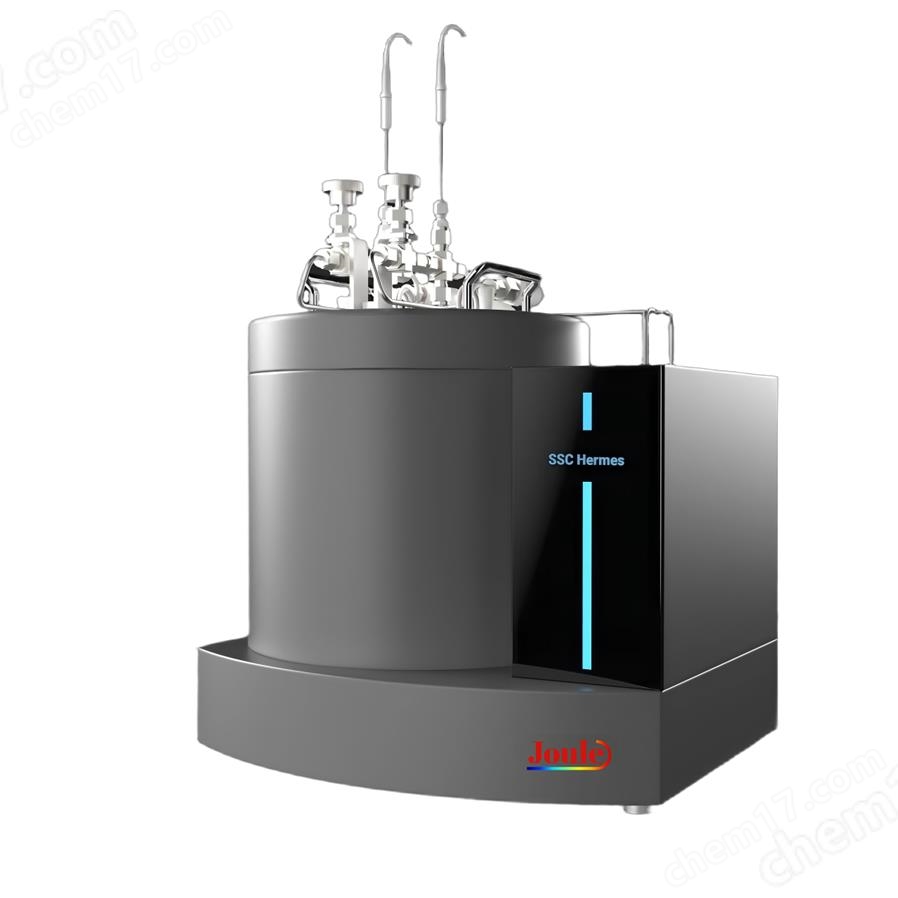
batteryIsothermal calorimeterIt is an instrument for measuring the thermal characteristic parameters of various types of batteries. It uses high-precision multi-channel temperature control to simulate the isothermal working environment of batteries. The power compensation method is used to accurately measure the parameters such as the heat absorption and release power, total heat absorption and release, maximum heat release power, battery efficiency, and battery capacity during the charging and discharging process of batteries at different temperatures. At the same time, synchronously record the voltage, current, temperature, time and other state parameters of the battery under different conditions. Integrated battery specific heat measurement and instrument calibration functions provide scientific data support for battery thermal safety performance evaluation and thermal management system development.
Isothermal calorimeterSpecifications
| Product Model | IBC Polaris | ||
| Maximum battery lengthmm | 400 | 700 | |
| Maximum battery widthmm | 230 | 350 | |
| Cold plate material | A6061 Aluminum Alloy | ||
Technical Specifications
| parameter | value |
| Temperature control range | -40℃~100℃ |
| temperature stability | ±0.005°C |
| temperature resolution | 0.001℃ |
| Battery Specifications | Supports square/soft pack batteries/18650/21700/26650/ |
| Maximum compensation power | 200w |
| Calorimetric sensitivity | 15mW (power compensation mode) 0.2mW (heat flow mode) |
| Measurement accuracy of enthalpy of heat release | ±1% |
| Heating channel | 2 |
| Sensor channel | Can support 8 channels |
| interface | Ethernet port |
| power | 1000w |
Function Mode
| test mode | data collection | Temperature control method |
| Power compensation mode | Power acquisition, temperature acquisition | Isothermal control |
| Heat flow measurement mode | Temperature acquisition | Constant temperature control |
| Heat capacity measurement mode | Temperature acquisition | Linear heating |
Optional features
| function | Brand/Model | parameter |
| Constant voltage and constant current source | Shide Technology/E3634A | Output: 50V/200w; Read back accuracy: 0.15% |
| charge and discharge equipment | New Wei | On demand selection |
| Square standard cast aluminum heater | 定制 | Maximum power 200W |
| 18650 standard cast aluminum heater | 定制 | Maximum power 50W |
Product Features
Compatible with isothermal power compensation and heat flux measurement modes, meeting the accuracy and sensitivity requirements for measuring batteries of different sizes.
Based on the comparative method to measure the heat capacity of batteries at different temperatures, the operation is fast and convenient.
It has the function of calibrating the accuracy of the measurement results of charging and discharging thermal characteristics.
The battery charging and discharging module can switch between charging and discharging modes, and set constant current/constant voltage
Installation requirements
| power supply | AC220V/50Hz |
| Venue requirements | The equipment should be placed on the experimental platform or ground to avoid vibration, equipped with a stable power supply and independent grounding. |
| Environmental Requirements | The equipment should be placed horizontally in a well ventilated laboratory with sufficient space around itFor operation and maintenance purposes. Temperature: (5-40) ℃, humidity:<85% RH |
| environmental requirements | The exhaust gas needs to be filtered by activated carbon or discharged externally, and the waste samples should be collected according to hazardous waste classification |
Isothermal calorimeterIt is a precision instrument used to measure the release or absorption of heat when substances undergo physical or chemical changes under isothermal conditions, and is widely used in materials science, chemistry, biology, and other fields. The core of its working process is to accurately measure the heat difference between the sample and the reference substance in a constant temperature environment, and obtain information such as reaction heat and enthalpy change through data processing. The following is its detailed working process:
Based on thermal conductivity calorimetry or heat flux calorimetry, the core design is a "dual pool structure":
Sample pool: Place the samples to be tested (such as chemical reaction systems, biological samples, material phase change systems, etc.).
Reference pool: Place reference materials (such as pure solvents or inert substances) that are consistent with the sample pool environment but do not react.
Two pools are in the same constant temperature environment (isothermal block). When the sample undergoes endothermic or exothermic reactions, a temperature difference is generated between the sample pool and the reference pool. The heat transfer is detected by sensors (such as thermocouples and heat flow sensors), and finally converted into a thermal power (change in heat per unit time) curve.
Detailed work process
1. Preparation stage
Preparation of samples and reference materials:
Process samples according to experimental requirements (such as solid grinding, liquid constant volume, biological sample constant temperature pretreatment) to ensure sample uniformity.
The reference material should be as close as possible to the sample in terms of physical properties such as heat capacity and thermal conductivity (for example, when the sample is an aqueous solution, pure water can be used as the reference material), and the volume should match the sample pool (to avoid thermal conductivity errors caused by volume differences).
Instrument preheating and constant temperature:
Turn on the host, set the target temperature (such as 25 ℃, 37 ℃, with an accuracy of usually ± 0.001 ℃), and start the constant temperature system (maintain the temperature stability of the isothermal block through the heating/cooling module).
The preheating time depends on the instrument model (usually 30 minutes to 2 hours), ensuring that the temperature of the isothermal block, sample cell, and reference cell reaches equilibrium (temperature difference ≤ 10 ⁻⁶ ℃).
Install samples and reference materials:
Use specialized tools to separately load the sample and reference into the sample cell and reference cell (avoiding finger contact with the cell body to prevent temperature interference).
If it is a sealed system (such as measuring volatile samples), it is necessary to ensure that the sample pool is well sealed (using a matching sealing cover or sealing ring).
Place the two tanks symmetrically into the tank of the isothermal block, cover it with a heat-insulating cover, and reduce environmental thermal interference.
2. Measurement phase
Baseline calibration:
Before formal measurement, perform a baseline scan (monitor the heat flux difference between the two cells when there is no sample) to ensure a stable baseline (fluctuation ≤ ± 1 μ W). If the baseline drift is too large, it is necessary to check whether the constant temperature system is stable and whether the pool body is clean (if residual impurities may cause abnormal thermal conductivity).
Start the measurement program:
Set measurement parameters through the instrument control panel or supporting software:
Measurement duration (set according to reaction speed, such as several minutes to several days);
Data collection frequency (such as once per second to once per minute, and the frequency can be increased when the reaction is severe);
(Optional) Trigger conditions (such as starting measurement after the temperature reaches a certain value, applicable to stepwise reactions).
Heat detection and recording:
When the sample undergoes reactions (such as chemical reactions, crystallization, adsorption, biological metabolism, etc.):
If the sample releases heat and the temperature of the sample cell is higher than that of the reference cell, the heat flows from the sample cell to the reference cell (or isothermal block) through a thermal conductivity path (such as a metal thermal conductivity rod);
If the sample absorbs heat and the temperature of the sample cell is lower than that of the reference cell, heat flows from the reference cell (or isothermal block) to the sample cell.
A heat flow sensor (such as a thermocouple array surrounding the pool) detects the difference in heat flow between two pools in real time, converts it into an electrical signal (voltage or current), amplifies it through an amplifier, and transmits it to the data acquisition module.
The instrument software records the real-time variation of thermal power (μ W or mW) over time and generates a heat flow curve (thermal spectrum).
3. Data processing stage
Curve analysis:
In the heat flow curve, the peak represents the moment when the reaction rate is the fastest, and the area enclosed by the curve and the time axis corresponds to the total heat (the enthalpy change Δ H is calculated by integration).
The software automatically deducts baseline drift and eliminates environmental interference (such as room temperature fluctuations and instrument thermal noise).
Parameter calculation:
Basic parameters: thermal power (P, unit W), total heat (Q, unit J), reaction start time, half-life (time when the reaction is halfway through), etc.
Derivative parameters: calculated according to experimental purposes (such as reaction enthalpy of chemical reactions, metabolic rate of biological samples, crystallization enthalpy of materials, adsorption heat, etc.).
Data output:
The software generates raw data (time thermal power), integrated heat curve, and statistical reports (such as average thermal power and total heat value), which can be exported in Excel, PDF, and other formats for further analysis.
4. End stage
Stop measurement and sample processing:
After the measurement is completed, first turn off data collection, then remove the sample pool and reference pool, and clean the residual samples (to avoid corrosion of the pool body, such as cleaning chemical sample residues with organic solvents).
If the sample is volatile or toxic, it needs to be handled in a fume hood to ensure safety.
Instrument maintenance:
Turn off the constant temperature system and wait for the instrument to cool down to room temperature before turning off the host power.
Clean the sample cell, reference cell, and isothermal block surfaces to avoid residual substances affecting the next measurement.
Record experimental conditions (such as ambient temperature, humidity, sample information) for easy data traceability.
Similar Product Recommend