-
E-mail
hzjoule@163.com
-
Phone
19012707638
-
Address
No. 598 Hejing Road, Hezhuang Street, Qiantang District, Hangzhou City, Zhejiang Province
Product Categories
Hangzhou Joule Intelligent Technology Co., Ltd
Reaction risk assessment test
NegotiableUpdate on 02/07
- Model
- Nature of the Manufacturer
- Producers
- Product Category
- Place of Origin
Overview
The ability to conduct risk assessment testing, obtain large sample sizes, and pressure data is a significant advantage, providing comprehensive and reliable safety data support for the laboratory.
Product Details
Product Introduction
Product introduction
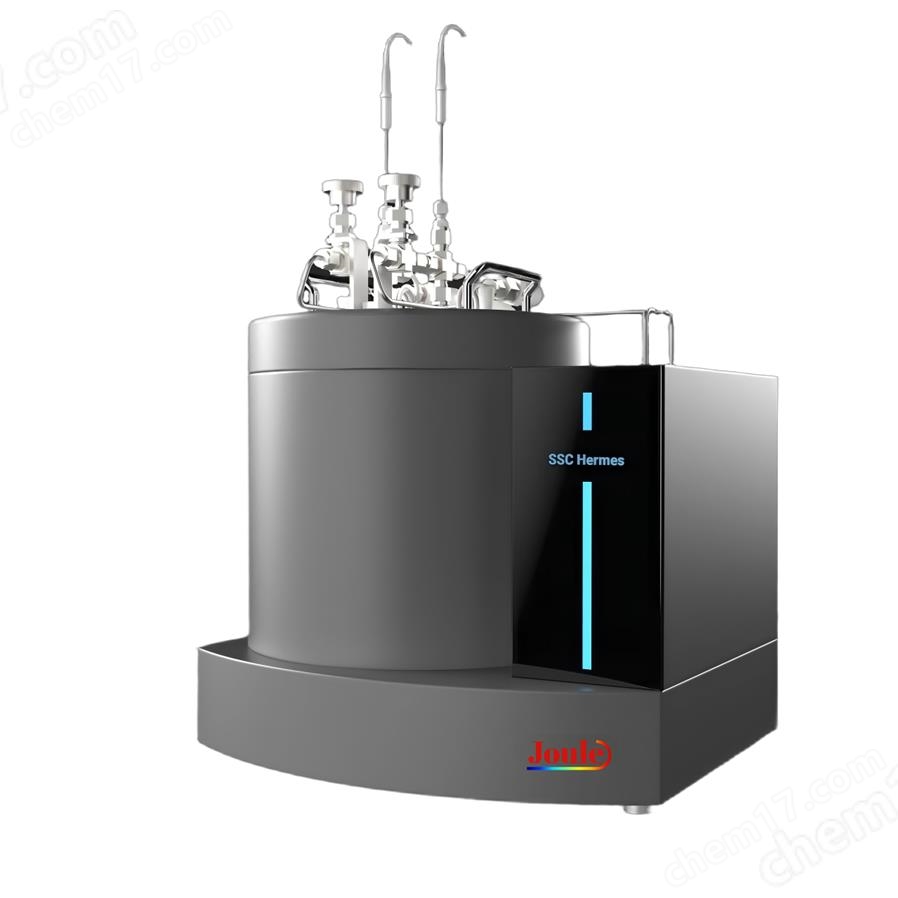
Quick screening calorimeter is a professional testing instrument designed for rapid assessment of reaction heat hazards. It uses * thermocouple sensors to accurately measure the thermal changes of the sample during the heating process. This instrument supports multiple temperature scanning modes and can obtain key data such as heat and pressure over a wide temperature range. It is widely used in chemical, pharmaceutical, and scientific research fields to evaluate the thermal stability of chemicals, screen reaction hazards, and optimize processes. Its dual channel design improves testing efficiency and accuracy, and its unique advantage lies in the ability to obtain large sample sizes and pressure dataReaction risk assessmentThe laboratory provides comprehensive and reliable security data support.
Product Specifications
| Product Model |
SSC Hermes |
| Container diameter mm |
35 |
| Container depth mm | 75 |
| Furnace body material |
Chrome red copper |
Technical Specifications
| parameter | value |
| Temperature control range |
Room temperature~400 ℃ |
| Temperature control mode |
Constant temperature mode, scanning mode, dual gradient scanning |
| Temperature display resolution |
0.01℃ |
| Maximum withstand voltage | (0~20)MPa |
| Pressure resolution | 1kPa |
| detection sensitivity | 1% DTBP@6ml toluene |
| Sample pool material | Stainless steel, titanium alloy, Hastelloy alloy |
| Sample pool specifications |
8mL |
| interface | RJ45 |
| power | 800W |
Product Features
ØEfficient and accurate heat measurement, rapid assessment of reaction risk.
ØWide temperature range and strong adaptability, meeting diverse testing needs.
ØDual channel synchronous testing with DTA function.
ØReal time data display and storage for detailed data analysis.
ØThorough safety protection design ensures the safety of the experimental environment.
Installation requirements
| power supply | AC220V/50Hz |
| Venue requirements | Inside the fume hood |
| Environmental Requirements | The equipment should be placed horizontally in a well ventilated laboratory, with sufficient space around for operation and maintenance. Temperature: (5-40) ℃, humidity:<85% RH |
| environmental requirements | During the experiment, smoke will be generated. It is recommended to install a smoke collection hood and exhaust duct above the equipment to solve the problem of smoke emissions |
Reaction risk assessmentIt is the core work of identifying, analyzing, and controlling potential hazards in chemical reaction processes, which must follow a systematic process and comply with international/national standards:
1、 Preliminary preparation and goal setting
Clearly define the scope and objectives of the evaluation
Identify the evaluation object (such as specific chemical reactions, production equipment, or process flows) and clarify the types of hazards that need to be addressed (such as explosions, fires, toxic gas leaks).
Data collection and equipment calibration
Collect chemical reaction parameters (temperature, pressure, reactant concentration, thermodynamic data), equipment design parameters (reactor material, safety valve settings), historical accident cases, and industry databases (such as the US CSB accident report).
Calibrate testing equipment (such as minimum ignition energy tester, thermal stability analyzer) to ensure energy control accuracy of ≤± 5%, and verify the reliability of sensors and control systems.
2、 Risk identification and analysis
Potential risk identification
Qualitative analysis: using hazard and operability analysis, identifying deviations through hazard analysis (such as high temperature and abnormal pressure), and combining expert experience and knowledge graph to locate key risk points (such as reaction runaway and electrostatic sparks).
Quantitative analysis: Quantify risk parameters through experimental tests (such as minimum ignition energy, thermal stability tests) or simulation calculations (such as thermodynamic models, dynamic simulations). For example, using Monte Carlo simulations to predict accident probabilities, or tracing root causes through Fault Tree Analysis (FTA).
Risk assessment and grading
Risk matrix method: Combining the probability of occurrence (low/medium/high) with the severity of consequences (mild/moderate/severe) to classify risk levels and form a visual heatmap.
Probabilistic Risk Assessment (PRA): Based on historical data, establish an event tree model to calculate the probabilities of each node in the accident chain, such as the correlation analysis between chemical pipeline leakage frequency and equipment aging coefficient.
Sensitivity and Vulnerability Analysis: Evaluate the sensitivity of the system to parameter fluctuations (such as the impact of reaction temperature ± 5 ℃ on yield), or identify vulnerable links (such as old pipelines, ungrounded equipment).
3、 Risk Control and Response Strategies
Development of control measures
Engineering control: Improve equipment design (such as explosion-proof reactors, pressure relief devices), optimize process parameters (such as temperature/pressure thresholds), and adopt intrinsic safety technologies (such as low-energy ignition sources).
Management measures: Develop operating procedures, implement regular maintenance (such as equipment calibration, pipeline inspection), and conduct personnel training (such as emergency drills, safety operation certification).
Emergency plan: Develop accident response procedures (such as leak disposal, fire extinguishing), equip emergency supplies (such as fire extinguishers, gas masks), and conduct regular drills.
Dynamic monitoring and continuous improvement
Real time monitoring of key parameters (such as temperature, pressure, gas concentration) using IoT sensors, and early warning of anomalies (such as sudden changes in reaction rate) through AI algorithms.
Regularly review risks (such as annual risk assessments), update models with new data, and adopt blockchain technology.
Similar Product Recommend