- Phone
-
Address
906, Building 1, Yuzhou City Plaza, Lane 49, Chuanshan Street, Pudong New Area, Shanghai
Product Categories
Shanghai Taoshi Industrial Development Co., Ltd

RIKEN Gas Detector
NegotiableUpdate on 05/15
- Model
- Nature of the Manufacturer
- Producers
- Product Category
- Place of Origin
Overview
The RIKEN gas detector is a gas detection and alarm device developed and manufactured by RIKEN Instruments, mainly used for monitoring the concentration of toxic, harmful, flammable, and explosive gases in industrial and municipal environments. Its product line covers portable single/composite gas detectors, fixed online monitoring systems, and controllers.
Product Details
JapanRIKEN Gas DetectorIt is a high-performance gas detection device that can detect very low gas concentrations, helping users detect potential gas leaks and dangers early. It can detect various gases, including flammable gases, toxic gases (such as carbon monoxide, hydrogen sulfide, etc.), oxygen, etc., and is suitable for different application scenarios.
The in-situ gas analyzer GM32 can measure SO2, NO, NO2, NH3, as well as TRS components in the sulfate pulping process, including pressure and temperature inside the gas pipeline. No gas sampling and transmission required, rapid detection can be carried out directly. This way, the control system can use the actual values in real time. Due to the self detection function, the reliability of the measured values is high, and if there is a fault, it will be promptly alerted. GM32 has been tested to comply with the European standard EN 15267 for detecting SO2 and NO. We also offer explosion-proof products with comprehensive safety protection functions and * system technology, such as GM32 TRS-PE (PE=pulp discharge) used for TRS detection in the sulfate pulping process.
Core technical features:
RIKEN's instruments are renowned for their high precision, long lifespan, and adaptability to harsh environments. Their core technology is mainly reflected in sensor technology:
1. Long life sensors: Sensors independently developed by RIKEN, especially electrochemical and catalytic combustion sensors, are usually designed to have a longer lifespan. Some models of oxygen sensors can last up to 5 years, and non consumable infrared sensors (NDIR) can even last for more than 10 years, reducing the cost of replacement for users.
2. Anti interference and anti-virus: For complex industrial environments (such as silane and sulfide that can easily cause sensor poisoning), RIKEN's sensors have undergone special coating treatment and have strong anti poisoning ability.
3. Intrinsic safety explosion-proof: All portable products comply with international explosion-proof standards (such as IECEx, ATEX, TIIS, etc.) and are suitable for high-risk areas such as Zone 0 and Zone 1.
4. Data management: Some models usually have built-in data recording functions (which can store tens of thousands of data), and can be connected to a computer through infrared or Bluetooth for data analysis and management.
JapanRIKEN Gas DetectorFeatures:
1. Direct and rapid in-situ detection
2. No need for sampling, sample gas transmission, or preprocessing
3. Can simultaneously detect up to 8 components, as well as temperature and pressure
4. DOAS and CDE evaluation models
5. Ensure multiple independent measurement ranges with the same accuracy
6. Automatic self check function without standard gas (QAL3)
7. Positive pressure sealing design suitable for explosion-proof Zone 1 and Zone 2
Typical application scenarios
1. Petrochemical industry: Inspection of explosion-proof areas in refineries and chemical plants (using GX-3R or GX-2012).
2. Municipal gas/pipeline: detect natural gas leaks (using GP series or composite instruments with LEL sensors).
3. Shipbuilding and shipping: Inspection of confined space entry on ships (requiring pump suction and oxygen sensors).
4. Semiconductor/Electronic Factory: Detection of special gases (such as AsH3, PH3, requiring the use of specialized electrochemical sensor models).
5. Fire and emergency rescue: Identification of unidentified gases at the accident site.
5. Selection suggestions
When choosing a RIKEN testing instrument, it is recommended to pay attention to the following points:
1. Gas type: Clarify whether you want to detect flammable gases (LEL/VOL%), oxygen, or toxic gases (such as CO, H2S, Cl2, NH3). If the gas types are complex, it is recommended to choose a model that can replace the sensor (such as GX-6000).
2. Sampling method:
Diffuse: Suitable for wearing on collars and chests, relying on natural air diffusion into the sensor.
Pump suction: Suitable for placing the instrument outside and inserting a suction tube into the interior for air extraction and detection before entering an unknown area, with fast response speed and safety.
3. Explosion proof level and protection level: Confirm whether the explosion-proof mark on the instrument nameplate meets the hazardous zoning requirements of your area. The protection level (IP67 indicates dust-proof and can be immersed in water for a short period of time) determines the durability of the instrument.
4. Data management requirements: If it is necessary to trace alarm records or conduct personnel behavior analysis, a model with data recording and wireless transmission functions needs to be selected.
Technical drawings:

Connection unit; Explosion-proof type

Transmitting and receiving unit; Explosion-proof type

Air blowing device
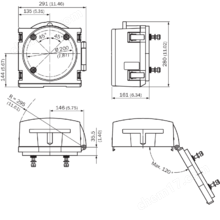
Reflection unit GM32

Gas testing probe (GPP)

Open Measurement Probe (GMP)

Purging gas accessory, explosion-proof model, passive

Blow gas unit SLV4-2, 2BH1300

Blow gas unit SLV6-1, 2SH1300, ATEX 3G

Connection unit; standard form

Transmitting and receiving unit; standard form

Wearing style; Explosion-proof type

Measurement probe type; Explosion-proof type

Wearing style; standard form

Measurement probe type; standard form

Wearing style

Measurement probe type


