-
E-mail
wei.zhu@shuyunsh.com
-
Phone
17621138977
-
Address
Room 602, Building 3, G60 Science and Technology Innovation Cloud Corridor, Lane 288, Qianfan Road, Songjiang District, Shanghai
Product Categories
Shuyun Instrument (Shanghai) Co., Ltd


Powder diffractometer
NegotiableUpdate on 01/09
- Model
- Nature of the Manufacturer
- Producers
- Product Category
- Place of Origin
Overview
The D8 ADVANCE powder diffractometer is a scientific instrument based on the principle of X-ray diffraction, used to analyze the crystal structure of powdered or polycrystalline materials. It reveals key information such as the crystal structure, phase composition, and lattice parameters of the material by measuring the diffraction pattern generated by the interaction between X-rays and the sample.
Product Details
Product: Powder diffractometer
Model: D8Advance
Origin: Germany
A powder diffractometer is a scientific instrument based on the principle of X-ray diffraction, used to analyze the crystal structure of powdered or polycrystalline materials. It reveals key information such as the crystal structure, phase composition, and lattice parameters of the material by measuring the diffraction pattern generated by the interaction between X-rays and the sample.
A powder diffractometer is a scientific instrument based on the principle of X-ray diffraction, used to analyze the crystal structure of powdered or polycrystalline materials. It reveals key information such as the crystal structure, phase composition, and lattice parameters of the material by measuring the diffraction pattern generated by the interaction between X-rays and the sample.
Working principle:
1. X-ray source: Generate monochromatic X-rays (such as Cu K α rays, with a wavelength of approximately 0.154 nm) and irradiate the powder sample.
2. Sample characteristics: The powder sample is composed of countless randomly oriented small grains, ensuring that all possible diffraction directions are covered.
3. Diffraction condition: When the X-ray wavelength (λ), interplanar spacing (d), and incident angle (θ) satisfy the Bragg equation (2d sin θ=n λ), coherent diffraction occurs, producing diffraction peaks.
4. Detector: Record diffraction angle (2 θ) and intensity to form a diffraction pattern.
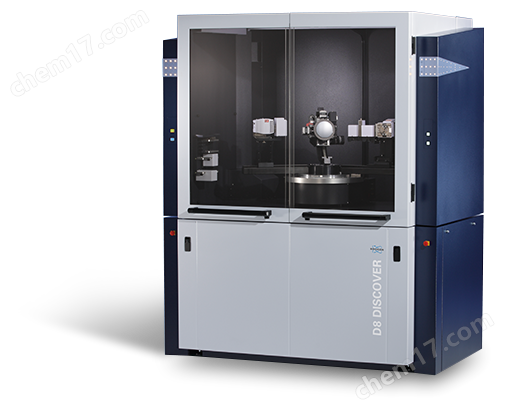
Brooke AXS's new D8ADVANCEPowder diffractometerUsing creative da Vinci design and TWIN-TWIN optical path design, we have successfully achieved fully automatic switching between qualitative and quantitative analysis under BB focusing geometry and thin film grazing incidence GID analysis and thin film reflectivity XRR analysis under parallel light geometry, without the need for light. Through the revolutionary TWISTTUBE technology, users can switch from linear light source applications (qualitative and quantitative analysis of conventional powders, GID and XRR of thin films) to point light source applications (texture, stress, micro area) in just one minute, making annoying issues such as light path switching and re alignment a thing of the past!

A high-precision angle measuring instrument can ensure that the error between the measured peak position and the standard peak position of each diffraction peak (note that it is not a single diffraction peak) in the full spectrum range does not exceed 0.01 degrees. Brooke AXS provides a guarantee!
*The Linx array detector can increase the intensity by 150 times, not only improving the efficiency of equipment use, but also significantly increasing the detection sensitivity of the equipment.
Main applications:
1. Qualitative analysis of physical phase
2. Analysis of crystallinity and amorphous phase content
3. Structural refinement and analysis
4. Quantitative analysis of physical phase
5. Accurate measurement of lattice parameters
6. Quantitative analysis without standard samples
7. Microscopic strain analysis
8. Grain size analysis
9. In situ analysis
10. Residual stress
11. Measurement of low angle mesoporous materials
12. Texture and ODF analysis
13. Thin film grazing incidence
14. Measurement of film reflectivity
15. Small angle scattering
Technical indicators:
Theta/theta vertical angle measuring instrument
2Theta angle range: -110 to 168 °
Angle accuracy: 0.0001 degrees
Cr/Co/Cu target, standard size light tube
Detector: Link Array Detector, Link XE Array Detector
Instrument size: 1868x1300x1135mm
Weight: 770kg
TWIN/TWIN optical path
Brooke's exclusive invention of TWIN-TWIN optical path design greatly simplifies the operation of D8 ADVANCE, making it suitable for various applications and sample types. For user convenience, the system can automatically switch between four different beam geometries. This system can switch between Bragg Brentano powder diffraction geometry and parallel beam geometry of poorly shaped samples, coatings, and films without human intervention. It is an ideal choice for analyzing all types of samples, including powders, bulk objects, fibers, sheets, and films (amorphous, polycrystalline, and epitaxial), in both ambient and non ambient conditions.

Dynamic Beam Optimization (DBO)
The unique DBO function of Bruker has set a new and important benchmark for the data quality of X-ray diffraction. The automatic synchronization function of motor-driven diverging slits, anti scatter screens, and variable detector windows can provide you with irreplaceable data quality, especially at low 2 ° angles. In addition, the entire series of LYNXEYE detectors support DBO: SSD160-2, LYNXEYE-2, and LYNXEYE XE-T.

LYNXEYE XE-T
LYNXEYE XE-T is the flagship product of the LYNXEYE series detectors. It is currently the only energy dispersive detector on the market that can collect 0D, 1D, and 2D data, suitable for all wavelengths (from Cr to Ag), with vertex counting rate and better angular resolution, making it an ideal choice for all X-ray diffraction and scattering applications.
LYNXEYE XE-T has an energy resolution better than 380 eV, which is truly outstanding and is a better performing fluorescence filter detector system on the market. With it, you can filter 100% of the excited iron fluorescence with zero intensity loss, without the need for metal filters, so there will be no artifacts in the data, such as residual K ß and absorption edges. Similarly, there is no need for a secondary monochromator that can remove the intensity.

XRPD method:
· Identify crystalline and amorphous phases and determine sample purity
· Quantitative analysis of crystalline and amorphous phases in multiphase mixtures
· Microstructure analysis (microcrystalline size, microstrain, disorder...)
· A large amount of residual stress generated by heat treatment or processing manufacturing components
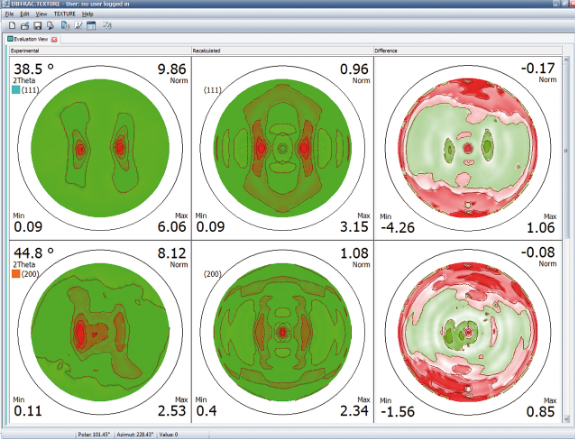
· Texture (preferred orientation) analysis
· Indicator based, de novo crystal structure determination, and crystal structure refinement
Analysis of Distribution Function
Distribution function (PDF) analysis is an analytical technique that provides structural information of disordered materials based on Bragg and diffuse scattering ("total scattering"). Among them, you can obtain information about the average crystal structure of the material (i.e. long-range order) through Bragg diffraction peaks, and characterize its local structure (i.e. short-range order) through diffuse scattering.
In terms of analysis speed, data quality, and analysis results for amorphous, weak crystalline, nanocrystalline, or nanostructured materials, D8 ADVANCE and TOPAS software have replaced PDF analysis solutions with better performance on the market
· Phase identification
· Structural determination and refinement
· Nanoparticle size and shape
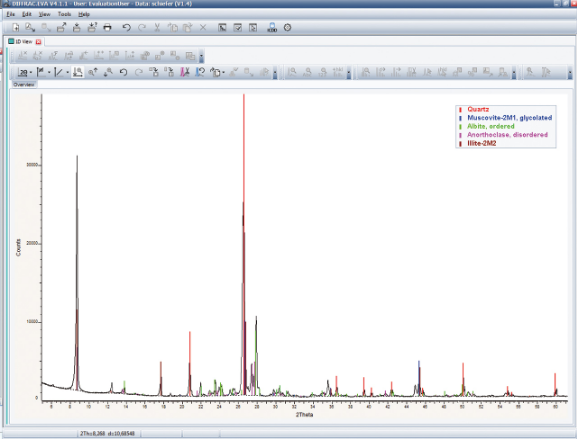
Thin films and coatings
The principle used for thin film and coating analysis is the same as XRPD, but further provides beam adjustment and angle manipulation functions. Typical examples include but are not limited to phase identification, crystal quality, residual stress, texture analysis, thickness determination, and composition and strain analysis. When analyzing thin films and coatings, emphasis is placed on the characteristic analysis of layered materials with thicknesses between nm and µ m (from amorphous and polycrystalline coatings to epitaxial growth thin films).
D8 ADVANCE and DIFFRAC.SUITE software can perform high-quality thin film analysis as follows:
·Grazing incidence diffraction
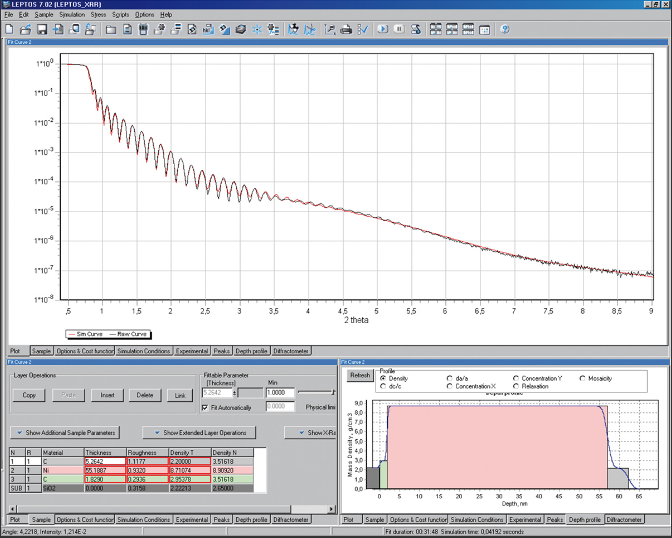
· X-ray reflection method
· High resolution X-ray diffraction
· Reverse space scanning