- Phone
-
Address
Building 5, No. 3701 Xiang'an North Road, Xiamen Torch High tech Zone (Xiang'an) Industrial Zone
Product Categories
Xiamen Moji Biotechnology Co., Ltd

Model based human small intestine organoid culture medium kit
NegotiableUpdate on 05/06
- Model
- Nature of the Manufacturer
- Producers
- Product Category
- Place of Origin
Overview
The Model Biology Human Small Intestinal Organoid Culture Kit is a set of small intestine organoid culture media used to establish and maintain a source of adult stem cells from the human intestine. The kit provides a complete set of reagents for small intestine crypt isolation, crypt retrieval, crypt activity analysis, and culture. It can maintain the activity of small intestinal crypts to a large extent and improve the formation rate of small intestinal organoids. The cultured human small intestinal organoids are mainly composed of small intestinal stem cells, rapidly expanding cells, intestinal absorptive cells, Paneth cells, goblet cells, and a small number of intestinal endocrine cells. In terms of self-renewal ability, tissue structure, cell type, and function, human small intestinal organoids can partially reproduce the characteristics of human intestinal epithelium, making them an ideal in vitro model for studying intestinal homeostasis and disease mechanisms.
Product Details
Human Intestine Organoid Kit
Human small intestine organoid culture medium kit
|
1 Product Description
Model based human small intestine organoid culture kit(Human Intestine Organoid Kit)It is a small intestine organoid culture medium kit used to establish and maintain human intestinal adult stem cell sources. The kit provides a complete set of reagents for small intestine crypt isolation, crypt recovery, crypt activity analysis, and culture. It can maintain the activity of small intestinal crypts to a large extent and improve the formation rate of small intestinal organoids. The cultured human small intestinal organoids are mainly composed of small intestinal stem cells, rapidly expanding cells, intestinal absorptive cells, Paneth cells, goblet cells, and a small number of intestinal endocrine cells. In terms of self-renewal ability, tissue structure, cell type, and function, human small intestinal organoids can partially reproduce the characteristics of human intestinal epithelium, making them an ideal in vitro model for studying intestinal homeostasis and disease mechanisms.
2 Product Information
| Product Name | Product Item Number | Kit components | specification | Kit component item number | storage/transportation | shelf life |
| Human small intestine organoid culture medium kit | MA-0817H002L | Basic culture medium for human small intestine organoids | 500mL | MG2002-HI-A500 | 4°C | 12month |
| Human small intestine organoid culture factorB(50x) | 10mL | MG2002-HI-B500 | -20°C | |||
| Human small intestine organoid culture factorC(250x) | 2mL | MG2002-HI-C500 | -20°C | |||
| Human small intestine organoid culture factorD(250x) | 2mL | MG2002-HI-D500 | -20°C | |||
| MA-0817H002S | Basic culture medium for human small intestine organoids | 100mL | MG2002-HI-A100 | 4°C | ||
| Human small intestine organoid culture factorB(50x) | 2mL | MG2002-HI-B100 | -20°C | |||
| Human small intestine organoid culture factorC(250x) | 0.4mL | MG2002-HI-C100 | -20°C | |||
| Human small intestine organoid culture factorD(250x) | 0.4mL | MG2002-HI-D100 | -20°C |
3 Other self provided materials and reagents
| Product Name | Product Item Number |
| Model based biomaterial adhesive | 082701/082703/082755 |
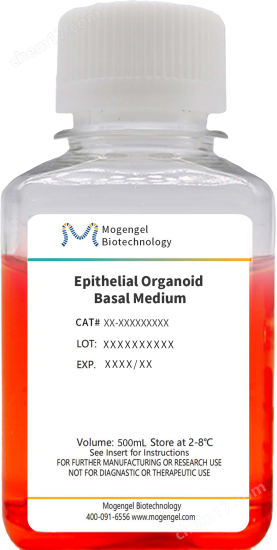
| Epithelial organ basic culture medium | MB-0818L07 |
| Organ culture anti adhesion moisturizing solution | MB-0818L03L/S |
| Organoid digestive fluid | MB-0818L01L |
| Pre cooling box for packaging of biobased adhesive | AB-YL1005 |
| -mixed solution | - |
| Phosphate buffer solution | - |
| EDTA (0.5 M, pH 8.0) | - |
| bovine serum albumin | - |
| DPBS(1X),Liquid, free of calcium and magnesium | - |
| Cell filter70μm | - |
| tissue culture plate96/48/24/12/6Kong |
|
| centrifuge tube1.5/5/15/50mL |
|
| cell culture dish6/10cm |
|
4 Preparation of human small intestine organoid culture medium
Prepare human small intestine organoid culture medium in a sterile and ultra clean workstation. To prepare10mLTaking human small intestine organoid culture medium as an example, if the required amount is different, the dosage can be adjusted accordingly.
1 Thawing human small intestine organoid culture factors on iceB(50x)Human small intestine organoid culture factorC(250x)Human small intestine organoid culture factorD(250x).
Attention: After thawing, it is recommended to use human small intestine organoid culture factorsB(50x)Human small intestine organoid culture factorsC(250x)Separate packaging and store for use to avoid repeated freezing and thawing.
2 After thawing the culture medium, invert it upside down and mix thoroughly. Then, pack it according to daily needs in a biosafety cabinet or clean workbench. It is recommended to pack it into10mL/Manage.
3 Please seal and store the packaged culture medium in-20℃Take out the packaged culture medium and let it equilibrate at room temperature before use.
Attention: The prepared human small intestine organoid culture medium can be used in2-8°CStorage, recommended for use within two weeks. In addition, human small intestine organoid culture factorsB(50x)Contains bacteria and fungal antibiotics inside(50x).
5 Establishment and Passage Culture of Human Small Intestinal Organoids
Attention: Research involving major human tissue materials must comply with all relevant institutions and government regulations. Prior to collecting primary human tissue materials, informed consent must be obtained from all subjects.
a) Establishment of primary human small intestine organoids
1 Sampling: Use a centrifuge tube to collect primary human small intestine tissue in cold primary tissue protective solution, and store the tissue sample in4°CUntil separation begins.
2 Cleaning: Transfer the tissue sample to a pre cooled containerDPBSIn a culture dish with buffer solution, the intestinal lumen is facing upwards. Use one hand to clamp one end of the intestinal tissue, and use the other hand to gently scrape off the intestinal villi on the surface of the intestinal lumen. After the villi are scraped off, place the intestinal tissue in a new containerDPBSClean in the culture dish, repeat cleaning2Next time. Crush the cleaned small intestine into pieces2mmTransfer to a new culture dish and useDPBSclean2All over.
3 Digestion: Transfer the cleaned intestinal segment to a container containing5mM/L EDTAPre coolingDPBSMiddle digestion, placed in4℃Or incubate in crushed ice20~30min, digestion20minGently blow the intestinal segment with a pipette on both sides, observe the supernatant under a microscope, and stop digestion when complete crypts appear in the supernatant. If there are no crypts, the digestion time can be appropriately extended.
4 Cleaning: After digestion is complete, transfer the tissue fragments to a new containerDPBSClean in the petri dish and repeat2Next to removeEDTA.
5 Suspension: Use5mLPipette is pre cooled0.1%BSAofDPBSThe culture dish or50mLBlow and resuspend tissue fragments in centrifuge tubes, repeatedly passing the tissue through the tip of the pipette to generate mechanical shear force, thereby separating the crypts from the basal layer. Take a portion of the suspension for microscopic examination. When a large number of crypt like structures can be seen, stop blowing and perform a test on the tissue suspension after blowing70μmFilter screen filtration.
6 Collection: Collect tissue suspension that has passed through the filter,300gcentrifugal force4℃centrifugation3min.
7 Count: Discard supernatant, use1mL0.1%BSAofDPBSResuspend tissue sediment, take20μLPerform microscopic examination and crypt counting on the suspension, and after counting, aspirate the suspension containing the required amount of crypts,300gcentrifugal force4℃centrifugation3minDiscard the supernatant and place it on ice.
8 Resuspend the tissue precipitate with an appropriate amount of matrix gel, with a recommended resuspension density of10μLThe matrix gel suspension contains70to100A crypt, resuspended and placed on ice, resuspended for no more than30sTo avoid premature solidification of the matrix adhesive.
Attention: The dilution ratio of the matrix adhesive should be within70%The above is to ensure the structural stability of the matrix gel during the cultivation process.
9 Point in the mixed suspension of matrix gel and tissue cells24The bottom of the orifice plate is straight, with each hole30μLOn both sides, avoid contact between the suspension and the sidewall of the orifice plate..10.Place the inoculated culture plate in37℃Incubate in a carbon dioxide constant temperature incubator30minWait for the matrix adhesive to solidify on both sides.
10 After the matrix gel solidifies, slowly add the prepared human small intestine organoid culture medium along the wall,24Each hole of the orifice plate500μLTo avoid damaging the already solidified structure.
11 Translate into English24The orifice plate is placed37℃Cultivate in a carbon dioxide incubator.
12 each2~3Change the culture medium once a day, and avoid damaging the matrix gel when changing the culture medium. Closely monitor the growth status of organoids, ideally, human small intestine organoids should be in5to7Built within the day.
b) Passage culture of human small intestine organoids
1 Cultivate human small intestine organoids to a diameter of200~500μmWhen the size is small (or when it turns black and no longer grows), human small intestine organoids can be passaged (approximately per generation)5About days). Use a gun tip that has been moistened with a cleaning solution to blow and scrape the organoids, and transfer the small intestine organoids and culture medium suspension to the one that has been moistened with the cleaning solution1.5mLEPIn the management.
2 Use a gun tip that has been moistened with a cleaning solution to vigorously blow and hit the suspension of heavy suspended organs multiple times(5~10Next, separate and blow the small intestine organoids from the matrix gel,300gcentrifugation3min.
3 Discard the supernatant and add1mLBlow the basic culture medium again to stimulate the organoids5~10Next, take a small amount of suspension and observe the status of the organoids under a microscope:
1) If the organoids have been dispersed into fragments, mechanical blowing can be used to directly blow and disperse the organoids300gcentrifugation3minAfter centrifugation, usePBSOr basic culture medium cleaning2Next time.
2) If the organoids are relatively intact300gcentrifugation3minAfterwards, discard the supernatant and add5Dissolve organoid digestive fluid equal to the volume of the mixture of matrix glue and human small intestine organoids, blow and mix well, and then place it in37℃Digestion in the incubator2minJoin5Terminate digestion with a basic culture medium that is twice the volume of digestive fluid. Used after centrifugationPBSOr basic culture medium cleaning2Next time.
4 Resuspend the cleaned organoid sediment with an appropriate amount of matrix gel and place it on ice for no more than a certain amount of time30sTo avoid premature solidification of the matrix adhesive.
Attention: The dilution ratio of the matrix adhesive should be within70%The above is to ensure the structural stability of the matrix gel during the cultivation process.
5 Point in the mixed suspension of matrix gel and organoids24The bottom of the orifice plate should be aligned to avoid contact between the suspension and the side wall of the orifice plate. Each hole30μL左右。
Attention: To prevent the matrix adhesive from solidifying at room temperature, this step should be completed as soon as possible.
6 Place the inoculated culture plate in37℃Incubate in a carbon dioxide constant temperature incubator15minAfter the matrix adhesive solidifies, take it out.
7 Prepare human small intestine organoid culture medium.
8 After the matrix gel solidifies, add preheated human small intestine organoid culture medium along the pore wall,24Each hole of the orifice plate500μL.
9 Place the cell culture plate in37℃Cultivate in an incubator and closely observe the growth status of human small intestine organoids3Take photos under an inverted microscope to record the morphology and distribution of human small intestine organoids in multiple fields of view.
V2.0edition
Update time:2025/6/17
Similar Product Recommend