- Phone
-
Address
Building 5, No. 3701 Xiang'an North Road, Xiamen Torch High tech Zone (Xiang'an) Industrial Zone
Product Categories
Xiamen Moji Biotechnology Co., Ltd

Model based human colon organoid culture medium kit Plus (amplification)
NegotiableUpdate on 05/06
- Model
- Nature of the Manufacturer
- Producers
- Product Category
- Place of Origin
Overview
The Human Colonic Organ Kit Plus (Expansion) is a culture medium used for amplifying human colon organoids. The amplified human colon organoids are mainly composed of colon stem cells and colon progenitor cells. Colonic organoids reproduce the characteristics of colonic epithelium in vivo in terms of self-renewal and differentiation ability, tissue structure, cell type, and function, making them an ideal in vitro model for human colon research.
Product Details
Human Colonic Organoid Kit Plus(Expansion)
Human colon organoid culture medium kitPlus(Amplification)
|
1 Product Description
Model based human colon organoid culture medium kitPlus(Amplification)【Human Colonic Organoid Kit Plus (Expansion) Plus】It is a culture medium used for amplifying human colon organoids, which are mainly composed of colon stem cells and colon progenitor cells during amplification. Colonic organoids reproduce the characteristics of colonic epithelium in vivo in terms of self-renewal and differentiation ability, tissue structure, cell type, and function, making them an ideal in vitro model for human colon research.
2 Product Information
| Product Name | Product Item Number | specification | storage/transportation | shelf life |
| Human colon organoid culture medium kit (amplification)Plus | MA-0817H001HLP | 500mL | -20°C | 24month |
| MA-0817H001HSP | 100mL |
3 Other self provided reagents and consumables
| Product Name | Product Item Number |
| Model based biomaterial adhesive | 082701/082703/082755 |
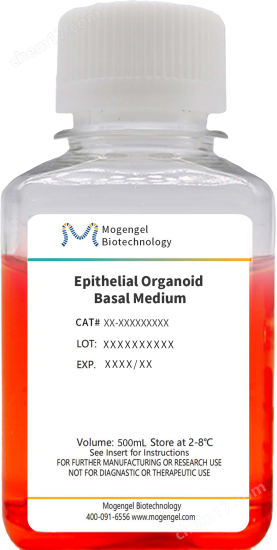
| Epithelial organ basic culture medium | MB-0818L07 |
| Organ culture anti adhesion moisturizing solution | MB-0818L03L / MB-0818L03S |
| Living tissue cell preservation solution | MB-0818L04L |
| Organoid digestive fluid | MB-0818L01L |
| Pre cooling box for packaging of biobased adhesive | AB-YL1005 |
| bovine serum albumin | - |
| Phosphate buffer solution | - |
| -mixed solution | - |
| EDTA(0.5M,pH8.0) | - |
| Cell filter100μm | - |
| tissue culture plate96/48/24/12/6Kong |
|
| centrifuge tube1.5/5/15/50mL | - |
| cell culture dish6/10cm | - |
4 Instructions for using human colon organoid culture medium (amplification)
1 After receiving the organoid culture medium, place the medium in4Thaw in a ℃ freezer.
2 After thawing the culture medium, invert it upside down and mix thoroughly. Then, pack it according to daily needs in a biosafety cabinet or clean workbench. It is recommended to pack it into10mL/Manage.
3 Please seal and store the packaged culture medium in-20℃Take out the packaged culture medium and let it equilibrate at room temperature before use.
5 Establishment and Passage Culture of Human Colonic Organoids
Attention: Research involving primary human tissue materials must comply with all relevant institutional and government regulations. Prior to collecting primary human tissue materials, informed consent must be obtained from all subjects.
a) Establishment of primary human colonic organoids
1 Primary tissue samples should be in vitro5minPlace pre cooled living tissue preservation solution inside(2-8℃)In the sample tube, the sample needs to be covered with tissue preservation solution (if the sample has already been placed in other buffer solutions or culture media, please replace the entire solution with pre cooled tissue preservation solution). Low temperature(2~8℃)Transport and transfer to the laboratory.
2 Place the matrix adhesive before the experiment4℃Thaw on ice while removing the culture medium and allowing it to equilibrate at room temperature. Centrifugal tubes, test tubes, or plastic tips in contact with cells need to be rinsed with organoid culture anti adhesion moisturizing solution before use.
3 In a clean workbench, transfer the sample to a culture dish and evaluate whether the obtained tissue is composed of epithelium. If there is fat or muscle tissue present, use a knife or forceps under an dissecting microscope to remove as much of these non epithelial components as possible. If there is no fat or muscle tissue, please proceed to the next step immediately.
4 Transfer the tissue sample to a pre cooled container containing dual antibodiesDPBSIn a culture dish with the intestinal lumen facing upwards, use one hand to clamp one end of the intestinal tissue, and use the other hand to gently scrape off any mucus or residual feces on the surface of the intestinal lumen. Then place the colon tissue in a new container containing bispecific antibodiesDPBSCleaning in a culture dish2-3Next time. Crush the cleaned intestines to about2mm*5mmSize, then transfer to50mLIntense shaking in the centrifuge tube30s(Vertical up and down oscillation20Counting once, about once1sthree timesthriceon three occasions3)
Discard the supernatant and repeat Next time.5Digestion: Add30mLofDPBSAdd it to the solution again300μL 0.5M EDTA, toEDTAThe final concentration is5mM. Set4℃On the shaker,80rpm, digestion2020~30min
Depending on the sample size, it can be digested After minutes of blowing and mixing, observe the digestion under a microscope. If a complete crypt structure is observed, proceed to the next step.6Cleaning: After digestion is complete, let the intestinal segment settle and discard the supernatant. Add pre cooling2DPBSGently shake well, let it stand, discard the supernatant, and repeatNext to remove
EDTA .7Resurrected: Join30mLPre cooled containing0.1%BSAofDPBS, Vortex10sTake the supernatant2100μm
Filter through a filter, collect tissue suspension that passes through the filter, and repeat the collection process Next time.8Collect:300gcentrifugal force4℃centrifugation
3min .
9 Suck off the supernatant and resuspend the precipitate in the basal culture medium of epithelial organs, and take the suspension for crypt counting.10300gcentrifugal force4℃centrifugation3minDiscard the supernatant and add an appropriate amount of cell pellet to the matrix gel according to the cultivation requirements(15>70%50)And mix well on ice (note: the mixing and blowing action should be gentle, avoiding the generation of a large number of bubbles, and mixing at room temperature needs to be controlled withinWithin seconds, mix well and place on ice. Note: The matrix adhesive should be stored on ice to prevent it from solidifying. Carry out the process as soon as possible. approximatelyA crypt should be inoculated in25μLIn the matrix adhesive. Do not excessively dilute the matrix adhesive (the proportion of matrix adhesive should be>70%(Volume of matrix adhesive)
/ (Total volume), as this may inhibit the correct formation of solid droplets.9611Place the mixed suspension of matrix gel and cells into the bottom of the culture well plate, and use a pipette tip to slightly level the suspension, taking care to avoid contact with the side wall of the well plate. (Recommended:Plate inoculation483~10μL/Hole,Plate inoculation2410~20μL/Hole,Plate inoculation
20~30μL/ Hole).
12 Attention: Once the organoid is resuspended in the matrix gel, proceed with seeding as soon as possible, as the matrix gel may solidify in the test tube or pipette tip.13Place the culture plate in37℃and5%CO₂In the incubator
15-25 Minute, let the matrix gel solidify.9614After the matrix gel solidifies, slowly add room temperature equilibrated organoid culture medium along the wall to avoid damaging the already solidified structure. (Recommended:Add orifice plate48100μL/Hole,Add orifice plate24250μL/Hole,Add orifice plate
500μL/ Hole). Note: Do not add the culture medium directly to the top of the matrix gel droplets, as this may damage the already solidified structure.15Place the culture plate in37℃and5%CO
₂ In a constant temperature incubator.16every
2~3 Change the culture medium once a day, carefully extract the culture medium from the well, and add fresh room temperature balanced organoid culture medium.
17 Closely monitor the growth status of organoids.
b) Passage culture of human colonic organoids1Cultivate the organoid to a diameter of1600μm
When the size is small (or when it turns black and no longer grows), the passage of organoids can be carried out (approximately per generation) week The following consumables that come into contact with cells must be rinsed with a moisturizing solution before use:2Discard the old culture medium, add an equal volume of epithelial organoid basic culture medium, gently scrape (or blow) off the matrix gel and organoid mixture with a cell scraper or pipette tip, and transfer to1.5mLIn centrifuge tubes (maximum collection per tube)2~3Pore like organs, avoid excessive volume and low digestion efficiency), blow and beat5~10Next, separate the organoids from the matrix gel,3300g
centrifugation minute53Remove the supernatant and addDissolve organoid digestive fluid equal to the volume of the matrix gel and organoid mixture, blow and mix well, and then place it in337℃Digestion in the incubatorminute Take out, blow and mix well10μLWhether the mixed solution is digested by microscopic examination
300μmLeft and right organoid masses.Note: To resuspend sediment in the following steps, it is necessary to control the blowing force and frequency, and to control the size of the organoid mass
300μm 左右。54After digestion is complete, addGently blow and mix the basic culture medium of double volume epithelial organs to terminate the digestion reaction, and then3250g
centrifugation minute25
Discard the supernatant and wash with epithelial organ basic culture medium Next, remove residual digestive fluids. Secondary cleaning can combine and collect organoids in the same centrifuge tube.6After cleaning, the cells in the centrifugal precipitate are passaged and cultured, and matrix gel is added to the cell precipitate(15>70%)And mix well on ice (note that the mixing and blowing action should be gentle, avoiding the generation of a large number of bubbles, and mixing at room temperature needs to be controlled withinWithin seconds, mix well and place on ice. Attention: The dilution ratio of the matrix adhesive should be within
70% The above is to ensure the structural stability of the matrix gel during the cultivation process.967Place the mixed suspension of matrix gel and cells into the bottom of the culture well plate, and use a pipette tip to slightly level the suspension, taking care to avoid contact with the side wall of the well plate. (Recommended:Plate inoculation483~10μL/Hole,Plate inoculation2410~20μL/Hole,Plate inoculation5020~30μL/Hole). approximatelyA cluster of organoids inoculated in
25μL In the matrix adhesive. Attention: To prevent the matrix adhesive from solidifying at room temperature, this step should be completed as soon as possible.8Place the culture plate in37℃and5%CO₂In the incubator
15-25 Minute, let the matrix gel solidify.969After the matrix gel solidifies, slowly add room temperature equilibrated organoid culture medium along the wall to avoid damaging the already solidified structure. (Recommended:Add orifice plate48100μL/Hole,Add orifice plate24250μL/Hole,Add orifice plate
500μL/ Hole). Note: Do not add the culture medium directly to the top of the matrix gel droplets, as this may damage the already solidified structure.10Place the culture plate in37℃and5%CO
₂ In a constant temperature incubator.11every
2~3 Change the culture medium once a day, carefully extract the culture medium from the well, and add fresh room temperature balanced organoid culture medium.
12Closely monitor the growth status of organoids until they require further experimentation.
V2.0edition
Similar Product Recommend