- Phone
-
Address
Room 529, Building 15, No. 15, Lane 6638, Songze Avenue, Qingpu District, Shanghai
Product Categories
Pulufu Electric (Shanghai) Co., Ltd

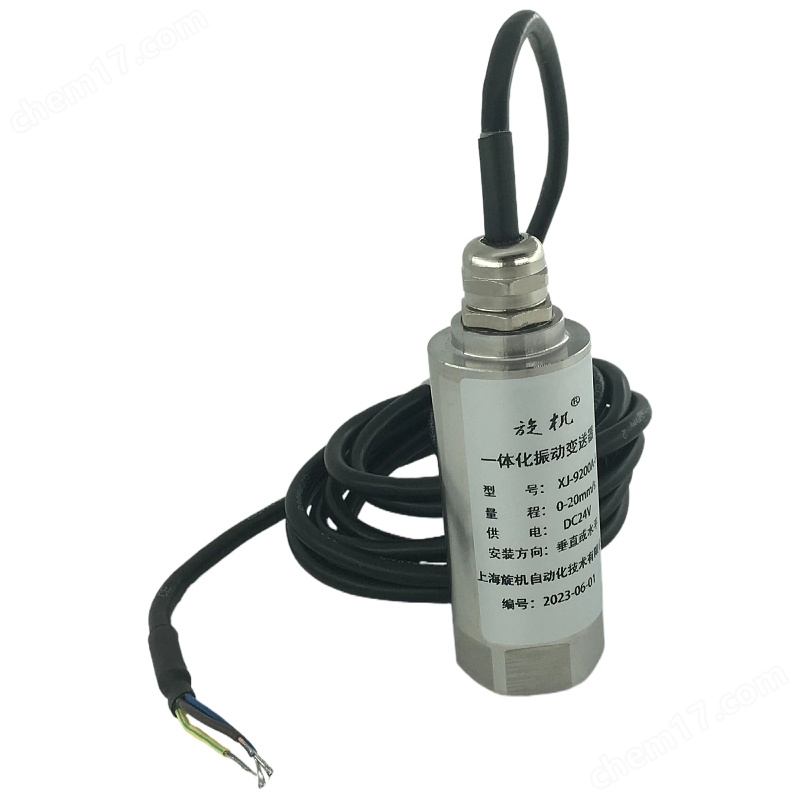


Integrated RK803 sensor for transmitting vibration signals of rolling bearings
NegotiableUpdate on 05/14
- Model
- Nature of the Manufacturer
- Producers
- Product Category
- Place of Origin
Overview
The RK803 integrated vibration signal transmission sensor for rolling bearings, and the RK-803 integrated vibration speed sensor and precision measurement circuit together form a high-precision vibration measurement system ..
Product Details
Integrated RK803 sensor for transmitting vibration signals of rolling bearings
The RK-803 rolling bearing vibration signal transmission sensor integrates the vibration speed sensor and precision measurement circuit together to form a high-precision vibration measurement system, which realizes the function of the traditional "sensor+monitoring instrument mode vibration measurement system. The transmitter can be directly connected to DCS, PLC or other equipment, and is an ideal choice for vibration measurement of factory equipment such as fans, motors, water pumps, etc.
Technical Specifications
Power supply: 24VDC ± 10%
Input signal: taken from the signal of the built-in vibration speed sensor
Sensitivity: 20mv/mm/s ± 5%
Frequency response: 10-1000 Hz or 5-1000 Hz (special instructions)
Range: 0-20mm/s (true RMS)
0-200um (peak to peak)
Measurement error: ± 1% of full scale
Output current: 4-20mA
Output impedance: ≤ 500 Ω
Temperature range: -25 ℃ to+65 ℃ during operation
Storage time: -40 ℃~85 ℃
Relative humidity: up to 95%, non condensing
Dimensions: φ 33 × 75mm
Weight: Approximately 340g
Order code
XJ-9200A □□ (optional) - □□ (V/D) - A □□ - B □□ - C □□
Selection instructions
Optional: Waterproof connector □: F-Waterproof connector
Kaizhuang outgoing line □: B-Kaizhuang pipe
Required: Selection Description
Range □□:
Vibration velocity ranging from 10V-0 to 10mm/s; 20V*-0~20mm/s; 30V-0~30mm/s; ……
Vibration displacement ranging from 100D-0 to 100 μ m; 100D-0~200μm; 300D-0~300μm; ……
Installation direction A □:
1- Level; 2- Vertical; 3 * - Universal
Install thread B □:
1*-M10×1.5; 2-M8×1.25; 3- Magnetic seat; 4- Special customization
Cable length C □:
1-1m; 2*-2m; 3-3m; ……
Unless there are special circumstances, the manufacturer produces according to each item; If you have any special requirements, please consult with our company
Selection example: XJ-9200A-20V-A3-B1-C2
Rolling bearing vibration signal transmission sensor RK-803


Technical Specifications
Power supply: 24VDC ± 10%
Input signal: taken from the signal of the built-in vibration speed sensor
Sensitivity: 20mv/mm/s ± 5%
Frequency response: 10-1000 Hz or 5-1000 Hz (special instructions)
Range: 0-20mm/s (true RMS)
0-200um (peak to peak)
Measurement error: ± 1% of full scale
Output current: 4-20mA
Output impedance: ≤ 500 Ω
Temperature range: -25 ℃ to+65 ℃ during operation
Storage time: -40 ℃~85 ℃
Relative humidity: up to 95%, non condensing
Dimensions: φ 33 × 75mm
Weight: Approximately 340g
Order code
XJ-9200A □□ (optional) - □□ (V/D) - A □□ - B □□ - C □□
Selection instructions
Optional: Waterproof connector □: F-Waterproof connector
Kaizhuang outgoing line □: B-Kaizhuang pipe
Required: Selection Description
Range □□:
Vibration velocity ranging from 10V-0 to 10mm/s; 20V*-0~20mm/s; 30V-0~30mm/s; ……
Vibration displacement ranging from 100D-0 to 100 μ m; 100D-0~200μm; 300D-0~300μm; ……
Installation direction A □:
1- Level; 2- Vertical; 3 * - Universal
Install thread B □:
1*-M10×1.5; 2-M8×1.25; 3- Magnetic seat; 4- Special customization
Cable length C □:
1-1m; 2*-2m; 3-3m; ……
Unless there are special circumstances, the manufacturer produces according to each item; If you have any special requirements, please consult with our company
Selection example: XJ-9200A-20V-A3-B1-C2
Rolling bearing vibration signal transmission sensor RK-803
What is a transmitter
transmitterconcept
atindustryIn process control, the measurement transmission unit, actuator, and regulator make up the entire systemcontrol systemThe three major components. The measurement and transmission unit is the transmitter, sometimes the transmitter is actually equivalent tosensorAnd actuators are like valves, regulators arecontrollerIt is the brain of the entire control system.
Sensors and transmitters together constitute automatic control monitoringsignalSource. A transmitter is a device that converts the output signal of a sensor into a signal that can be recognized by a controller, or converts the non electric input of the sensor into an electrical signal and amplifies it simultaneously, converting it into a standard signal source (such as 4-20mA DC)power supply)Can be used for remote measurement and control. Therefore, the transmitter is not only a conversion medium, but also a medium.
The process in automatic control is: signal source -->sensor -->transmitter -->arithmetic controller -->actuator -->control output.
In industrial sites, sometimes transmitters and sensors are interchangeable because the output signals of most modern sensors are already signals that can be received by a universal controller, and this signal can be directly recognized by the controller without being converted by the transmitter. Similar to sensors, transmitters are generally divided into temperature/humidity transmitters, pressure transmitters, differential pressure transmitters, and liquid level transmitters,currentTransmitter, power transmitter, flow transmitter, weight transmitter, etc.
Principle of transmitter
'Change'——Transformation refers to the process of converting various physical quantities from sensors into electrical signals. For example, using thermocouples to convert temperature into electrical potential; Using a current transformer to convert high current into low current. for another examplehumidity sensorisChange according to changes in humiditycapacitorofcapacitanceMeasure the quantity to calculate the relative humidity in the air.Due to the ease of processing electrical signals, modern transmitters convert various physical signals into electrical signals.
'Sending' - refers to the process of transmitting various electrical signals that have already been transformed, in order to facilitate the reception and transmission of other instruments or control devices, and then passing them through againelectronic circuitUnify the electrical signals from the sensors (e.g. 4-20mA, 0-5V). The method is through multiple meansoperational amplifierTo achieve. For example, the GS512 ducted temperature and humidity transmitter from Haigu can convert and transmit standard 4-20mA signals from the temperature and humidity module.
Signal transmission andpower supplyClassification of wire systems
Second line system:In the heatresistanceThe method of connecting a wire to each end of the wire to extract a resistance signal is called two-wire system: this wiring method is simple, but due to the inevitable existence of wire resistance r when connecting wires, the size of r is related to the material and length of the wire, so this wiring method is only suitable for situations with low measurement accuracy;
three-wire system:The method of connecting a lead at one end of the root of a thermal resistor and two leads at the other end is called the three wire system. This method is usually used in conjunction with an electric bridge to effectively eliminate the influence of lead resistance and is commonly used in industrial process control.The thermal resistor adopts a three wire connection method. The use of a three wire system is to eliminate measurement errors caused by the resistance of connecting wires. This is because the circuit for measuring thermal resistance is usually an unbalanced bridge. As a bridge arm resistor of the electric bridge, the thermal resistor's connecting wire (from the thermal resistor to the central control room) also becomes a part of the bridge arm resistor. This part of the resistor is unknown and varies with the ambient temperature, causing measurement errors. Adopting a three wire system, one wire is connected to the power terminal of the bridge, and the other two wires are respectively connected to the bridge arm where the thermal resistance is located and the adjacent bridge arm, thus eliminating measurement errors caused by the resistance of the wire line;
Four wire system: The method of connecting two wires at each end of the root of a thermistor is called a four wire system, in which two leads provide a constant current I to the thermistor, convert R into a voltage signal U, and then lead U to the secondary instrument through the other two leads. It can be seen that this lead method can eliminate the influence of lead resistance and is mainly used forhigh precisionthe temperaturedetection.
Primary and secondary instruments
The explanation of secondary instruments is to accept the use of transmitterstransformerThe electrical or gas signals sent by sensors (including thermocouples, thermistors) indicate the process technology being detectedparameterInstruments for measuring values. Taking physical objects as examples, such as digital displays, temperature controllers, etc. A primary meter belongs to signal acquisition and conversion (various transmitters, temperature components, signal acquisition devices), and a secondary meter is used for display alarm adjustment (panel mounted display alarm instruments, input of distributed control systems, input of distributed control systems).
- END -
Integrated RK803 sensor for transmitting vibration signals of rolling bearings
Similar Product Recommend


