-
Phone
18782066269
-
Address
Shibatan Industrial Zone, Xindu District
Product Categories
- Modified emulsified asphalt equipment
- Sewage treatment equipment
- Resin production line
- Ink and paint production line
- Mixing machine
- High speed disperser
- Sand grinder
- Storage tank
- Spiral conveyor
- Heat exchanger
- High shear emulsifier
- Blender selection parameters
- Other supporting equipment
- Other chemical pressure vessels
- dry mortar production line
- Dry powder mortar equipment
- Environmental dust collector
- Resin production equipment
- Paint equipment | Paint production equipment
- Steel lined PO anti-corrosion series
- PTFE lined anti-corrosion series
- Steel lined PE anti-corrosion series
- Chemical anti-corrosion steel lined plastic pipeline
- Anti corrosion of steel lined PP polypropylene storage tanks
- Sichuan Jinti Yongtong PTFE Anti corrosion Technology Co., Ltd
- Complete set of putty powder equipment
- Other complete sets of chemical equipment
- reaction kettle
Chengdu Xindu Yongtong Machinery Factory
Inorganic insulation mortar equipment (single component)
NegotiableUpdate on 12/30
- Model
- Nature of the Manufacturer
- Producers
- Product Category
- Place of Origin
Overview
Inorganic insulation mortar equipment (single component)
Product Details
 Introduction to Inorganic Thermal Insulation Mortar Equipment (Single Component)
1、 Reasons for choosing a single component set of vitrified microsphere inorganic insulation mortar equipment
Unlike two-component polystyrene particle insulation mortar, two-component vitrified microsphere insulation mortar is prone to causing significant damage to the vitrified microspheres due to limited mixing conditions at the construction site and improper operation by workers, resulting in excessive dry density and thermal conductivity of the slurry. As the water absorption of the microspheres increases, the hidden dangers of shrinkage cracking and hollowing of the entire insulation layer also increase.
Meanwhile, extensive experiments and on-site construction have confirmed that the use of inappropriate mixers or mixing methods in factories to mix single component inorganic insulation mortar can cause significant damage to the vitrified microspheres. From mixing single component dry powder to mixing with water on the construction site, the overall breakage rate of vitrified microspheres is much higher than that of two-component materials under appropriate feeding sequence and water mixing time control conditions. Therefore, the main advantage of making inorganic insulation mortar into a single component cannot be fully utilized. Therefore, adopting a single component production method, selecting the appropriate vitrified microsphere insulation mortar mixer and the matching of the mixer are crucial!
2、 Reference and performance requirements for raw materials required for the production of single component vitrified microsphere inorganic insulation mortar
| Raw materials (reference) | Mixing amount (g/ton) |
| 42.5R cement | 700~800 |
| Secondary fly ash or heavy calcium powder | 200~300 |
| crumb | 10~15 |
| PP fiber 10mm | 2~3 |
| HPMC | 5 |
| The mixing ratio of rubber powder and vitrified microbeads is 1 ton of powder, with a ratio of 4-5 m ³ of vitrified microbeads | |
| Vitrified microbeads (compliant with C/T 1042-2007) | 4~5m³ |
|
Note: |
|
|
Formula and raw material technology can be contacted: 13730683862 |
|
Attachment:In DB51/T5061-2008 "Technical Specification for Cement based Composite Expanded Glass Bead Building Insulation System",
Requirements for the performance of expanded vitrified microspheres
| project | unit of measurement | Indicator |
| Particle size | % | The 2.5mm sieve residue is 0 |
| bulk density | Kg/m3 | 80~130 |
| Cylinder compression strength | kPa | ≥120 |
| Thermal conductivity (25 ℃) | w/(m·k) | ≤0.050 |
| Volume water absorption rate | % | ≤45 |
| Volume floating rate | % | ≥80 |
| Surface vitrified closed cell rate | % | ≥80 |
Analysis in the table aboveThe stacking density, cylinder compression strength, and volumetric water absorption rate are contradictory to each other!
- Low packing density, such as 80kg/m3, then the volume is large (12.5m)3/The theoretical construction area per ton is large; However, due to the low compressive strength and high volumetric water absorption rate of vitrified microbeads, they are prone to water absorption and crushing during mixing and application, resulting in a small construction area and poor mortar quality.
- High packing density, such as 130kg/m3, then the volume is small (7.7m3/The thermal conductivity of the vitrified microsphere insulation mortar needs to be tested and mixed in order to meet the requirements, as it has a small theoretical construction area per ton, a low volumetric water absorption rate, a high compressive strength, and is not easily crushed during mixing and application!
——Based on experimental data, construction experience, and cost verification, the optimal packing density for expanded vitrified microspheres should be 110kg/m3The compressive strength and volumetric water absorption rate of the inorganic insulation mortar formulated with it can meet the requirements of the regulations and have the best cost. This is also the consensus among current glass bead manufacturers to produce 11kg/bag (i.e. 0.1m per bag)3、 11kg, 10 bags are 1m in length3、 110 kg), But is the actual volume of vitrified microbeads in a bag of 11kg 0.1m3The buyer needs to identify it themselves. In addition, considering the current production equipment and construction site mixing equipment of vitrified microsphere inorganic insulation mortar in the southwest region, we recommend using 110-130kg/m3 The vitrified microbeads.
3、 The main components of single component vitrified microsphere inorganic insulation mortar equipment
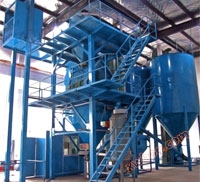
The single component vitrified microsphere inorganic insulation mortar equipment mainly consists of a rubber powder mixing system and an insulation mortar mixing system; The rubber powder mixing system consists of raw material storage tanks, conveying systems, weighing and measuring systems, mixing warehouses, mixers, finished product warehouses, packaging machines (auxiliary equipment for producing other mortars), dust removal systems, platforms, etc. The insulation mortar mixing system consists of a conveying system (including an air conveying device), an air material separation device, a weighing and measuring system, a pre mixing device, a mixer, a finished product warehouse, a packaging machine, a dust removal system, a platform, etc.

1. Raw material storage tank:
- In the production line of vitrified microsphere inorganic insulation mortar, it is used to store bulk raw materials such as cement, secondary fly ash or heavy calcium powder. Cement and bulk secondary fly ash are loaded onto bulk tankers, while heavy calcium powder is loaded onto bucket elevators.
- Small amounts of additives can be stored in small tanks for storing rubber powder, HPMC, PP fibers, wood fibers, etc. Small complete sets of equipment with low automation can choose manual feeding.
- The volume of raw material storage tanks is determined based on the production volume; Storage tanks are usually installed vertically to facilitate material transportation. To prevent material blockage, flow assistance systems are installed near the discharge ports.
- When bulk tank trucks load materials into storage tanks, they generate high pressure inside the tanks. To prevent damage to the tanks due to excessive pressure, pressure reducing devices and top dust removal devices are installed inside the tanks.
2. Conveyor system
There are many ways to transport materials. In the production of vitrified microsphere inorganic insulation mortar, we usually use spiral conveyors, bucket elevators, and pneumatic conveyors for feeding. The volume of raw material storage tanks is large and usually placed outdoors. To ensure that materials are not affected by external factors such as wind and rain during transportation, using a screw conveyor to transport materials is the safest and most reliable method.
The screw conveyor is composed of the body, end face bearings, intermediate bearings, electric motor, reducer, etc. Spiral conveyors have two methods: horizontal conveying and inclined conveying. To ensure the accuracy of weighing and measurement, inclined conveying is generally used, with the feed inlet of the spiral conveyor lower than the discharge outlet. The motor power of a screw conveyor is calculated based on the conveying capacity, inclination angle, and screw length, while the conveying capacity is calculated based on the inclination angle, material density, and rotational speed of the screw. So, the correct choice of screw conveyor is crucial for the stability of the entire system process. However, screw conveyors have drawbacks such as material storage and difficulty in cleaning. To reduce the adverse effects of these drawbacks, we have installed cleaning ports at appropriate locations on the screw conveyor.
The bucket elevator generally adopts a belt type bucket elevator, with models including D160, D250, D350, D450, and lifting heights ranging from 4 meters to 30 meters; The increase ranges from 3 cubic meters per hour to 70 cubic meters per hour; The maximum diameter for conveying granular materials can reach 55mm.
In the feeding stage of the two-step mixing process for vitrified microbeads, the use of air feeding significantly reduces the breakage rate of vitrified microbeads. The entire system can accurately and automatically measure different raw materials according to the formula, reducing labor intensity and environmental pollution, while also ensuring the quality of insulation mortar products.
3. Weighing, measuring and batching system:
It consists of a hopper measuring scale, a feeding screw conveyor, a discharging screw, a computer control system, and a small material (trace) feeding device. Weighing and measuring are carried out by several raw material conveying screws in a set order to the measuring scale. Each type of raw material is conveyed in sequence according to the set weight. After the weight of material A reaches the set weight, the weighing instrument directly controls the start and stop of material A screw, and then starts the conveying screw of material B. After the weight of material B reaches the set weight, material B screw is closed and material C screw is started. This process ensures the accuracy of measurement to a large extent. After the various raw materials for producing inorganic insulation mortar are weighed, all the raw materials are transported to the bucket elevator by the discharge screw of the measuring scale. At the same time, the bucket elevator is started to deliver the raw materials to the mixing bin located above the main machine. At this point, the raw material balancing work is completed.
4. Hybrid system:
Requirements for the mixing machine of vitrified microsphere inorganic insulation mortar:
A、 High mixing uniformity: It can meet the uniform mixing of various powders in rubber powder materials, especially HPMC and other trace additives with an addition amount of only about 2kg.
B、 Good dispersibility of fibers: It can break down fibers and evenly disperse them in rubber powder without clumping.
C、 In the mixing process of rubber powder and vitrified microbeads, the mixer has the smallest possible crushing effect to maintain the original packing density, cylinder compression strength, and volumetric water absorption rate of vitrified microbeads.
Traditional high mixing efficiency and uniformity double axis blade mixers, plow blade mixers, or low crushing double cone mixers and V-type mixers cannot simultaneously meet the above three conditions. Therefore, Sichuan Yongtong Mechanical Mortar Technology Group has specially adopted a two-part mixing process, using a gravity free mixer or plow blade mixer equipped with high-speed flying blades for the mixing of rubber powder materials. At the same time, a large volume horizontal drum mixer with extremely low crushing effect and continuous production has been developed for the mixing of rubber powder materials and inorganic vitrified microspheres in the second stage. The rubber powder mixed by the gravity free mixer is input into the mixing bin of the horizontal drum mixer, and pre mixed with the lightweight vitrified microbeads sent up by the air. Then, it is gradually discharged into the horizontal drum mixer for continuous mixing and discharge. By matching two sets of mixtures according to certain parameters, continuous production and maximum efficiency can be achieved.
5. Glass bead inorganic insulation mortar packaging machine:
The speed of valve pocket packaging for lightweight materials is too slow. It is recommended to use an open pocket packaging machine and sew the seams after bagging.
6. Bag type pulse dust removal system:
Used for recycling dust from dry powder mortar production lines, which is beneficial for environmental protection. The pipeline is generally located on the top of the cement silo, at the feeding port of the elevator, etc.
7. PLC control system
Various parameters can be set through the PLC automatic control system to improve the productivity of the entire vitrified microsphere inorganic insulation mortar equipment and reduce labor intensity.