-
Phone
18782066269
-
Address
Shibatan Industrial Zone, Xindu District
Product Categories
- Modified emulsified asphalt equipment
- Sewage treatment equipment
- Resin production line
- Ink and paint production line
- Mixing machine
- High speed disperser
- Sand grinder
- Storage tank
- Spiral conveyor
- Heat exchanger
- High shear emulsifier
- Blender selection parameters
- Other supporting equipment
- Other chemical pressure vessels
- dry mortar production line
- Dry powder mortar equipment
- Environmental dust collector
- Resin production equipment
- Paint equipment | Paint production equipment
- Steel lined PO anti-corrosion series
- PTFE lined anti-corrosion series
- Steel lined PE anti-corrosion series
- Chemical anti-corrosion steel lined plastic pipeline
- Anti corrosion of steel lined PP polypropylene storage tanks
- Sichuan Jinti Yongtong PTFE Anti corrosion Technology Co., Ltd
- Complete set of putty powder equipment
- Other complete sets of chemical equipment
- reaction kettle
Chengdu Xindu Yongtong Machinery Factory
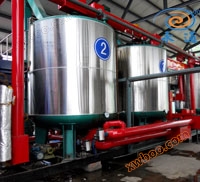
Asphalt swelling tank
NegotiableUpdate on 12/30
- Model
- Nature of the Manufacturer
- Producers
- Product Category
- Place of Origin
Overview
Asphalt swelling tank
Product Details
 Introduction to Asphalt Swelling Tank

In a modified emulsified asphalt production line, multiple asphalt swelling tanks are usually configured. After the swelling of one asphalt swelling tank is completed, the mixture is immediately pumped into a three-stage high shear emulsifier. At the same time, another asphalt swelling tank can be filled with matrix asphalt and SBS for swelling at this time. This repeated cycle of production can effectively improve production efficiency.
Working temperature of asphalt swelling tank:
The swelling degree of SBS varies in different qualities of asphalt, and the swelling degree of the same modifier in the same asphalt varies at different temperatures. As the temperature increases, the degree of swelling accelerates and increases; Under low temperature conditions, the degree of swelling of SBS is also low and the rate is slow. The composition of asphalt also determines its compatibility. When there is more aromatic content, the compatibility is better. The more asphalt there is, the poorer the compatibility. The decrease in penetration of asphalt leads to a decrease in compatibility, indicating that saturation plays a significant role in the modification effect of SBS modified asphalt. The melting point of SBS is around 180 ℃. The higher the temperature of the base asphalt, the easier SBS is to melt and can accelerate its dissolution rate. But the higher the temperature of asphalt, the more prone it is to aging. So, mastering the heating temperature of the asphalt swelling tank is also a key issue. There are significant differences in the penetration, softening point, and 5 ℃ ductility of SBS modified asphalt at different temperatures.
Generally speaking, as both petroleum asphalt and SBS modifier are typical high molecular weight substances, they exhibit very sensitive characteristics to temperature. In order to ensure that they do not reduce conventional indicators during the production process, the heating temperature of the asphalt swelling tank must be strictly controlled. Engineering practice has proven that the heating temperature for SSB asphalt modification should be controlled between 170-180 ℃.
Design of Mixing Structure for Asphalt Swelling Tank:
As a high viscosity liquid, asphalt is usually in a laminar flow state inside the mixing tank. High viscosity liquids are difficult to form significant flow in laminar flow, and their energy is quickly released after leaving the stirring blade. Therefore, the asphalt swelling tank requires a large area of stirring blades to push the fluid to achieve the purpose of mixing with SBS modifier.
The viscosity of matrix asphalt is relatively high, and it belongs to low-speed mixing of high viscosity liquids when mixed with SBS modifier. To increase the mixing range and fully promote fluid movement, the lower end of the asphalt swelling tank mixing blade should be a slurry type inclined blade, and the upper end should be a frame type conical blade. The rotation radius and end line velocity should be specifically designed based on the geometric shape and effective volume of the asphalt swelling tank. The appropriate end line velocity for the stirring blade of a 10T asphalt swelling mixing tank is 0.5-0.6 m/s.
In addition, to eliminate the swirling phenomenon of the liquid inside the asphalt swelling tank and enable the material inside the tank to flow up and down axially to form a uniform mixture, it is necessary to add baffles on the wall of the asphalt swelling tank. When no baffle is added, the liquid in the middle of the tank rushes towards the tank wall and rises under the action of centrifugal force, and the liquid level in the central part drops to form a vortex. The vortex center can descend to the contact position with the mixing blade, reducing the mixing efficiency, and the empty valley in the middle occupies a considerable volume. After installing baffles on the walls of the asphalt swelling tank, the hollow vortices are cleared and the mixing is smooth and uniform. The liquid forms turbulence under stirring, and the effect is very significant. In order to achieve better mixing effect, it is necessary to carry out such mixing design.


