-
E-mail
1575097019@qq.com
-
Phone
19032291360
-
Address
306, Building 1, Ideal Science and Technology Park, No. 603 Hongfeng Road, Donghu Street, Linping District, Hangzhou City
Product Categories
Hangzhou Chuanyi Experimental Instrument Co., Ltd


High temperature and high pressure microwave digestion with 8-position built-in pressure relief polytetrafluoroethylene digestion tank
NegotiableUpdate on 01/09
- Model
- Nature of the Manufacturer
- Producers
- Product Category
- Place of Origin
Overview
The high-throughput intelligent microwave digestion instrument, equipped with a pressure relief polytetrafluoroethylene digestion tank, is an instrument that uses microwave heating principle to achieve sample pretreatment under high temperature and high pressure conditions in a closed container. And it provides fast, safe, and automated solution instruments for samples, widely used in fields such as food, environmental protection, disease control, quality supervision, commodity inspection, and scientific research institutes.
Product Details
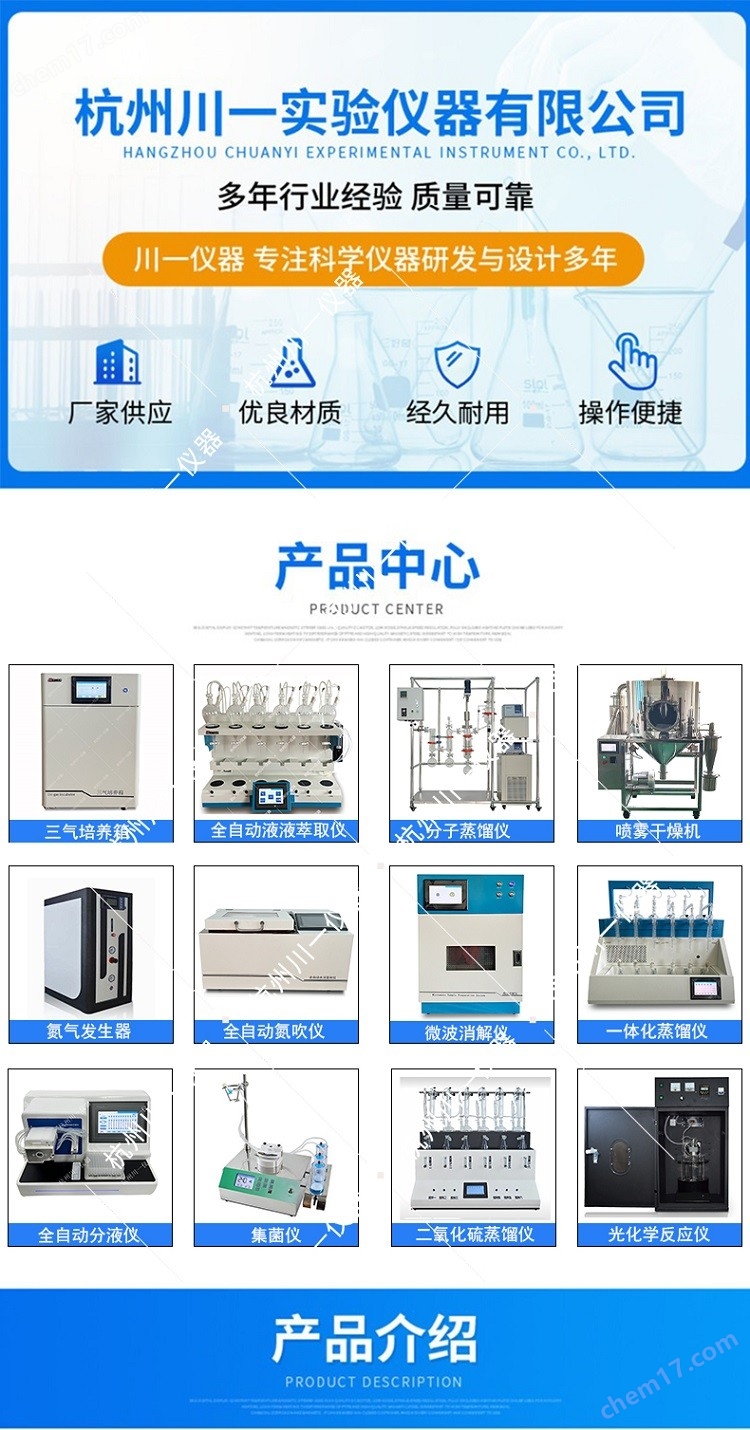
High temperature and high pressure microwave digestion with 8-position built-in pressure relief polytetrafluoroethylene digestion tankMain features
The CYWB series high-throughput intelligent microwave digestion instrument adopts microwave non pulse continuous automatic frequency conversion control, which extends the service life of the instrument and the uniformity of electromagnetic waves. The chamber adopts a large volume of 52L, specially made of stainless steel chamber material, and a self-locking buffer explosion-proof furnace door. When the reaction is abnormal, the buffer structure ensures the personal safety of the operator and the integrity of the furnace door structure. The furnace door and chamber are tightly combined, and microwave leakage meets national standards. The instrument adopts a temperature and pressure dual control system to control the pressure and temperature of the synthesis experiment, with real-time display, 360 ° continuous rotation, uniform microwave, ensuring the same microwave environment for each sample and improving the consistency of experimental results.
High temperature and high pressure microwave digestion with 8-position built-in pressure relief polytetrafluoroethylene digestion tankTechnical Specifications
Host parameters:
1.1 Power supply: 220-240 VAC 50/60Hz 15A; Microwave frequency: professional microwave source/2450MHz; Installation power of the whole machine: 2600W;
1.2 Microwave output power: 0~1600W, automatically continuously adjustable;
1.3 Microwave output characteristics: Microwave non pulse continuous automatic frequency conversion control, 0-100% automatic output;
1.4 Microwave cavity: 52L, all stainless steel cavity, corrosion-resistant, high temperature resistant (optional PTFE coating);
1.5 Self locking buffer explosion-proof furnace door. When the reaction is abnormal, the buffer structure ensures the personal safety of the operator and the integrity of the furnace door structure;
1.6 Exhaust and cooling system: The furnace chamber is equipped with a high-power exhaust system, and various reactions can be carried out continuously for a long time in a ventilated, safe, and easily observable environment; The furnace chamber ventilation adopts acid resistant and high air volume centrifugal fans, with an exhaust air volume of not less than 5m3/min; The furnace chamber has air cooling function, which continuously cools the reaction tank and displays temperature and pressure in real-time.
Control system parameters:
2.1 Control mode: touch screen design, 7-inch large screen display, remote direct reading of reaction process, real-time display of closed reaction tank temperature and pressure, and real-time display of temperature pressure curve;
2.2 Temperature control range: Room temperature -~300 ℃; Temperature control accuracy: ± 0.5 ℃;
2.3 Temperature control system: adopting non-contact temperature control method, precise temperature control, using high-precision platinum resistance temperature sensors; Real time detection, control, and display of temperature and curve inside the microwave digestion reaction tank;
2.4 Pressure control system: adopting non-contact pressure control method, precise pressure control, real-time detection, control and display of pressure inside the microwave digestion reaction tank;
2.5 Rotary table design: 360 ° continuous rotation in the same direction, uniform microwave, ensuring the same microwave environment for each sample and consistency of experimental results.
Reaction tank parameters:
The outer tank is importedPEEK aerospace material, inner tank material: polytetrafluoroethylene material; Inner tank reaction volume: 55ml (standard) and 100ml (optional).
model |
CYWB-4 |
CYWB-6 |
CYWB-8 |
CYWB-10 |
CYWB-12 |
CYWB-16 |
CYWB-20 |
Processing Quantity |
4 people |
6 people |
8 digits |
10 people |
12 digits |
16 bits |
20 people |
Number of internal infusions |
4 of them |
6 of them |
8 of them |
10 of them |
12 of them |
16 of them |
20 of them |
Number of outer tanks |
4 of them |
6 of them |
8 of them |
10 of them |
12 of them |
16 of them |
20 of them |
volume |
55ml |
55ml |
55ml |
55ml |
55ml |
55ml |
55ml |
working method |
360-degree rotation |
360-degree rotation |
360-degree rotation |
360-degree rotation |
360-degree rotation |
360-degree rotation |
360-degree rotation |
Outer tank material |
PEEK |
PEEK |
PEEK |
PEEK |
PEEK |
PEEK |
PEEK |
Internal infusion material |
Polytetrafluoroethylene |
Polytetrafluoroethylene |
Polytetrafluoroethylene |
Polytetrafluoroethylene |
Polytetrafluoroethylene |
Polytetrafluoroethylene |
Polytetrafluoroethylene |
Application in environmental monitoring
The environmental samples involved in microwave digestion include soil, solid waste, coal, coal fly ash, marine sediments, silt, wastewater, etc. Many environmental samples are products of complex processes and sedimentation, with complex matrix components including heavy metals and pesticide residues. Due to the diversity of environmental samples and the complexity of matrices, a large amount of literature research is needed to determine the properties of the samples and the required digestion reagents based on the different tested components and testing methods. Environmental samples usually contain some organic compounds that are difficult to digest with acid under normal pressure, while sealed microwave digestion can effectively solve this problem. In addition, some volatile elements will not be lost.
Microwave digestion has been widely used in the analysis of metal elements in environmental samples. The method of determining elements in solid waste using microwave digestion (USEPA3051) has been tested for precision and accuracy through extensive experiments, verifying the reliability of microwave digestion.
Chemical Oxygen Demand (COD) is one of the main indicators for water quality monitoring. The classic method is potassium dichromate reflux method, but it consumes more samples and reagents and has a long reflux time (greater than 2 hours). Microwave digestion technology is time-saving and fast.
The research on non-metallic elements mainly focuses on sulfur, nitrogen, and phosphorus. By using microwave heating pressure digestion, more than 10 samples can be digested simultaneously, which greatly improves the analysis speed compared to conventional analysis methods.
Microwave digestion is a highly efficient sample processing method that can meet the requirements of modern instrument analysis for sample processing, especially in the analysis and detection of volatile elements.
What are the main microwave characteristics of microwave digestion equipment
The microwave digestion instrument adopts microwave non pulse continuous automatic frequency conversion control, which extends the service life of the instrument and the uniformity of electromagnetic waves. The chamber is specially made of 52L large volume 316L stainless steel chamber material, with a self-locking buffer explosion-proof furnace door. When the reaction is abnormal, the buffer structure ensures the personal safety of the operator and the integrity of the furnace door structure. The furnace door and chamber are tightly combined, and microwave leakage meets national standards. The instrument adopts a temperature and pressure dual control system to control the pressure and temperature of the digestion experiment, and displays them in real time. 360 ° round-trip continuous rotation, uniform microwave, ensuring the same microwave environment for each sample and improving the accuracy of experimental results. When the pressure inside the tank exceeds the set protection value, the microwave will automatically stop heating. The safety explosion-proof membrane has a dual safety function. When the pressure inside the tank exceeds the pressure that the explosion-proof membrane can withstand, the explosion-proof membrane will rupture first, and gas will leak out, preventing damage to the tank body and harm to the human body.
Microwave characteristics of microwave digestion instrument:
(1) Metal materials do not absorb microwaves and can only reflect them. Such as copper, iron, aluminum, etc. Using metal (stainless steel plate) as the furnace of a microwave oven, the back and forth reflection acts on the heating material. Metal containers cannot be placed in microwave ovens, as reflected microwaves can damage the magnetron.
(2) Insulators can transmit microwaves and absorb almost no microwave energy. Glass, ceramics, plastics (polyethylene, polystyrene), polytetrafluoroethylene, quartz, paper, etc. are transparent to microwaves, and microwaves can penetrate them and propagate forward. These substances either do not absorb microwave energy or absorb very little microwave energy. The strength of microwave absorption by a substance is essentially related to its complex dielectric constant, that is, the larger the loss factor, the stronger the ability to absorb microwaves. Most household microwave oven containers are made of plastic products. The materials used for microwave sealed digestion and sample dissolution tanks are polytetrafluoroethylene, engineering plastics, etc.
(3) Substances with polar molecules can absorb microwaves (substances with high loss factors), such as water, acid, etc. Their molecules have a permanent nine dipole moment (i.e. the centers of the positive and negative charges of the molecules do not coincide). Polarized molecules rapidly change orientation and rotate back and forth in a microwave field with the frequency of the microwave, causing collisions and friction between molecules, absorbing the energy of the microwave and raising the temperature. The food we eat contains water, which is a highly polar molecule that can be heated in a microwave oven.


Similar Product Recommend