-
E-mail
1575097019@qq.com
-
Phone
19032291360
-
Address
306, Building 1, Ideal Science and Technology Park, No. 603 Hongfeng Road, Donghu Street, Linping District, Hangzhou City
Product Categories
Hangzhou Chuanyi Experimental Instrument Co., Ltd
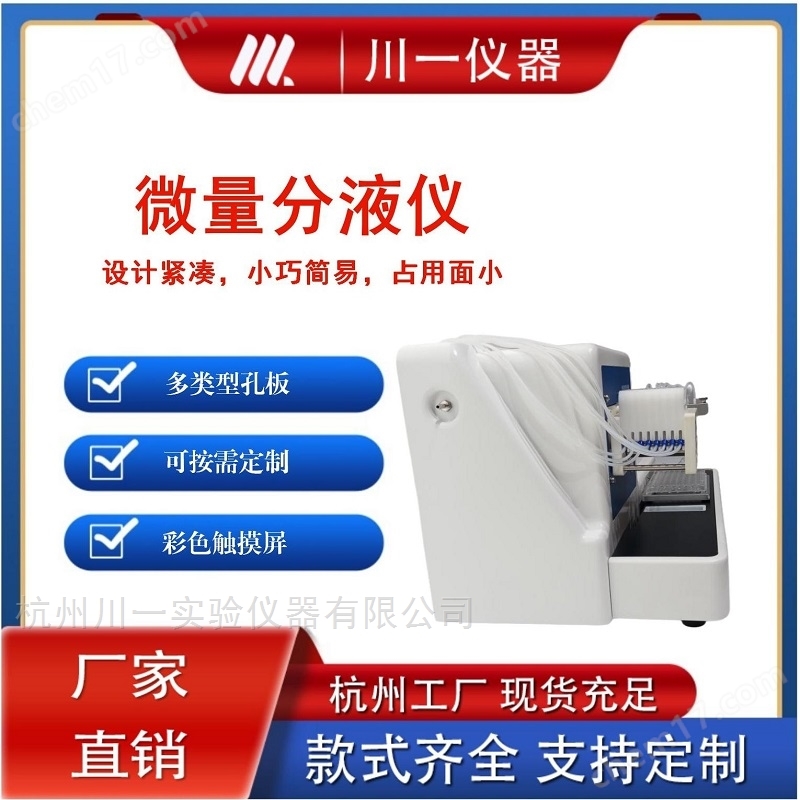


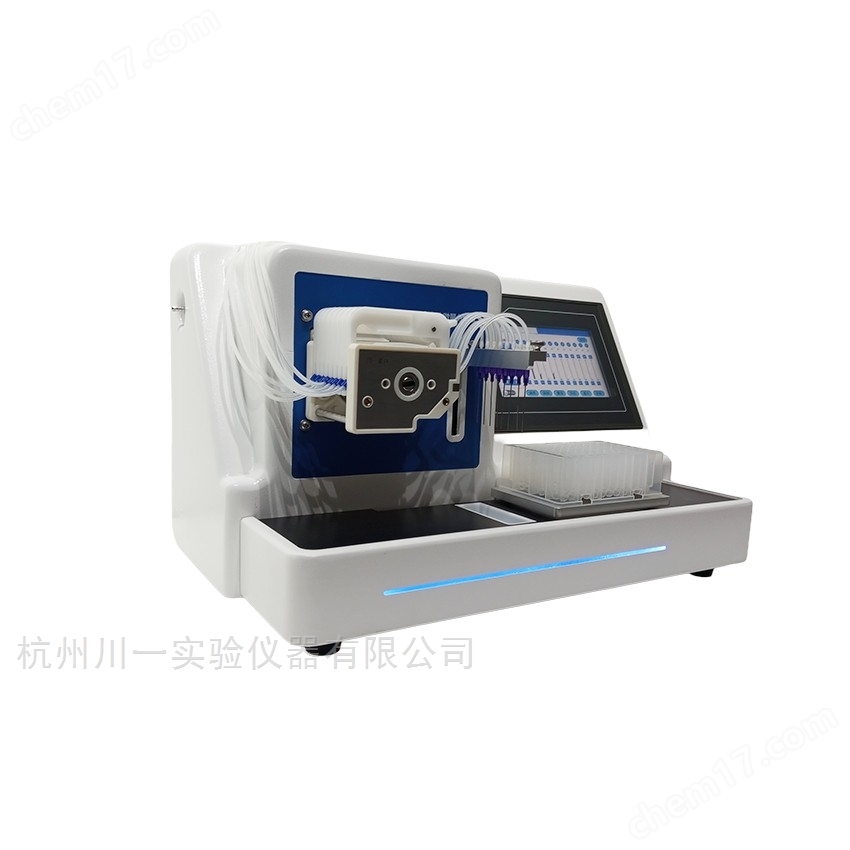
Fully automatic micro liquid analyzer CYFY-8 liquid separation device peristaltic pump feeding
NegotiableUpdate on 01/09
- Model
- Nature of the Manufacturer
- Producers
- Product Category
- Place of Origin
Overview
The CYFY-8 fully automatic micro liquid analyzer, equipped with a peristaltic pump and a robotic arm, is a liquid separation device that can quickly, accurately, and consistently complete automated liquid separation operations. It can be widely applied in fields such as disease control screening, food testing, animal quarantine, and life science research. Liberate the hands of experimenters to improve efficiency while avoiding errors
Product Details

Fully automatic micro liquid analyzer CYFY-8 liquid separation device peristaltic pump feeding Main features:
1. The equipment adopts a precision peristaltic pump for non-contact liquid separation, and the whole machine is exquisite and compact, which can be placed in a super clean table for use.
2. Adopting a 7-inch color LCD touch screen, the operation is simple, and the liquid separation methods include quantitative separation and non quantitative separation. You can choose to add liquid to the whole board or any column.
3. The separation accuracy is high, with an error of less than 1.5% for a 96 well plate of 100 μ L. The minimum separation volume is as low as 5 µ L, and the addition time for a 96 well plate of 100 µ L is 12 seconds.
4. The separation strength can be adjusted in two levels, high and low, suitable for different experimental needs.
5. The movable waste liquid tank facilitates the discharge of waste liquid, and the bottom of the waste liquid tank can be connected to a pipeline to automatically recover waste liquid into the waste liquid bottle.
6. After separation, it can perform functions such as oscillation, pullback, and rinsing.
7. Applicable plate types: 96 well plate, 48 well plate, 384 plate, eight tube PCR tube, 96 PCR plate, enzyme-linked immunosorbent assay plate, various test tubes, centrifuge tubes, EP tubes (compatible with corresponding adapter racks)
Full automatic micro liquid analyzer CYFY-8 liquid separation device peristaltic pump feeding technical parameters:
1Model: CYFY-8
2Applicable version: 96 hole plate (standard)
3Separation method: Whole board or any column, column separation volume can be set
4Liquid separation speed: adjustable in two levels of "high low"
5Liquid separation volume: 1-2000 µ l (can be customized according to customer requirements)
6Liquid distribution pipeline: 8 channels
7Display mode: 7-inch LCD touch screen
8Liquid separation accuracy: 100 µ l ≤ 1.5% (96 well plate)
9Cleaning function: automatic lubrication and suction function
10Auxiliary functions: oscillation, return function
11Compatible container: customizable according to needs
12Working temperature: -20 ℃ -40 ℃
13Relative humidity:<80%
14Liquid requirements:Can be packaged in barrels or bottles
15Suitable container:On-demand customization
Working principle and precautions of the liquid analyzer
The working principle of a liquid separator is simple, as it utilizes the incompatibility and gravity of liquids. The liquid in the separator will be divided into two phases that are separated from each other due to their different densities and strong incompatibility. As a result, they will naturally stratify, with the organic phase on top and the aqueous phase on the bottom. When it is necessary to separate two phases, the liquid is usually injected into the separator through a funnel, and then after the two phases separate, the bottom valve is opened to release the bottom water phase from the container. After the water phase is completely drained, close the valve and use a dry filter paper (or calcium chloride)
Precautions
(1) Maintenance and upkeep
Please regularly check the wear condition of the pump tube, and replace it promptly if any abnormalities or damages are found. Before long-term storage, the equipment needs to be cleaned and the pump tube removed. During storage, attention should be paid to moisture prevention.
1. Regularly check whether the connections of each component of the machine are tightened to ensure that the machine will not be damaged due to looseness during operation.
2. Regularly clean the residue inside the machine, keep it clean, and prevent corrosion.
3. Maintain appropriate temperature and humidity in the laboratory, avoiding environments that are too cold, too hot, or too humid, which may affect the stable operation of the instruments.
4. Regularly calibrate instruments to ensure the accuracy of measurement results.
5. Keep the instrument dry, especially during operation, pay attention to timely closing the system valves to prevent liquid leakage.
6. Regularly update software programs to ensure excellent performance and operation of the instrument.
7. Do not disassemble or modify the instrument at will. If maintenance is required, please contact professional personnel for operation.
During use, if any abnormalities are found, the operation should be stopped immediately and relevant personnel should be contacted.
(2) Liquid volume calibration
The calibration of the equipment needs to be carried out in conjunction with an analytical balance. The actual liquid output is converted into volume by weighing and compared with the set value of the equipment for verification. The liquid output is adjusted by adjusting the ratchet buckle on the peristaltic pump head. Pulling the ratchet buckle upwards reduces the fluid output, while pulling it downwards increases the fluid output. The separation accuracy can reach within 1.5% of 100 μ l error on a 96 well plate, with a minimum separation volume as low as 5 µ L. The addition time for 100 µ L on a 96 well plate is 10 seconds.
What is the difference between a channel analyzer and a pipette?
The 8-channel liquid analyzer and pipette each play important roles in the laboratory, and there are significant differences in their operating methods, accuracy, liquid handling capabilities, and applicable scenarios.
1. Firstly, in terms of operation mode, the 8-channel liquid analyzer adopts automated operation, which can efficiently and accurately complete the separation task of multi-channel samples, significantly improving work efficiency. However, a pipette is a manual tool that, although having certain advantages in flexibility, can be time-consuming and cumbersome when handling large amounts of samples.
2. In terms of accuracy, both can meet the high-precision requirements required by the laboratory. However, the pipette requires regular calibration during use to ensure accuracy, while the 8-channel pipette automatically completes calibration through a precision control system, reducing human error.
3. In terms of liquid processing, the 8-channel liquid analyzer, with its multi-channel design, can process multiple samples at once, which not only improves work efficiency but also reduces the risk of cross contamination. In contrast, pipettes require operators to process samples one by one. Although they are flexible for handling small or specific samples, there may be contamination and waste issues when handling large amounts of samples.
4. In terms of applicable scenarios, the 8-channel liquid analyzer is more suitable for laboratory environments that require fast and accurate processing of large amounts of samples, such as biochemical analysis, clinical medical testing, drug development, and other fields. However, the pipette is more suitable for experiments that require precise control of liquid volume, such as cell manipulation and gene editing, due to its flexibility and precision.
In summary, both the 8-channel liquid analyzer and the pipette have their own advantages, and the choice of which tool to use depends on the specific needs and workflow of the laboratory. In practical applications, the reasonable combination of these two tools will help improve experimental efficiency and ensure the accuracy and reliability of experimental results.


Similar Product Recommend