-
E-mail
1019062891@qq.com
-
Phone
18021603489
-
Address
Room 108, Building 3, Hexin Zhihui Technology Park, 118 Anyang Road, Huqiu District, Suzhou City
Product Categories
Weisite Technology (Suzhou) Co., Ltd


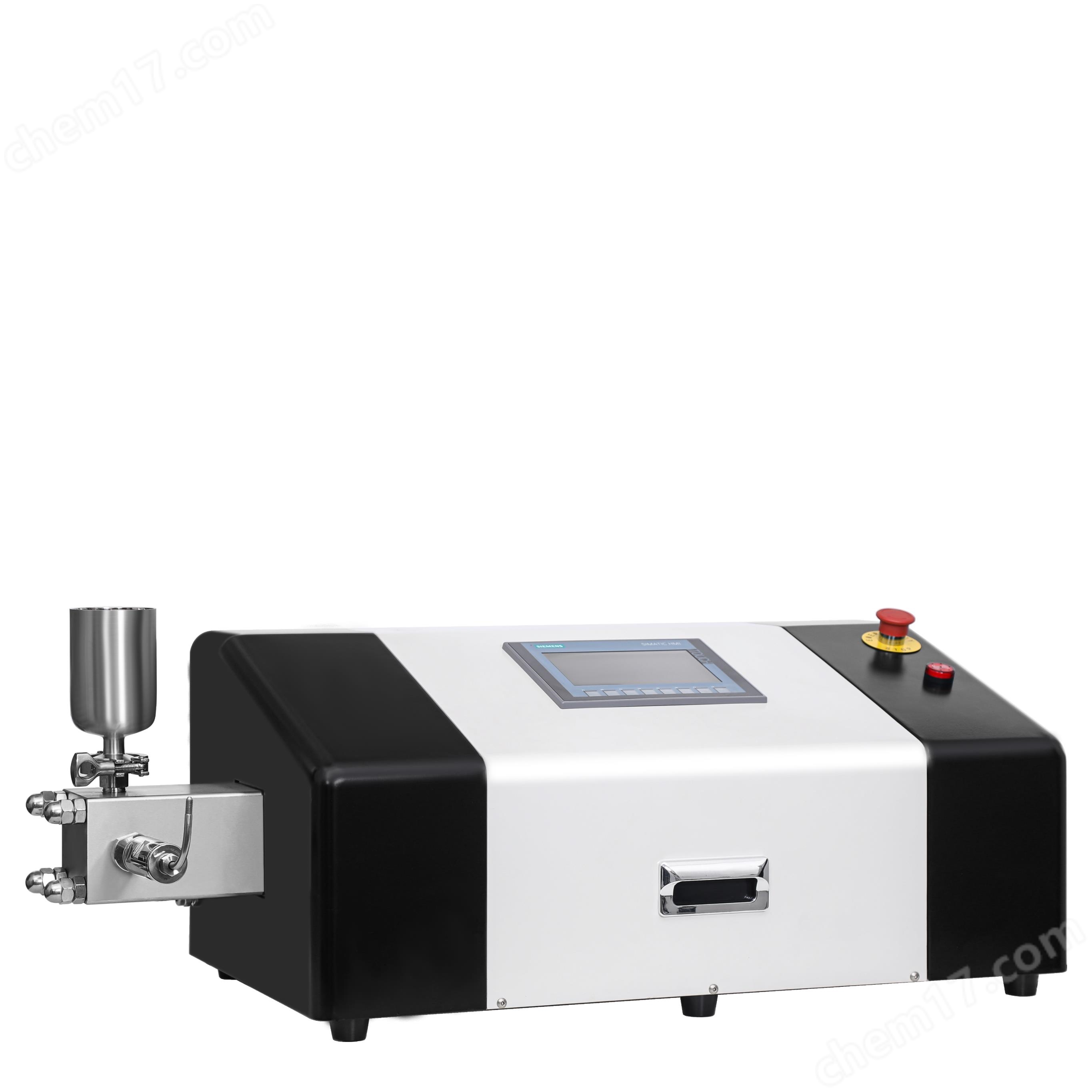
Experimental micro jet homogenizer
NegotiableUpdate on 01/31
- Model
- Nature of the Manufacturer
- Producers
- Product Category
- Place of Origin
Overview
The experimental micro jet homogenizer WST-MINI is a small high-pressure micro jet homogenizer designed for laboratories, with an operating pressure of up to 2000 bar. Due to considerations of laboratory operation safety and convenience, the WST-MINI size design is exquisite, requiring only one table to conduct experiments. The equipment adopts a servo direct drive electric cylinder system, with PLC and touch screen as the control system, which runs stably, noiselessly, and is more convenient to operate. The $r $n device can also be equipped with corresponding solutions such as oil cylinder drive and real-time cooling system.
Product Details
1、 Introduction to Micro Jet Technology
Microfluidic technology utilizesMicrochannels and structuresTo achieve specific and complex fluid operationsInterdisciplinary technologyThe micro jet homogenizer utilizes mature and stable hydraulic technology to pressurize liquid materials under the action of a plunger pump. With accurate pressure regulation, the material pressure is increased to the set pressure value; The pressurized material flows towards a fixed geometric shapeDiamond NanoprocessorAnd generate high-speed microjets. Materials with high-speed jets generate physical forces such as shear, collision, and cavitation effects in the microchannels of the nanoprocessor, thereby reducing particle size, achieving uniformity, emulsification, and encapsulating active ingredients.
2、 Working principle of microjet homogenizer
Microfluidic injection is the process of injecting high-pressure suspension materials into channels with pore sizes ranging from tens to hundreds of micrometers through hydraulic means, creating a huge pressure gradient before and after the valve inlet, causing the suspension of the material to be subjected to high velocityShear actionreach, achieve, attainFirst crushingPurpose; After passing through the valve hole, the material liquid forms a high-speed jet with subsonic or supersonic velocity at the outlet of the valve holeVelocity difference and turbulence effectThe formation of materialsBroken againWhen high-speed jets interact with diamond target plates or jets in the opposite directionHigh speed collision, then the target impact crushing is formed to enhance the crushing effect and complete the suspension of particles in the material liquidUltrafine pulverization.
IIICore component - diamond interactive cavity
The specially designed micro pores inside the diamond interactive cavity can form 300Mpa under the action of the boosterofHigh pressure. The application of diamond has increased its service life, YType andZThe design of different channels meets various homogeneous application requirements.
Advantages of diamond mutual cavity:
Diamond has a built-in layer, which is more wear-resistant and suitable for processing samples with harder particles;
※ It can be customized according to different applications of customers;
Using turbulence and collision between samples to achieve sample processing reduces the risk of sample contamination!
The pressure resistance can reach 30000 psi, which can achieve greater shear force, cavitation and turbulence effects!
4Experimental micro jet homogenizerEquipment parameters
equipment |
Experimental micro jet homogenizer |
model |
WST-MINI |
Operating pressure |
0-2000bar |
processing capacity |
3-6L/h |
voltage |
220V,2.17KW |
power system |
Servo direct drive electric cylinder system |
control system |
Siemens from Germany and Emerson servo control system from the United States |
5Device Application
1. Complex injection formulations: nanoemulsions, liposomes, nanoparticles, nanocrystals, microspheres, etc;
2. Biotechnology: Cell lysis extraction, vaccine adjuvant;
3. Liposome cosmetics;
4. Fine chemicals: conductive polymers, inkjet printing, etc;
5. New energy materials: hydrogen fuel cell membrane electrode dispersion, carbon nanotube dispersion, graphene stripping, etc;
6. Food and beverage: food macromolecule modification, nanocellulose, liposome nutritional supplements, etc.