- Phone
-
Address
Room 426-2, 4th Floor, Building A, Shuangzha Community Center, No. 19 Yecheng Road, Jianye District, Nanjing City
Product Categories
Nanjing Huiyanda Electric Co., Ltd


CHCONTECH sensor CH-LF1-50KN in stock in the United States
NegotiableUpdate on 05/15
- Model
- Nature of the Manufacturer
- Producers
- Product Category
- Place of Origin
Overview
CHCONTECH sensor in stock in the United States CH-LF1-50KN$r$nCWM30801 20,30,40,60T$r$nCWD30802 20,30,40,50T$r$nCWM80201 20,30,40,50T
Product Details
CHCONTECH sensors from the United States are a professional manufacturer of high-precision weighing and force sensors. The main products are sensors made of stainless steel material, which are corrosion-resistant, have high hardness, and good stability. The product categories include spoke sensors, S-type sensors, cantilever beam sensors, parallel beam sensors, weighing instruments, weighing modules, etc. The products are used in automation control industries such as testing machines, mixing plants, packaging machines, belt scales, etc.
CHCONTECH sensor CH-LF1-50KN in stock in the United States
CHCONTECH sensor CH-LF1-50KN in stock in the United States

The weighing sensor:
CW90101 20, 30, 40, 60100200T (* replaces the C16A series of German HBM)
CWM90101 20,30,40,60T
CW90102 20, 30, 50100200300T (* can replace the GD series from Toledo, Switzerland)
CW90102B 20,30,50,100,200,300T
CW90103 0.5-2, 20, 30, 50, 100, 200, 300T (* can replace the PR6201 series of German Sartorius)
CW90103B 0.5-2,20,30,50,100,200,300T
CW80201 20,30,40,50T
CWM80201 20,30,40,50T
CW80207 3,5,7.5,10,15,20,30,50,60T
CW70304 0.22, 0.55, 1.1, 1.76, 2, 2.2, 4.4, 10T (* replaces the HLC series of German HBM)
CWM70304 0.22,0.55,1.1,1.76,2,2.2,4.4,10T
CW703031 5, 10, 20, 50, 100, 200, 500, 1000 KG (* replaces the Z6F series of German HBM)
CWM703031 5,10,20,50,100,200,500KG
CW703032 10, 20, 50, 100, 200, 500 KG (* replaces TEDEA's 355 series in the United States)
CWM703032 10,20,50,100,200,500KG
CF604011 0.1,0.2,0.3,0.5,0.75,1,2,3,5T
CF604013 0.1, 0.2, 0.3, 0.5, 0.75, 1, 2, 3, 10T (* replaces the BSS series of American Transsion)
CF60405 20,30,50,75,100,150,200,250,300,500,700KG,1,1.5,2,3,5,7.5,10T
CF604016 0.05,0.1,0.2,0.5,1,2,3,5T
CR40601 1,2.2,4.7,10,15,22,33,47,68,100,150,220,330,470T (* RTN series replacing German HBM
CRM40601 1,2.2,4.7,10,15,22,33T
CF6040602 0.05, 0.1, 0.2, 0.5, 1, 2T (* replaces the C2 series of German HBM)
CFM6040602 0.05,0.1,0.2,0.5,1,2T
CF6040632 1, 2, 5, 10, 20, 50100200T (* replaces the C2 series of HBM in Germany)
CFM6040632 1,2,5,10,20,50,100,200T
CF6040633 0.05,0.1,0.2,0.5,1,2,5,10,20T
CF60406081 0.3, 0.5, 1, 1.2, 5, 10, 25, 50100T (* replaces the 1200 series of American interfaces)
CWD30801 20, 30, 40, 60T (can replace the C16IC3 series of German HBM)
CWM30801 20,30,40,60T
CWD30802 20,30,40,50T
CWM80201 20,30,40,50T
Product Name:CH-1B spoke type force sensor
Product Features:The CH-1B spoke type force sensor is made of high-quality stainless steel material, which has the characteristics of high precision, high stability, low profile, easy and fast installation, etc. Suitable for testing machines.
Range:500kg,1t,2t,5t,10t
Overall dimensions:
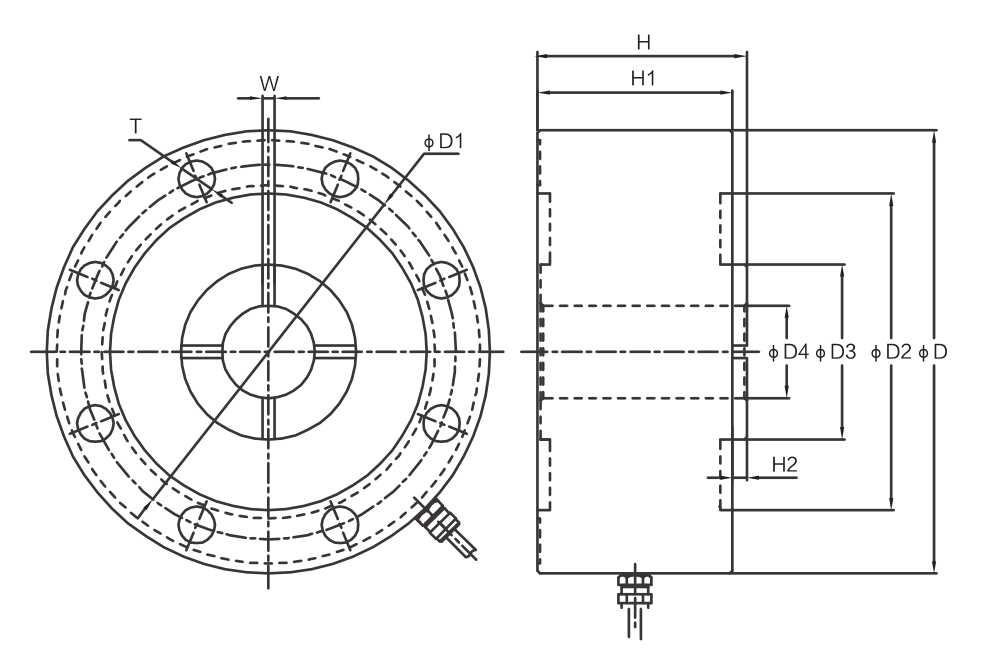
Range (kN) |
|
D |
D1 |
D2 |
D3 |
D4 |
H |
H1 |
H2 |
W |
T |
5-100 |
mm |
118 |
100 |
82 |
36 |
24 |
50 |
43 |
6.5 |
4x5.1 |
8X φ 9 |
Technical Specifications:
Technical Specifications |
|
|
|
rated output |
2.0mV/V±0.002 |
input impedance |
385±10Ω |
nonlinear |
±0.05%F.S |
output impedance |
351±3Ω |
hysteresis |
<±0.05%F.S |
insulation resistance |
≥5000MΩ |
repetitiveness |
<±0.05%F.S |
Allow excitation voltage |
5~15V/DC |
creep |
<±0.05%F.S/30min |
Compensation temperature range |
-10℃~+40℃ |
Zero temperature influence |
<±0.03%/10℃ |
Working temperature range |
-30℃~+70℃ |
Output temperature impact |
<±0.03%/10℃ |
Safe overload |
150%F.S |
Zero balance |
<±1%F.S |
Ultimate Overload |
300%F.S |
wiring method |
Motivation:+Red Black Signal:+Green White Shielding: Yellow Thick |
||
Since the 21st century, China's port construction has maintained rapid and stable development, effectively promoting the rapid improvement of China's port machinery technology level. At present, the loading and unloading equipment of major large-scale commercial ports along the coast of China has generally reached the world level. The design, manufacturing, and application of loading and unloading equipment such as 40 foot shore container cranes, 3500t/h bridge grab unloaders, 3800t/h chain bucket continuous unloaders, and 8000t/h coal loaders have enabled the design and manufacturing technology of large-scale port machinery in China to reach the world level, and some specialized technologies to reach the world level. Chinese made port machinery is steadily entering the world and occupying an important position in the global port machinery market.
With the development of China's economy shifting from extensive growth to intensive growth, the development model of port machinery is also undergoing changes. Port loading and unloading equipment is transitioning from large-scale, high-speed, and automated to specialized, intelligent, energy-saving, and environmentally friendly directions, driving new technological advancements.
1、 Current Status of Port Equipment Development
(1) The level of specialized equipment for port lifting has been further improved
The main form of our country's ten thousand ton docks is now specialized docks, which are highly efficient and can be automated managed. There are nearly a thousand specialized berths and nearly 700 general berths (including bulk cargo berths and general cargo berths) in China's 10000 ton level ports. The trend of using large tonnage cargo ships in Chinese ports continues, which can reduce the cost of cargo transportation. In order to accommodate the loading and unloading of large tonnage cargo ships, the tonnage of port supporting loading and unloading equipment is constantly increasing. For example, the rated tonnage of shore container cranes has been nearly doubled, and now a port shore container crane with a rated lifting capacity of 120 tons has been developed in China. Many research institutes in our country have invested in the development of large tonnage port cranes, so the improvement of the level of port lifting equipment in our country is just around the corner.
(2) The product quality needs to be improved
Domestic port machinery has experienced multiple failures such as structural cracking, hydraulic system oil leakage, damage to supporting components, and insufficient braking force during use. The problem of excessive self weight is also common in domestic port machinery. Especially for general-purpose mobile machinery, the failure rate is often high and the durability is insufficient.
(3) Uneven technological development
The current situation of domestic port machinery is characterized by a small number of large-scale machinery with advanced capabilities, such as shore container cranes, large bridge grab ship unloaders, and continuous bulk cargo unloaders, coexisting with the majority of conventional general machinery in terms of quantity, most of which have low technical levels.
(4) Application of railway and waterway combined transportation of port containers
The development of railway and waterway combined transportation of containers in China has been relatively slow. Currently, environmental pollution in our country is relatively severe. Compared to the combined transportation of railways and waterways, road transportation has a more severe impact on air pollution. The combined transportation of railways and waterways can effectively reduce environmental pollution, which is also the main form of transportation in China's future. With the development of inland waterways and ports in China, railway and waterway combined transportation will become the main form of transportation.
(5) The systematic development and research of technology need to be strengthened
There are many domestically produced port machinery with independent and automatic operation, but there are still few that can combine the automatic operation of a single machine with the entire terminal system, or even the entire port and shipping system.
2、 Development prospects of port machinery and equipment
(1) Port machinery is developing towards energy conservation and environmental protection
China's Energy Conservation Law clearly proposes to restrict the development of high energy consuming and high polluting industries and promote the development of energy-saving and environmentally friendly industries. It will inevitably promote the adjustment of industrial structure and energy consumption structure in ports, encourage enterprises to reduce energy consumption per unit of output value and per unit of product, eliminate outdated production capacity, improve energy development, processing, conversion, transportation, storage and supply, and enhance energy utilization efficiency. The development and utilization of new energy will undoubtedly receive strong promotion from the government. At present, port equipment is undergoing renovation. For example, the use of electrically driven tire type container gantry cranes can reduce pollution emissions, improve working environments, and lower operating costs, with significant economic and social benefits. Most of the mobile machinery equipment in ports is driven by fuel, and the fuel consumption of towing vehicles in ports generally accounts for about one-third of the total fuel consumption of loading and unloading equipment, which is the main factor in fuel consumption and emissions in port areas. The use of mobile machinery can effectively save energy and reduce emissions. During the docking period of ships, fuel powered auxiliary engines are used to generate electricity to meet the ship's electricity needs. The emissions from their engines are the main source of emissions in the port area. The use of shore power technology by docked ships can effectively save energy and reduce emissions.
(2) Variety expansion and localization
Although there are already many types of domestically produced port machinery, there are a few models such as container tractors, container tractor trains, and large lifting mobile cranes, which are basically dominated by foreign products; There is another type of mobile machinery such as container front-end cranes, cleaning and pushing rakes, sliding steering loaders, etc. Although there are also series of products in China, they are not competitive with foreign products in terms of variety and quality, and still need to be developed vigorously domestically. After the reform and opening up, China has introduced some high-performance bulk cargo loading and unloading machinery, such as dump trucks, double belt unloaders, spiral unloaders, corrugated edge tape (loading) unloaders, and large bucket wheel stacker reclaimers. In the future, it will gradually enter the period of upgrading the main components and complete machines, and the localization work will be very difficult.
(3) Large scale and high efficiency
Improving loading and unloading speed has always been the goal pursued by ports. For bulk cargo handling machinery and mobile machinery, it is generally possible to achieve this by increasing operating speed and expanding machinery scale, while for shore container cranes, it is limited. The shore container crane models for operating super Panamax container ships have a large scale, and the increase in operating speed is largely offset by the increase in displacement of the mechanism, resulting in limited improvement in loading and unloading efficiency. Therefore, various new models have been proposed abroad to improve container loading and unloading speed, such as double lifting with mobile baskets, foundation elevated type, bridge lifting type, and additional lifting type. Chinese scholars have also proposed a new idea of double trolley shore container cranes. China's container transportation is developing rapidly, and soon there will be a demand for new and efficient shore container cranes.
(4) Standardization of rail mounted container gantry cranes
Rail mounted container gantry crane (RMG) is a technologically mature model with good operational stability, low maintenance costs, and high operational reliability; Adopting electric drive, environmentally friendly and energy-saving; Single action, easy to achieve automation of container loading and unloading. However, compared to tire type container gantry cranes (RTG), the standardization level of RMG is relatively low. Most container terminals determine parameters based on their respective situations, resulting in a variety of RMG parameters, such as track gauge parameters ranging from 25m to 60m, which is not conducive to the comprehensive promotion and use of RMG. The standardization of rail mounted container gantry cranes requires breaking through traditional concepts and gradually forming standardized RMG yard loading and unloading processes, especially establishing relatively uniform track gauge parameters. Its standardized application is conducive to improving the utilization rate of yards and equipment and the efficiency of dock operations, reducing manufacturing, usage, and maintenance costs, and promoting the development of energy conservation and emission reduction work in ports. Optimization research can be conducted from three aspects: loading and unloading technology, loading and unloading efficiency, and energy consumption. Optimization parameters such as track gauge, overhang gauge, lifting height, and operating speed can be obtained. It is recommended to use a 32m (8-row container+2 lanes or 9-row container+1 lane) or 35m (9-row container+2 lanes or 10 row container+1 lane) gauge.
(5) Improvement in the production process of the product
Based on the product design drawings, optimize and analyze the cutting of the product to maximize the utilization of main materials; Secondly, improve quality management in the procurement of outsourced parts, component suppliers, and electrical accessories. While ensuring the quality of procurement, more consideration should be given to the production period of products to shorten the supply cycle of purchased parts, reduce the production period of products, and lower the production cost of products; Afterwards, based on the product production plan, develop a detailed schedule and establish cost standards. Based on the decomposed product target cost as the standard, the target cost is further decomposed according to the actual processing technology of each product, and the fixed cost of materials, fuel and power, tooling, quality, labor, and depreciation for each process is formulated. The fixed cost is used as the basis for cost control. And compare the actual cost incurred with the fixed cost, control the production process of the product, eliminate non value added links in the production process, and reduce the production cost of the product.
(6) Establish an internal settlement system
The cost of product manufacturing itself is a quantifiable financial indicator in monetary terms. Since every link in the product manufacturing process incurs costs, corresponding cost assessment categories and methods must be established. By establishing an internal product cost settlement system within the enterprise, the cost settlement of main products in each link can be completed regularly to obtain comprehensive cost information of the products. *The establishment of an internal settlement system for enterprises, especially for large production and manufacturing enterprises of Hong Kong machinery, is the essential foundation for their cost management work. The formulation of reasonable settlement prices within an enterprise requires a significant amount of basic cost management work as a prerequisite. Enterprises must obtain sufficient basic cost information to establish a cost management system.
Similar Product Recommend


