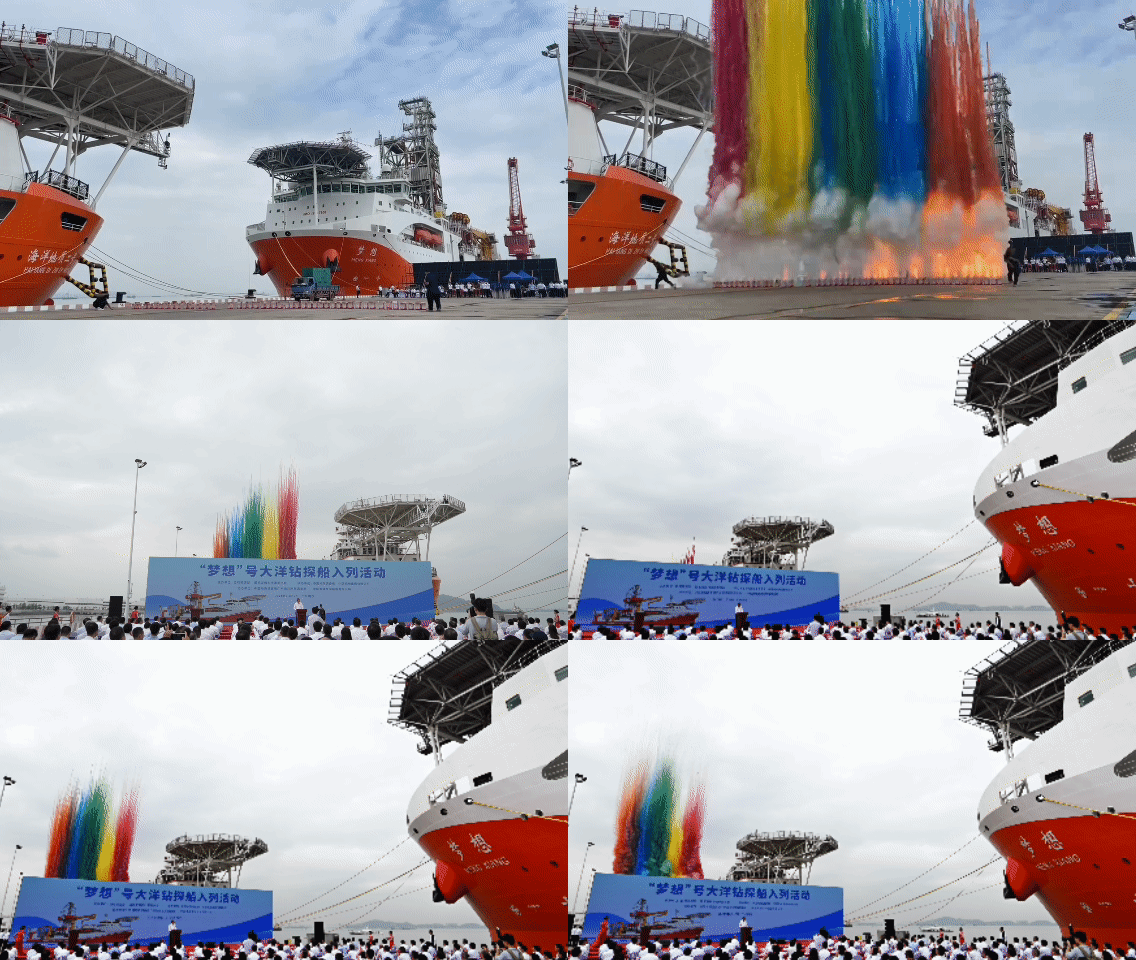
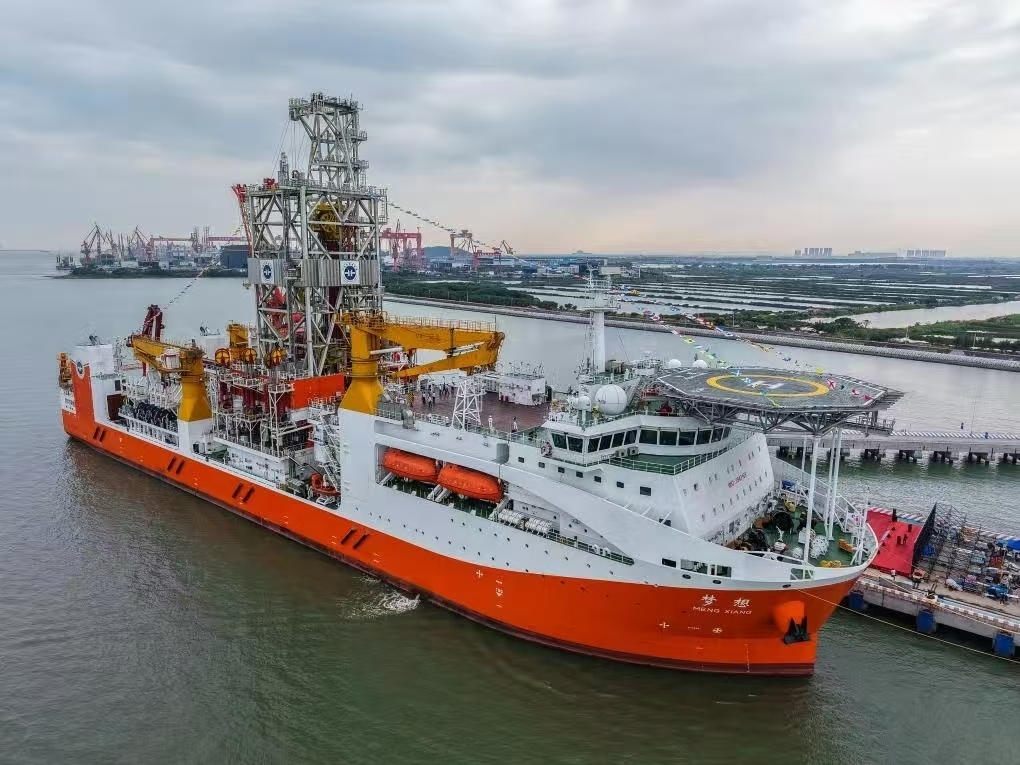
On November 17th, the first ocean drilling vessel "Dream" with a maximum drilling depth of 11000 meters, independently designed and built by China, was officially commissioned in Guangzhou, marking a major breakthrough in China's key technology and equipment for deep-sea exploration.
The X-ray CT scanner carried by the ship was developed and successfully delivered by Sanying Precision Company. This not only certifies Sanying Precision's technology and domestic CT brand, but also highlights China's strong innovation in the field of independent research and development of marine technology equipment.
The "Dream" ocean drilling vessel has been put into operation
The "Dream" ship has a captain of 179.8 meters, a width of 32.8 meters, a displacement of 42600 tons, a range of 15000 nautical miles, a self-sustaining capacity of 120 days, a crew of 180 people, and an unlimited navigation area in global waters. It can operate normally under level 6 sea conditions and survive safely under level 16 super typhoons, meeting the requirements for bridge passage and dock docking in major global waters.
The "Dream" ocean drilling vessel undertakes multiple missions such as deep-sea resource exploration, ocean scientific drilling, and deep-sea scientific exploration, and is of great significance in serving national energy and resource security, promoting key deep-sea technology research, and developing new marine productivity.
As a globally leading deep-sea operation platform, the "Dream" can be regarded as a "national laboratory" for maritime mobility. The entire ship is equipped with nine functional laboratories, including basic geology, paleomagnetism, inorganic geochemistry, organic geochemistry, microbiology, marine science, natural gas hydrates, geophysics, drilling technology, etc. The total area exceeds 3000 square meters and is equipped with a ship borne core automatic transmission and storage system, which can meet the research needs of all disciplines in the marine field. Its superior drilling and extraction system takes us one step closer to the dream of 'breaking through the Moho surface and entering the upper mantle'. ”
Image provided by the Propaganda and Education Center of the China Geological Survey
The ship was built by more than 150 participating research and construction units from across the country, pooling their wisdom and efforts to complete the construction task in three years. The construction period was shortened by more than a year compared to similar international ships, and the main performance indicators were excellent, proving the strong advantages of the new national system. The deep core samples obtained by the "Dream" spacecraft can provide the most direct evidence for global scientists to understand the tectonic plates of the Earth, the evolution of oceanic crust, ancient oceanic climate, and the evolution of life, helping humans better understand, protect, and develop the ocean.
Photo by Xinhua News Agency reporter Liu Dawei
The X-ray CT scanner loaded on the "Dream" vessel serves as the first testing "checkpoint" for core samples on board, relying on the X-ray CT three-dimensional imaging technology provided by Sanying Precision to quickly and accurately perform high-resolution, quantitative non-destructive testing and analysis on various core samples collected by the drilling vessel. This technology goes beyond the limitations of surface observation and does not require sample rotation. It can achieve multiple scanning imaging modes for full diameter core samples (diameter 60mm-150mm, length ≥ 1.5m) at once, completing three-dimensional intuitive observation and digital modeling of the internal structure of the core. Through this technology, it is possible to quantitatively calculate the pore structure parameters of rock and soil, and provide detailed information on the physical properties of rock and soil, which can be used to analyze the quality of rock cores, reservoir status, hydrate distribution, and other situations, providing new ideas for global scientists to study rock core systems.

Dream X-ray CT scanner
In response to the special requirements of the marine environment, the Three Ying design team has successfully innovated the fixed connection technology after multiple explorations. By installing shock absorbers at the bottom and sides of the X-ray CT scanner, a stable connection with the steel base of the ship laboratory has been cleverly achieved, effectively resisting ship vibrations and ensuring safe operation of the equipment in harsh sea conditions (lateral tilt of 15 °, lateral tilt of 22.5 °, longitudinal tilt of 5 °, longitudinal tilt of 7.5 °). Built in tilt angle sensor, once the ship tilts beyond the limit, it will automatically enter protection mode and stop working to ensure equipment safety.
Dream X-ray CT scanner
Partial test results display
Image: Marine Soil Profile Display Tested by Whole Core CT Scanner
Note: Some of the content in this article is sourced from Xinhua News Agency of China Geological Survey