In the field of polymer synthesis,“Continuous flow technology”It has always been the core direction of large-scale and precision production——It can achieve rapid mixing, efficient heat transfer, making the reaction more controllable and stable. But when it comes to“Cationic polymerization”The combination with continuous flow often causes headaches for researchers: traditional methods not only require low-temperature cooling and strict impurity removal, but also rely on expensive and sensitive catalysts, making the operation so complex that it is daunting.
Until recently, a joint team from Soochow University and Warwick University brought a breakthrough: they catalyzed visible light induced cations with manganeseRAFTAggregation successfully extended to continuous flow systems, achieving“Room temperature operation, no purification required, precise and controllable”The synthesis of polymers has been published in the top journal in the field of polymers, opening a new door for the industrial application of continuous flow polymerization technology!1What is the difficulty of traditional continuous flow cationic polymerization?
Prior to this study, continuous flow cationic polymerization had been facing three major challenges“stranglehold”Question:
1. Strict conditions: It must be carried out at low temperatures (monomers and initiators need to be cooled in advance, and the entire reaction process is placed in a cold bath), with high energy consumption and complex operation;
2. Catalyst sensitivity: commonly usedLewisAcid catalysts are highly susceptible to moisture and fail, requiring a suitable reaction environmentveryStrict;
3. Poor controllability: difficult to balance high conversion rate and narrow molecular weight distribution(MWD)The precision of polymer structure is insufficient. These pain points make continuous flow cationic polymerization, although promising, difficult to popularize. And Professor Zhu Jian from Soochow University, Warwick UniversitySébastien PerrierThe research conducted by the professor's team has precisely solved these difficult problems!
2、 Core breakthrough: Manganese catalysis+Visible light, continuous flow can also“Gentle and efficient”
The core innovation of the team is to integrate the previously developed“Manganese catalyzed visible light cationRAFTaggregation”The system has been successfully integrated into a continuous flow reactor.
The advantages of this system“Innate adaptation”Continuous flow:
-The catalyst is awesome: commercially available manganese pentacarbonyl bromide is used(Mn(CO) ₅Br)As a photocatalyst, the Earth is rich in metal preparation, with low cost and strong stability. It does not require inert atmosphere protection and can work stably in the air;
-Mild reaction conditions: room temperature throughout the entire process(25℃)Operation, monomers do not require strict purification or deoxygenation, bidding farewell to low-temperature cold baths and complex pretreatment;
-The aggregation mechanism is controllable: visible light (blue light)LED)Inducing catalyst decomposition to generate active species and trigger polymerizationTogether, throughRAFTThe mechanism achieves precise regulation of chain growth, ensuring the narrow distribution characteristics of polymers from the root. Simply put, this system“delicate”The cationic polymerization has become“Durable and sturdy leather”The continuous flow process lowers the threshold directly!
3、 Key device: This“Light driven continuous flow reactor”What does it look like?
In order to achieve efficient aggregation, the team designed a simple yet powerful continuous flow device (as shown in the figure)1As shown, the core components are clear at a glance:1. Reaction channel: usingPTFEMicroreactor (inner diameter)1mm, volume1mL),PTFEThe material has strong chemical inertness, does not interact with the reaction system, and has high heat transfer efficiency, which can quickly dissipate the reaction heat;
2. Light source system: Assembled around the reactor129A low-energy blue lightLED(wavelength)440nm)The light intensity can be adjusted(3.7-38.7 mW·cm ⁻²)Ensure even coverage of the reaction channel with light;
3. Drive and collection: Control the flow rate of the reaction solution through a sample injection pump, collect the product directly after the reaction, and operate in an open manner throughout the process without the need for complex sealing. The advantage of this device is that“Simple and easy to replicate”——Without complex components, even a regular laboratory can be built, laying the foundation for future promotion!
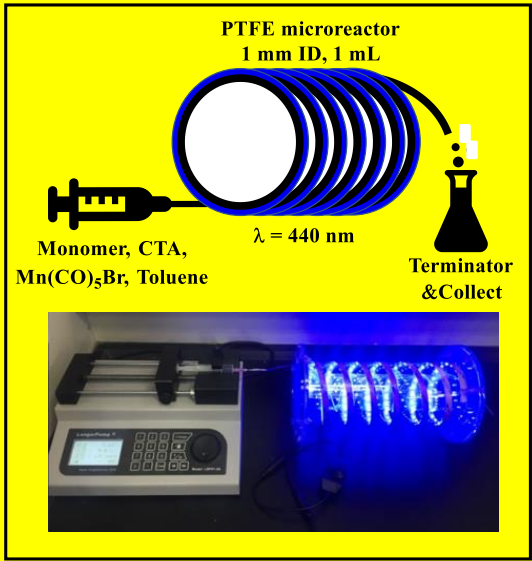
image1 Diagram of Continuous Photochemical Equipment Installation
4、 Measured data: controllable and flexible, light intensity is the final say!
The team conducted systematic testing on continuous stream aggregation, and the results can be regarded as“perfect”:
1. In the experiment of maintaining high controllability at different flow rates, the team adjusted the flow rate of the reaction solution(0.015-0.04 mL/min)Corresponding reaction time22-57In minutes, it was found that:
-The conversion rate steadily increases with the extension of reaction time: flow rate0.015 mL/minAt that time, the conversion rate was as high as82%;-All products maintain a narrow molecular weight distribution(3<1.2)The measured molecular weight is highly consistent with the theoretical value (such as flow rate)0.015 mL/minWhen,Mn,SEC=10300 g/mol,3=1.12);
-Even at high conversion rates, the fidelity of polymer chain ends remains good, supporting subsequent chain extension reactions. This means that regardless of the production efficiency, polymers with uniform structure can be stably produced, and the industrial application potential is enormous!
2. light intensity“One click control”Molecular weight, reversible!
What's even more surprising is that this system achieves precise molecular weight measurementtemporalControl:
-Fixed flow rate(0.03 mL/min), adjust the light intensity from3.7 mW·cm ⁻²upgrade to38.7 mW·cm ⁻²The molecular weight of polymers ranges from6100 g/molGradually increase to10100 g/mol;
-Adjust the light intensity back to3.7 mW·cm ⁻²The molecular weight can be reduced again6000 g/molLeft and right, reversible and precise regulation.
5、 Where exactly is this technology?
Compared to traditional continuous flow cationic polymerization, this technology has significant advantages“dimensionality reduction strike”:
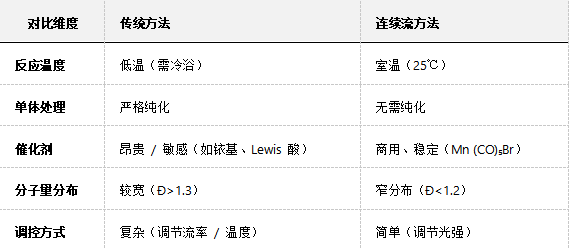
In addition, it also has“Batch aggregation”and“Continuous flow aggregation”Dual advantages: It can quickly optimize conditions in laboratory trials and directly scale up to industrial production, achieving“From small-scale testing to mass production”Seamless connection.
6、 The future is promising: not just aggregation, but also the synthesis of new paradigms
The significance of this research goes far beyond developing a new continuous flow process:
-for“Cationic polymerization+continuous flow”Provided a gentle and controllable solution, breaking the limitations of traditional technology;
-The flexibility of light intensity regulation provides precise synthesis of polymers with different molecular weights“One-click switch”The canCan;-Computer controlled light intensity adjustment is expected to be compatible withAICombining algorithms to achieve“On-demand design-Automatic synthesis”Intelligent polymer preparation.
Conclusion
Brilis, with mature industrial grade continuous photochemical cases, has developed a tubular reactor for vitamin production that improves product yield through precise light intensity control15%-25%Increased production capacity compared to traditional equipment3-5Twice.For a certain medicineThe continuous kettle type photoreactor designed by the enterprise reduces the reaction time of intermediates from 12 Shorten hours to2 Hour, yield from35%upgrade to60%Annual production capacity reaches500 Ton. These cases all demonstrate the core advantages of Braunschweig technology:PLCIntelligent control (parameter fluctuation)≤±1%)High transparency quartz material (light transmittance)95%)Modular design (supporting multiple reactors in series)/Parallel connection) and green environmental protection features (reduced energy consumption)40%Reduce the use of heavy metal catalysts. as of2025 In the year, Brilliance has established cooperation with enterprises such as China Resources Shuanghe and Zhejiang Xinhecheng to promote the large-scale application of continuous photochemical technology in the fields of medicine, new energy, and environmental protection.
References:Jiajia Li et al., Manganese-Catalyzed Batch and Continuous Flow Cationic RAFT Polymerization Induced by Visible Light, Polym. Chem. & WRAP.