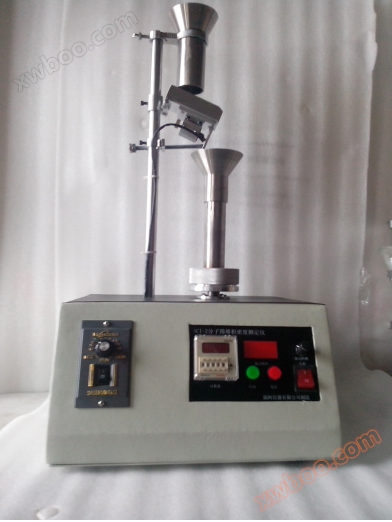
The vibration density detector and vibration density testing instrument FT-2000A particle and powder characteristic analyzer (multifunctional type) FT-2000A particle and powder characteristic analyzer is produced by ROOKO Instrument Company, mainly providing a testing platform and solution for comprehensive analysis of powder and particle physical properties The physical properties of powders include particle size distribution, surface area, bulk density, porosity, true density, particle adhesion, surface energy, surface charge, pore size distribution, moisture content, tensile strength, shear strength, etc. This instrument mainly measures and comprehensively reflects the flowability and characterization characteristics of powders and particles by measuring the tap density, bulk density, angle of repose (angle of repose), spatula angle, collapse angle, differential angle, shear properties, dispersity, agglomeration degree, flowability, and flow time of powders and particles. Through automation control technology, this instrument reduces the operational and calculation errors caused by human factors in the testing process. The testing of each test item is achieved through laser, motor, and measurement and control electronics; The testing process and results are represented by software curve plots, and reports are automatically generated; Provide reliable and data for the characterization of powder particles FT-2000A Particle and Powder Characteristics Analyzer Parameters and Function Description: 1 Vibration density: After measuring data through the fixed volume method or fixed mass method, the vibration density is automatically calculated After measuring the tap density and bulk density, the Hausner Ratio (tap density/bulk density) and compressibility index (tap density/bulk density x 100) data are directly obtained; No need to configure a weighing scale to display data directly, and automatically calculate the loose density. 3. Resting angle (resting angle): Configure an automatic mixing device to solve the testing of powders and particles with poor flowability. The powder flows out automatically through a control valve, and the laser probe collects real-time data on the changes in stacking angle at different times, which can obtain the process curve of flow time and stacking angle, mass and time, volume and time changes. 4. Flow time: The time for a certain mass to pass through the funnel is automatically obtained without manual operation, and timing is automatically started and stopped And display data 5. Collapse angle and flatness angle: data obtained directly from the laser probe; The difference angle data can be directly obtained from the angle of repose and the angle of collapse Void fraction: Void fraction refers to the percentage of voids in a powder that accounts for the entire volume of the powder. No need for additional weighing and calculation, the porosity data can be obtained directly after testing, which varies due to factors such as particle shape, arrangement structure, and particle size of the powder. When the particles are spherical, the porosity of the powder is about 40%; When the particles are ultrafine or irregularly shaped, the porosity of the powder is 70-80% or higher Shear strength: Powder shear strength test 8. Scope of application: It is recommended to test powder particles below 2500 microns.