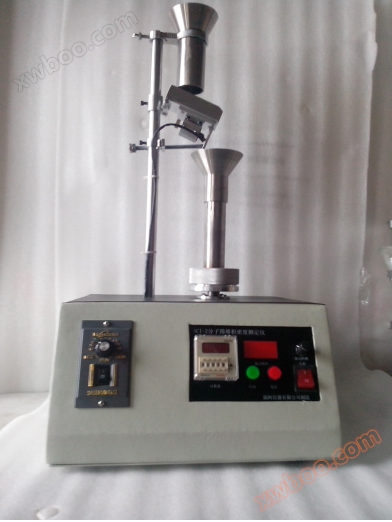
Bulk density tester Powder resistivity vibrating density tester FT-103D Bulk material stacking angle/reverse angle tester I. Meets the standard JB/T 9014.7-1999 for measuring the stacking angle of bulk materials in continuous conveying equipment instead of ZB J8 1 006.7-88 "Determination of stacking angle of bulk materials in continuous conveying equipment". II. Scope of application: The standard specifies the method for measuring the stacking angle of bulk materials; Suitable for measuring the natural and dynamic stacking angles of granular materials with a particle size of 0-50mm transported by continuous conveying equipment. 3、 Principle: Under certain experimental conditions, the natural and dynamic stacking angles of materials are measured to determine their flowability level and calculate their internal friction coefficient. Powder resistivity tester for powder measurement 4. Technical parameter requirements: 1. Materials with particle size less than 6mm shall be measured using a stacking angle and reverse angle tester. 2. Vibration platform: magnetic vibration method shall be used; In half wave mode, the amplitude is 0.5mm and the frequency is adjustable from 0-250Hz 3. Stacking plate: diameter 1M. 4. The distance between the discharge port and the plate can be adjusted by 250mm; The diameter of the blanking opening is 50mm, and the inner diameter of the cylinder is 300mm. 5. There is a control valve at the outlet of the cylinder. 6. Timer: 0-9999H/M/S can be set at will. 8. Auxiliary tools are configured: vernier caliper, angle ruler, material tray, material shovel, shovel, steel ruler, brush, wire brush. 7. Materials with particle size greater than 6mm are measured by manual stacking method. 8. Input: 220v 9. Environmental requirements: it is recommended to use in a dust-free space at normal temperature. 5. Test steps. 1. Materials with particle size greater than 6mm are measured by stacking angle and backstop angle testers. 1) Adjust the height of the discharge hole of the instrument to 250mm from the stacking plate; divide the prepared material sample into two parts, take either part and put it into the material cylinder of the stacking angle and reverse angle measuring instrument. When loading, make the material rise above the cylinder mouth to form a cone and scrape it flat. 2) After cleaning the stacking plate, open the discharge port of the aggregate cylinder and allow the material to fall freely onto the stacking plate into a conical pile. 3) Measure the natural stacking angle of the material pile with an angle ruler, or measure the calculation parameters of the natural stacking angle and check angle inside the material cylinder and on the material pile with a height vernier caliper and a vernier caliper, and record them. 4) Start the vibration platform to vibrate the stacking plate and material pile together with the vibration platform, gradually increasing the amplitude and accelerating the vibration frequency until the amplitude is 0.5mm and the frequency is 50Hz. Continue to vibrate for 2 minutes under this vibration frequency and amplitude condition. 5) Measure and record the various calculation parameters of the dynamic stacking angle of the material pile after vibration. 2. Materials with a particle size greater than 6mm are measured using manual stacking method. 1) Prepare material samples. The material samples with the particle size of 25 mm shall not be less than 20 L, and the material samples with the particle size of 25 mm or more shall not be less than 40 L. When feeding, the distance between the mouth of the shovel or shovel and the cone of the stock pile shall not exceed 50 mm until the materials form a stable and stable stock pile at the slope angle on the stock pile plate. 4) Measure the various calculation parameters of material stacking angle and record them. 5) Start the vibration platform to vibrate the stacking plate, material pile, and vibration platform together, gradually increasing the amplitude and accelerating the vibration frequency until the amplitude reaches 0.5mm and the frequency reaches 50Hz, and continue to vibrate for 2 minutes. Measure and record the various calculation parameters of the dynamic stacking angle of the material after vibration. 6) Result calculation 3. The arithmetic mean of two test results is taken as the stacking angle of the material for result evaluation. If the error between two measurements exceeds 5%, a new test report must be submitted in accordance with the requirements of section 3.6 of JB/T 9014.2-1999.