-
E-mail
2822343332@qq.com
-
Phone
15810615463
-
Address
Mapo Xiangyue Sijisan District, Shunyi District, Beijing
Product Categories
Beijing Jingke Zhichuang Technology Development Co., Ltd


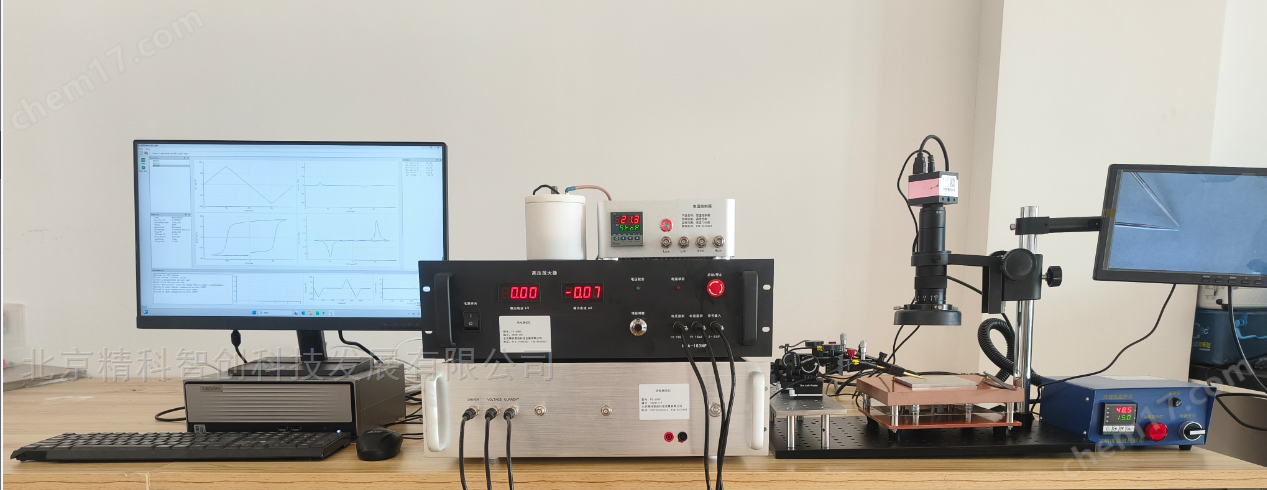
Thin film+block+powder+fixture precision piezoelectric coefficient D33 tester
NegotiableUpdate on 01/05
- Model
- Nature of the Manufacturer
- Producers
- Product Category
- Place of Origin
Overview
The ZJ-6 piezoelectric tester (quasi-static d33/d31 (+d15) measuring instrument) is a specialized instrument designed for measuring the d33 constant of piezoelectric materials. It can be used to measure piezoelectric ceramics with large piezoelectric constants, piezoelectric single crystals with small piezoelectric constants, and piezoelectric polymer materials. In addition, it can also measure the equivalent piezoelectric d33/d15 constant of piezoelectric single crystals with any orientation and certain piezoelectric devices. The instrument has a wide measurement range, fine resolution, high reliability, simple operation, and no special requirements for sample size and shape. Circular discs, rings, tubes, blocks, strips, columns, and hemispherical shells can all be measured, and the measurement results are
Product Details
Thin film+block+powder+fixture precision piezoelectric coefficient D33 tester
ZJ-6Type piezoelectric tester (quasi-static)d33/d31(+d15)Measuring instrument)

At present, our country attaches increasing importance to material testing, and many units and research institutions have encountered significant problems in product identification. However, to truly test materials, it is necessary to choose a precise and reliable testing product, which will have a great impact on one's own testing results and research,It provides great guidance for our production.
keywords:piezoelectric,ceramic materials,polymer
1、 Product Introduction:
ZJ-6 piezoelectric tester (quasi-static)d33/d31(+d15)The measuring instrument is used to measure piezoelectric materialsd33A specialized instrument designed for constants, which can be used to measure piezoelectric ceramics with large piezoelectric constants, piezoelectric single crystals with small piezoelectric constants, and piezoelectric polymer materials. In addition, it can also measure the equivalent piezoelectric properties of piezoelectric single crystals with arbitrary orientations and certain piezoelectric devicesd33/d15Constant, wide measurement range of the instrument, fine resolution, high reliability, simple operation, no special requirements for sample size and shape. It can measure circular discs, rings, tubes, blocks, strips, columns, and hemispherical shells. The measurement results and polarity are directly displayed on a three and a half digit panel table.
ZJ-6 piezoelectric tester (quasi-static)d33/d31(+d15)The measuring instrumentd33The measurement limit has been expanded to 8000pC/NNot only can it be used to measure ordinary piezoelectric ceramic materials, but it can also be used to measure new piezoelectric single crystals with large piezoelectric constantsd33Constant, such asPZN-PT91/9Piezoelectric single crystal(d33reachable3000pC/NLeft, right, or higher)
ZJ-6 piezoelectric tester (quasi-static)d33/d31(+d15)Measuring instrument with measuring functiond31A piezoelectric constant accessory that can be used to measure the transverse piezoelectric constant of radially polarized circular tubes and rectangular piezoelectric elementsd31.
ZJ-6 piezoelectric tester (quasi-static)d33/d31(+d15)If paired with a tangential force adapter (optional accessory), the measuring instrument can also measure the tangential piezoelectric constant of piezoelectric elementsd15(d15The measurement range, accuracy, and resolution are the samed33).
This instrument is used in the production, application, and research departments of piezoelectric materials and piezoelectric components.
2、 Main application areas: non-destructive testing ultrasonic testing, medical ultrasonic testing, aerospace, oil and gas equipment, automotive IoT, industrial, consumer programs, etc.
2、 Main functions of the product:
Measuring piezoelectric materialsd31constant
Measurement of piezoelectric ceramics with large piezoelectric constants
Piezoelectric single crystals and piezoelectric polymer materials for measuring small piezoelectric constants
Measure the equivalent piezoelectric properties of arbitrarily oriented piezoelectric single crystals and certain piezoelectric devicesd’33constant
Measure the tangential piezoelectric constant of piezoelectric elementsd15
3、 Main technical indicators:
D33/d15: Range:×1 档:20to8000pC/N;×0.1档:2to200pC/N
×1档:±2%±1to3 (pC/N)Whend33in200Up to 8000pC/N
×0.1 档: =±2%±1to3 (0.1pC/N)Whend33in20to200pC/N
± 5% ± 1 to3 (0.1pC/N)Whend33 in2to20pC/N
Measurement calibration standard sample size:18mm*0.8mmAging time:2-3Year (one of the important criteria for evaluating the accuracy and performance of piezoelectric testers)
Provide piezoelectric film standard sheets:20*20MM
Voltage protection: discharge protection function
D31Block fixture,D15Block fixture,D15Circular tube fixture,D31Block fixture, film stretching fixture (new function),Coplanar electrode function (new)
±5%±1A number, whend33in10to200pC/N;
×0.1Gear: ±2%±1A number,(whend33in10to200pC/N)
±5%±1A number, whend33in10to20pC/N.
Resolution: ×1Block:1 pC/N; ×0.1Block:0.1 pC/N.
Frequency: 110Hz
Alternating force: 0.25N
Size: Force application device: Φ110×140mmInstrument body:240×200×80mm.
Weight: Force application device: approximately4kg .
Instrument body:2kg .
Power Supply:220Fu,50He,20Wa.
Piezoelectric ceramics are widely used in energy harvesters, transducers, robots, and other fields due to their ability to achieve bidirectional conversion between mechanical energy and electrical energy. With the development of additive manufacturing technologies such as 3D printing, complex geometric structures that are difficult to achieve through traditional processing are gradually becoming possible. This article summarizes the influence of geometric shapes on energy conversion performance in piezoelectric ceramic devices, covering various typical designs such as multilayer structures, benders, helices, shells, topology optimized structures, and metamaterials. Provide reference for the design and manufacturing of new piezoelectric devices.
Introduction to Piezoelectric Ceramics
The piezoelectric effect is the coupling of mechanical and electrical energy, and piezoelectric materials play an important role in many key technologies. Its positive piezoelectric effect is widely used in various sensors, ultrasonic equipment, and energy harvesters; The reverse piezoelectric effect is commonly used in high-precision drivers and high-power ultrasound systems. At present, the market valuation of piezoelectric ceramics is about 2 billion US dollars, mainly dominated by lead containing ceramics such as PZT. Compared with single crystal materials, ceramics have higher processability and can be easily prepared into various complex shapes, making them the core direction of research and application of piezoelectric materials.

Architecture diagram of piezoelectric equipment
Design of piezoelectric ceramic shape
Although piezoelectric ceramics have long been used in traditional design forms such as disks, plates, rings, and tubes, advances in manufacturing methods have made non-traditional piezoelectric ceramics with complex shapes and electrode and polarization networks possible.
The shape of piezoelectric elements affects their vibration modes, which in turn affects the analytical expression of the electromechanical coupling factor, as shown in the following figure. Piezoelectric elements with different aspect ratios from standard requirements will generate overlapping responses of multiple vibration modes. This makes the interpretation of impedance spectra in characterizing material parameters complex and requires additional data analysis, especially when these components are used as sensors in devices.

The electromechanical coupling coefficients of several resonant modes, where t is thickness, d is diameter, L is other dimensions, and P is polarization direction
The geometric shape of piezoelectric elements significantly affects the type and magnitude of their coupling coefficients. For example, compared to plate-like or columnar structures, thin disks have lower coupling coefficients in the same direction. The transformation of shape from a disc to a column or rod can enhance longitudinal response. The variation in aspect ratio can also affect the measured charge coefficient (such as d ∝). The "effective" d ∝ value measured in the experiment may differ from the inherent d ∝ of the material. For example, Barzegar et al. found that the d ∝ value of PZT thin disks generally decreased by about 30%. Stewart et al. further found that the thickness effect in thin circular disks leads to a decrease in the value of d ③③ for soft PZT, while the value for hard PZT increases.
In addition, another key factor related to shape is curvature. In curved structures, the displacement caused by the d ∝ 3 component is more significant at the edges, and the bending moment generated by piezoelectric normal stress is significantly greater in curved structures than in straight structures, thereby further enhancing the piezoelectric response.
Similar Product Recommend