- Phone
-
Address
Jiaohe Industrial Zone, Botou City, Hebei Province
Product Categories
Hebei Yuanxin Machine Tool Manufacturing Co., Ltd

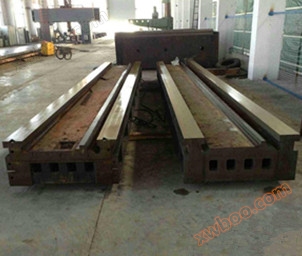
T-shaped block
NegotiableUpdate on 09/13
- Model
- Nature of the Manufacturer
- Producers
- Product Category
- Place of Origin
Overview
The machining of T-shaped grooves can generally be done using planers or milling machines. For those with less strict size requirements, we can use marking to improve production efficiency.
Product Details
Method for processing T-shaped grooves:
1Cast iron platformFirst, align and clamp the flat plate according to the machining line already drawn on the end face and upper plane.
2. Use a slotting knife to create a right angled groove.Customized cast iron partsIf the T-shaped groove is small (groove width less than 100mm) and the precision requirement for the top right angle groove is not high, it can be cut in one go to make its width equal to the width of the T-shaped groove slot. If the T-shaped groove is small and the groove accuracy requirement is high, or if the T-shaped groove is large,Testing PlatformIt is necessary to perform rough and fine planing twice to create a right angle groove.
3. Plan the left and right grooves on the side.Cast iron platformBefore processing, use a cast iron square ruler to check whether the cutting edge of the elbow cutter is perpendicular to the top surface (allowing a small angle of inclination ε, generally taken as ε=25 '~30', to resist the bending elastic deformation of the planer blade caused by cutting resistance). If it is not perpendicular, the tool should be readjusted to ensure verticality.cast iron surface plateThen use an elbow cutter to cut the grooves on the left and right sides separately.
4. Chamfering. Use two pointed planers with a main angle of 45 ° to chamfer.
Crossed platformThere are several points to note:
1. When planing the groove of the T-shaped groove, it is required that,3D flexible welding platformAnd manual cutting should be used to avoid damaging the tool and workpiece.
2. During the process of planing T-grooves, it is important to note that the non cutting parts of the tool should not rub or collide with the cast iron plate to avoid accidents or the production of waste products.
3Riveting platformBetween the end of each cutting stroke and the beginning of the return stroke, the planer should be lifted out of the groove. Therefore, both the forward and backward movements should be appropriately enlarged to provide sufficient space for lifting or lowering the knife.
The machining of T-shaped grooves can generally be done using planers or milling machines. For those with less strict size requirements, we can use marking to improve production efficiency.