-
E-mail
sxxuanrui@126.com
-
Phone
15389283550
-
Address
Intersection of Hancheng South Road and Fenghao West Road in Lianhu District, Xi'an City (south of Xichao Square)
Product Categories
- Calibration device for penetrating mortar strength tester
- measuring instrument
- Calibration device for construction project detector group
- Small angle inspection instrument
- Railway gauge gauge calibrator
- Railway distance gauge calibrator
- Calibration device for bonding strength tester of decorative tiles
- Calibration device for cement fineness negative pressure sieve analyzer
- Concrete impermeability tester calibration device
- Verification device for physical performance testing machine of doors and windows
Shaanxi Xuanrui Electrical Automation Equipment Co., Ltd
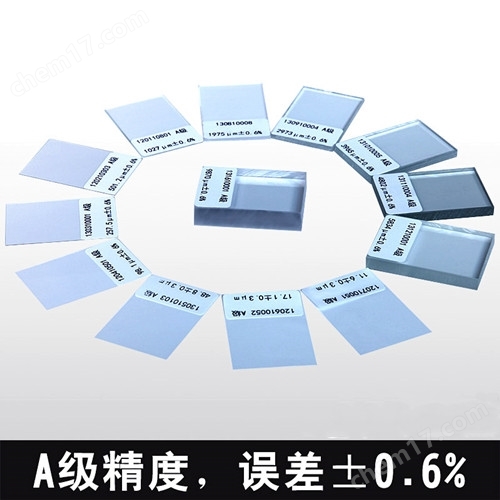
Standard thickness sheet
NegotiableUpdate on 01/09
- Model
- Nature of the Manufacturer
- Producers
- Product Category
- Place of Origin
Overview
This standard thickness sheet complies with JJG818-2018 "Verification Regulations for Magnetic and Eddy Current Coating Thickness Measuring Instruments".
Product Details
1. Execution standards
thatStandard thickness sheetComplies with JJG818-2018 "Verification Regulations for Magnetic and Eddy Current Coating Thickness Measuring Instruments"
2. Technical requirements
2.1 Product accuracy:Standard thickness sheetComplies with JJG818-2018 "Verification Regulations for Magnetic and Eddy Current Coating Thickness Measuring Instruments"
2.2 Product error: ± 0.6%;
2.3 Product specifications: 1 piece each for 10 µ m, 50 µ m, 100 µ m, 500 µ m, 1000 µ m, 5000 µ m, and 10000 µ m.
2.4 Certificate, 1 set
3 Measurement Methods
Use a digital inductive micrometer (choose a 1N force measuring head, and a flat measuring head for thickness plates not greater than 50 μ m) and a three gauge block or grating micrometer, etc., to measure on a flat workbench using a comparative method or a direct method. Direct measurement method: First, zero the digital inductive micrometer or grating micrometer, and then place the measured thickness sheet on a flat workbench. Within the measurement area 5mm away from the edge, evenly distribute 5 points. Take the average of 5 readings from the center point as the actual value of the thickness sheet, and calculate its thickness value H according to the formula; Take the maximum difference between the indicated values and the actual values at each point as the uniformity of the thickness sheet, and calculate the indicated values according to the formula.
Comparative measurement method: Use a digital inductive micrometer (with a 1N force measuring head) and a three gauge block to measure on a flat workbench using the comparative method. Select a three gauge block with a difference of less than 20um from the nominal value of the thickness gauge, have the digital inductance micrometer zero, record the value at this time, and then place the measured thickness gauge on a flat workbench for measurement. The displayed value plus the actual value of the gauge block used is the thickness value of the measured point. The actual value of H is calculated according to the formula; The uniformity of its thickness sheet is calculated according to the formula.
For cases where there is no gauge block within 20m of the nominal thickness of the thickness sheet, a combination of gauge blocks can be used for measurement. For example, when measuring a thickness gauge with a nominal value of 405 μ m, first use a 1.4mm gauge block to zero the digital inductive micrometer, record the value at this time, place the 1mm gauge block on the workbench, and place the thickness gauge on the 1mm gauge block to measure with the digital inductive micrometer. The actual daily value is calculated according to the formula; The uniformity of its thickness sheet is calculated according to the formula.
Similar Product Recommend


