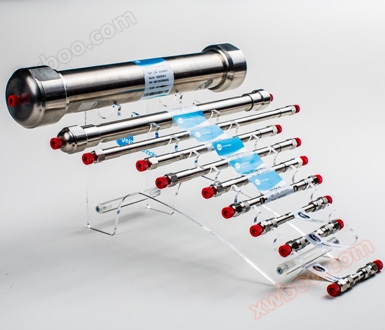
Special column information
The Venusil Stachydrine Hydrochloric Acid Salicylic Acid Column is designed specifically for the analysis of hydrochloric acid sophocarpine in Leonurus japonicus. This product is based on silicone gel, and due to the use of neutral amide groups in the bonding phase, it has good selectivity for strongly polar and water-soluble alkaline organic compounds in hydrophilic interaction chromatography mode.
HILIC is a hydrophilic interaction chromatography mode, in which elution is arranged in the order of increasing hydrophilicity/polarity of compounds. Increasing the proportion of organic phase in the mobile phase will increase solute retention. The typical mobile phase is acetonitrile (40% -97%)/water (or volatile buffer salt), and it can be used with higher volatility mobile phases or buffer salts, making it convenient for combination with mass spectrometry detectors and evaporative emission detectors.
Testing method and analytical spectrum of hydrochloric acid hydroxides
Referring to the chromatographic conditions under the content determination item of Leonurus heterophyllus in the 2015 edition of the Chinese Pharmacopoeia:
Using propyl amide bonded silica gel as the filler and acetonitrile 0.2% glacial acetic acid solution (80:20) as the mobile phase, detection was performed using an evaporative light scattering detector. The theoretical number of trays should not be less than 6000 when calculated based on hydrochloric acid and soda ash.
Chromatographic column: Venusil stackdrine; 5μm,4.6*250mm
Order number: VH952505-LH
Mobile phase: Acetonitrile: 0.2% glacial acetic acid solution=80:20 (v/v)
Flow rate: 0.5 mL/min
Column temperature: 20 ℃
Detector: ELSD (Evaporative Light Scattering Detector)
Injection volume: 10 μ L

Retention time/min |
theoretical plate number |
tailing factor |
17.888 |
15203 |
1.06 |
install
1. Open the column packaging box and confirm the type and specifications of the chromatographic column.
2. Unscrew the sealing plugs at both ends of the column and put them back into the packaging box for future use.
3. Connect the chromatography column to the detection instrument using a PEEK head and PEEK tube or stainless steel fitting according to the flow direction of the mobile phase indicated on the column.
4. Using small inner diameter connecting fittings, analytical columns generally use pipes with an inner diameter of 0.25 mm (0.010 ") and shorten the length of the connecting pipes to reduce dead volume.
Usage and maintenance
protection
Attention should be paid to safety when connecting and using chromatography columns, wearing gloves, masks, and protective goggles. Any solvent and sample leakage caused by loose pipeline connections, aging pipelines, or aging PEEK heads can directly contact operators and have an impact on their health.
Direction of use
During the use of the chromatographic column, the direction of the mobile phase should be consistent with the arrow direction indicated on the column. Unless there are special circumstances, it is not recommended to use it in reverse (for example, when cleaning contaminants on the column head, low flow rate reverse flushing can be considered)
activation
The liquid phase in the new hydrochloric acid sodium hydroxide special column is acetonitrile when it leaves the factory. During storage and transportation, the column may briefly dry up,Therefore, before the first use of the new column, acetonitrile with a volume greater than 20 times that of the column should be activated at a flow rate of 0.5mL/min, and then the operating conditions required for the experiment should be selected for equilibrium. If the mobile phase required for the experiment contains buffer solution, it should be usedTransition between organic phase and water in an equal proportion to the flow to avoid salt precipitation.
sample pretreatment
To avoid clogging of the chromatography column front sieve plate by particulate impurities in the sample or mobile phase, all reagents and samples used in the experiment should be filtered using 0.45 μ m or 0.22 μ m microporous membranes before use. For samples with complex matrices, it is recommended to use SPE solid-phase extraction system for pretreatment.
Mobile phase and sample pH
In order to achieve better lifespan and performance of the chromatography column, please follow the pH range recommended by the manufacturer. The pH range for the hydrochloric acid sodium hydroxide special column is 2.0-6.0. If the pH is too high, the silica gel will dissolve, and if the pH is too low, some or all of the bonded phases will fall off, resulting in a decrease in column performance and the reproducibility of experimental results.
Mobile phase and sample solvent
It is advisable to avoid using phosphate or other buffer salts that are immiscible with the organic phase in high organic phase systems as the mobile phase, in order to prevent damage to the chromatographic column due to salt precipitation. To avoid interfering with the HILIC separation mechanism, do not use trifluoroacetic acid and other ion pair reagents. If possible, please choose to dissolve the sample in the mobile phase as much as possible, and do not use water or DMSO to dissolve the sample, in order to avoid the peak shape deterioration caused by solvent effects.
Column temperature and pressure
The maximum operating temperature should be below 60 ℃. Long term use at high temperatures (>60 ℃) can damage the chromatographic column, which is most evident when the pH is greater than 6.0. The chromatographic column can withstand a pressure of 400 bar, but long-term exposure to high pressure can affect the performance and service life of the chromatographic column. It is recommended that the column pressure be lower than 200 bar during normal operation and use.
Protection column
When analyzing samples with complex matrices, it is recommended to use a protective column before the chromatographic column to block particles in the system and delay chemical contamination of the stationary phase by the sample in order to achieve better column lifespan.
Rinse program
After using the chromatography column, it is necessary to rinse at least 20 times the column volume with 50% acetonitrile, 5% acetonitrile, and 100% acetonitrile at 0.5mL/min. If there is a protective column connected in front of the column, it should be disconnected from the chromatography column and rinsed separately.
store
When storing the chromatography column, do not leave any water or buffer in the column. Acetonitrile can be used as the sealing solvent for the column. To prevent the column bed from drying up, it is recommended to regularly flush the chromatography column that has not been used for a long time. After flushing, plug the two ends of the chromatography column tightly with plugs