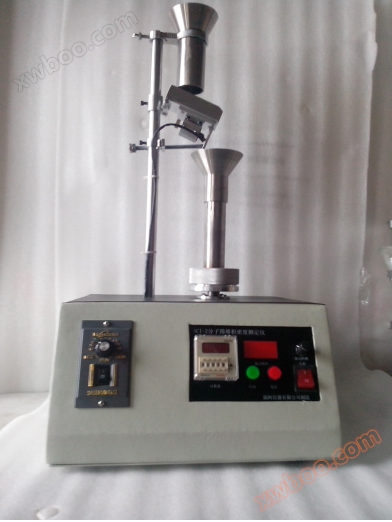
Powder resistivity compaction density meter
Function description:Function deion:
Automatic pressure measurement, capable of real-time measurement of the relationship between resistivity and compaction density during powder compaction process, pressure and compaction density map, automatic analysis of the rebound deformation of the sample after constant pressure and pressure relief, as well as the change maps of resistivity and conductivity during elastic deformation process, self reading sample height measurement up to 0.001mm; two control modes: touch screen and PC software; Integrated control system, report function; Automatic operation, the instrument has self safety protection and abnormal alarm functions
two.Reference standard:
1. Compaction density measurement reference: GBT 24533-2009 Graphite based negative electrode materials for lithium-ion batteries,
Appendix L: Testing Method for Powder Compaction Density
2. The four probe tester refers to GB/T 1551, GB/T1552-1995, ASTM F84 American A.S.T.M standard.
3. The four probe method for powder testing shall be made in accordance with the requirements of the arbitration method for the determination of powder conductivity in GBT 30835-2014 "Carbon composite lithium iron phosphate positive electrode materials for lithium-ion batteries"
III Scope of application:Scope of application
1. Measurement of electrical resistivity of carbon composite lithium iron phosphate cathode material for lithium-ion batteries;
2. Used for the analysis and detection of semiconductor powder materials that require measurement using the four probe method;
3. Used for measuring the resistivity of graphite powder materials;
4. Applied to enterprise quality inspection; R&D department, colleges and universities; Research institutes; And quality inspection agencies
four.working principle:
During the compression process of external force, as the powder moves and deforms, the gaps are filled, and the contact area between particles increases, resulting in attractive forces between atoms and strengthened mechanical wedging between particles, thus forming a compact with a certain density and strength Measure the changes in resistance, resistivity, and conductivity in real-time during the process of forming the billet until they stabilize
five. Parameter dataparameter
|
Test project/model
|
FT-8600A
|
FT-8600B
|
|
1.Resistance Range
|
10-5~2×10⁵Ω/□
|
10-4~1×10⁷Ω/□
|
|
2.Range of resistivity
|
10-6~2×10⁶Ω-cm
|
10-5~2×10⁸Ω-cm
|
|
3. Conductivity range
|
5×10⁻⁶~106ms/cm
|
5×10⁻⁸~105ms/cm
|
|
4. Test current range
|
0.1μA,1μA,10μA,100µA,1mA,10mA,100 mA
|
10mA ---200pA
|
|
5. current accuracy
|
±0.1%
|
±2%
|
|
6main pressure
|
5Ton; Sensor:1level
|
|
7Sample height measurement
|
0.001mm—25.000mm; Automatic
|
|
8Instrument operating range
|
0-50mm
|
|
9 control system
|
Hydraulic control system
|
|
10.Display mode
|
7Inch touch screen+PCsoftware
|
|
11.mold
|
Inner diameter:12.8mm; High:25mm; Accuracy0.1mm
|
|
12.Demoulding method
|
automatic
|
|
13.Protector
|
Automatic diagnosis, overload protection, and emergency stop control/
|
|
14.Temperature and humidity range
|
normal temperature-50Degree; Humidity:20%-98%/
|
|
15.time setting
|
0-99.9S
|
|
16.Density value
|
99.99999g/cm3Different samples have different characteristics and densities; Error:3%
|
|
17.strain
|
Measurable deformation of elastic materials
|