-
Phone
15921165535
-
Address
No. 418 Huajing Road, Shanzhong Science and Technology Park, Waigaoqiao Free Trade Zone, Pudong New Area, Shanghai
Product Categories
Duzhi Instrument (Shanghai) Co., Ltd

Oxford CMI243 Coating Thickness Gauge, Oxford, UK
NegotiableUpdate on 01/11
- Model
- Nature of the Manufacturer
- Producers
- Product Category
- Place of Origin
Overview
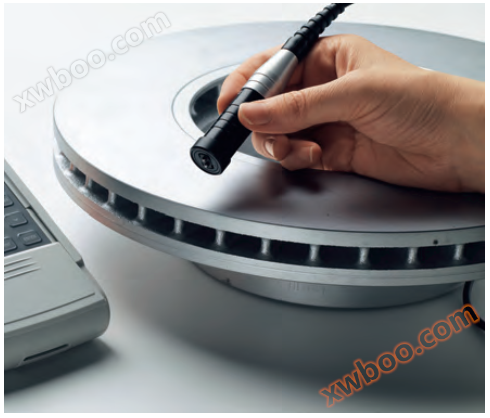
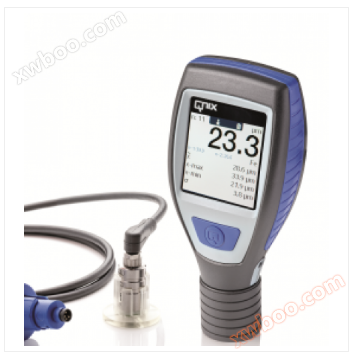
CMI243 is a handheld thickness gauge that combines the advantages of accurate measurement, reasonable price, and reliable quality to measure the thickness of metal coatings on black metal substrates. CMI243 is a convenient and easy-to-use instrument designed specifically for metal surface processors. The configured single probe can measure almost all metal coatings on iron substrates, even on small, specially shaped, or rough surface samples. This thickness gauge is an ideal tool for the fastener industry. Using phase based eddy current technology, the CMI243 handheld thickness gauge is easy for users to control and can rival the accuracy and precision of X-ray fluorescence thickness gauges.
Product Details
product description
CMI243 is a handheld thickness gauge that combines the advantages of accurate measurement, reasonable price, and reliable quality to measure the thickness of metal coatings on black metal substrates. CMI243 is a convenient and easy-to-use instrument designed specifically for metal surface processors. The configured single probe can measure almost all metal coatings on iron substrates, even on small, specially shaped, or rough surface samples. This thickness gauge is an ideal tool for the fastener industry. Using phase based eddy current technology, the CMI243 handheld thickness gauge is easy for users to control and can rival the accuracy and precision of X-ray fluorescence thickness gauges. In order to enable customers to purchase at low cost, CMI243 eliminates the need for multiple probes, operation training, and continuous maintenance. Oxford Instruments provides reliable high-quality products and has a responsive customer service team. What's even more valuable is that this side thickness gauge comes with a one-year warranty period.

measurement
General testing methods, such as the conventional magnetic induction and eddy current methods used by thickness gauge manufacturers, cannot achieve accurate measurement of the thickness of metallic coatings due to the substrate effect caused by the "lift off effect" of the probe and interference caused by the shape and structure of the test piece. However, Oxford Instruments has applied the new phase based eddy current technology to CMI243, achieving an accuracy of within 1% (compared to standard pieces). The Oxford Instruments' special application of eddy current technology minimizes the 0.3% substrate effect, making measurements accurate and not affected by the geometric shape of the parts. Additionally, instruments generally do not require calibration on iron substrates.
 |
|
 |
Advanced ECP-M probe
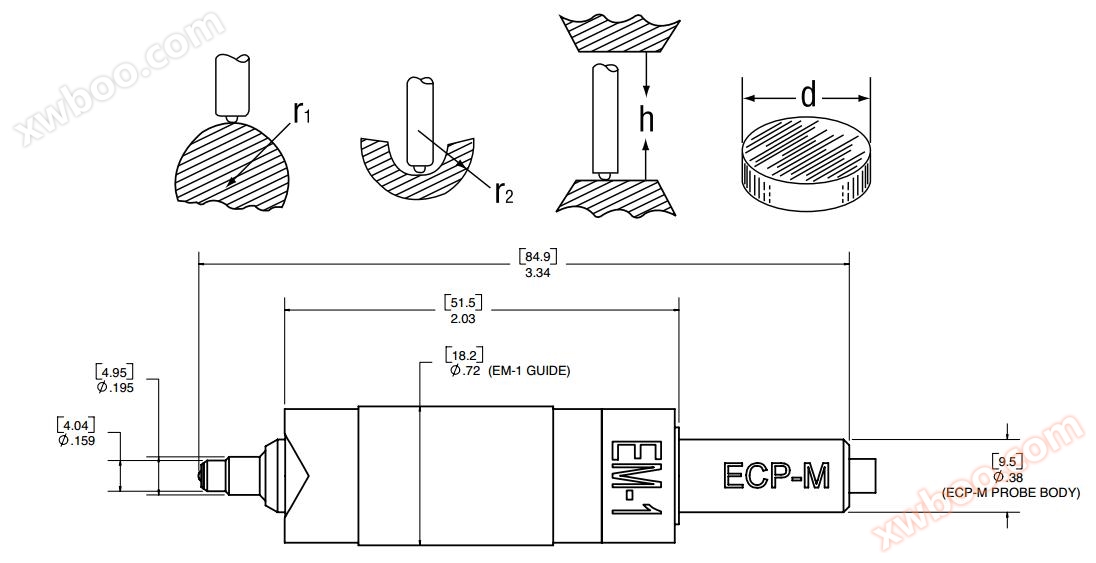
The ECP-M probe is designed for difficult to measure metal coatings, and this single probe can measure almost all metal coatings on iron substrates, such as zinc, nickel, copper, chromium, and tungsten. Smaller probes provide convenient measurement for small, uniquely shaped, or surface refined parts. 
|
 |
The basic configuration includes:
ECP-M probe and removal guide
Calibration Iron Galvanized Standard Sheet Group
SMTP-1 (magnetic induction probe) can be purchased separately
|
|
Operation range |
||
|
Iron plating |
Coating thickness range |
probe |
|
Zn |
0.1-1.5mils (38μm) |
ECP-M |
|
Cd |
0.1-1.5mils (38μm) |
ECP-M |
|
Cr |
0.1-1.5mils (38μm) |
ECP-M |
|
Cu |
0.1-0.40mils (10μm) |
ECP-M |
|
Non-MagFe |
0.1-50mils (1270μm) |
SMP-1 |
|
Technical Parameter |
|
|
accuracy |
Relative standard piece soil1% |
|
accuracy |
0.3% |
|
resolution |
0.01mils (0.1u m) |
|
*Small convex radius |
0.045'(1.143mm) |
|
*Small concave radius |
0.135'(3.429mm) |
|
Height |
4.0'(10.16cm) |
|
*Small measurement area (diameter)d) |
0.090'(2.086mm) |
|
*Small substrate thickness(mils) |
12(0.3mm) |
|
Eddy Current |
followDIN50984,BS5411Part 3,ISO 2360,ISO 21968Draft,ASTM B499,reachASTM E376 |
|
storage |
26,500Strip storage reading |
|
size |
5 7/8”(long)x 3 1/8'(wide) x 13/16”(tall) (14.9 x 7.94 x 3.02 cm) |
|
weight |
9 oz (0.26 kg)Including batteries |
|
unit |
Automatic conversion between imperial and metric systems with one button |
|
display |
Three-digitLCDLCD display, font1/2inch(1.27cm)tall |
|
battery |
9Alkaline battery |
|
BATTERY LIFE |
65Continuous use for hours |

About Us
Duzhi Instrument (Shanghai) Co., Ltduse“High quality achievement value——Focus On Better Quality”With the aim of focusing on the research, introduction, and promotion of metrological testing and material analysis equipment, the company leverages its deep engineering and technical background and efficient resource integration to significantly improve efficiency and reliability in various aspects such as original design, development cycle, product quality, and in-service testing.
Similar Product Recommend