-
E-mail
lina-he@zolix.com.cn
-
Phone
13810146393
-
Address
No. 16 Huanke Middle Road, Jinqiao Industrial Base, Tongzhou Park, Zhongguancun Science and Technology Park, Beijing, Building B, No. 68, Liandong U Valley Pilot Zone
Product Categories
Beijing Zhuoli Han Guang Instrument Co., Ltd
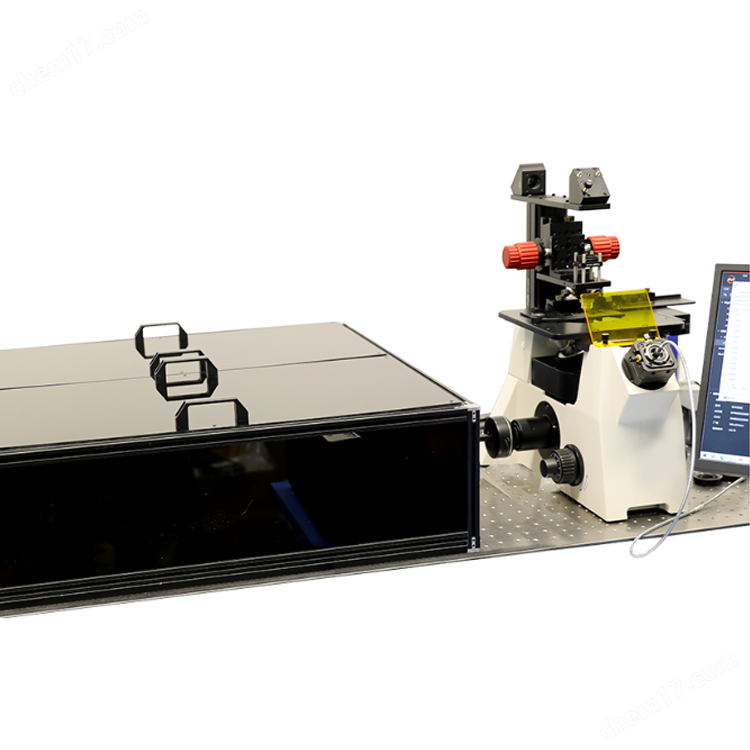
Omni fs TA femtosecond transient absorption spectroscopy system
NegotiableUpdate on 02/11
- Model
- Nature of the Manufacturer
- Producers
- Product Category
- Place of Origin
Overview
The femtosecond transient absorption spectroscopy system Omni fs TA is used to study the excited state spectra and dynamics of optoelectronic materials, optoelectronic devices, organic solar cells, and other materials. It is an effective tool for studying various dynamic processes in physical and chemical material systems at ultrafast time scales, and is used for deeper exploration and demonstration of photochemical processes in energy materials, nanomaterials, and organic molecular materials.
Product Details
Omni fs TA femtosecond transient absorption spectroscopy system
The Omni fs TA femtosecond transient absorption spectroscopy system is used to study the excited state spectra and dynamics of optoelectronic materials, optoelectronic devices, organic solar cells, and other materials. It is an effective tool for studying various dynamic processes in physical and chemical material systems at ultrafast time scales, and is used for deeper exploration and demonstration of photochemical processes in energy materials, nanomaterials, and organic molecular materials.
Pump detection principle
Light is an important means of regulating and measuring molecular energy level transitions. When a molecule is excited by light, it undergoes energy level transitions, which are accompanied by changes in the number of ground and excited states of the molecule. This can cause changes in the absorption or emission of light by the molecule or material system. Pump detection technology excites a sample with a pulsed light beam for energy level transition, and then uses a pulsed light beam to detect the excited state. By continuously adjusting the time delay of the excitation light pulse and the detection light pulse, the dynamic process of the excited state changing with time can be obtained, and the relaxation process of the excited state can be monitored.

Schematic diagram of pump detection energy level transition
Omni fs TA femtosecond transient absorption spectroscopy system
Femtosecond transient absorption spectroscopy is a time-resolved pump probe technique on the femtosecond time scale. Due to its short time scale, this method can be used to detect most of the information about electronic excited states, including energy transfer, electron transfer, relaxation, and isomerization studies. This technical method mainly uses a pump light to generate an excited state, and then uses another wide spectral range detection light to measure the absorbance of transient intermediate species. It can simultaneously measure the dynamics of excited states in both ultrafast time and spectral dimensions.
The femtosecond laser serves as the system light source and is divided into two paths. One beam is used as the pump light to excite the sample from the ground state to the excited state, while the other beam enters the white light generator to generate supercontinuum white light as the transient absorption detection light. Obtain transient absorption signals by testing the changes in absorbance of luminescent materials with and without excitation. In principle, in order to advance the signal-to-noise ratio and reduce false signals caused by probe light jitter, the probe light can be divided into two paths, one as the probe light and the other as the reference light. At the same time, it is necessary to eliminate the influence of background signals and fluorescence signals on transient absorption signals.

The energy level transition of materials due to external photoelectric effects mainly occurs in femtosecond time, accompanied by subsequent excited state relaxation, such as electron or spatial recombination, which mainly occurs in picosecond and nanosecond time scales. For many semiconductor materials, due to the presence of defect states internally, there are slower time scales involving defect states, including microseconds, milliseconds, and other time scales. Femtosecond transient absorption spectroscopy can obtain the excited state dynamics in the femtosecond nanosecond time range, and is a powerful tool for studying ultrafast chemical and physical processes in materials or organic molecules.


Pump detection principle

Transient absorption spectra obtained under different time delays (t)
Application of femtosecond transient absorption spectroscopy
As one of the ultrafast spectroscopy techniques, femtosecond transient absorption spectroscopy is an important method for studying ultrafast dynamics. It can not only explore the dynamic processes of molecules, but also provide insights into some epigenetic phenomenaA deeper understanding and interpretation of phenomena at different levels. At present, it has been widely applied in research in biology, physics, chemistry, materials and other fields. For example, research on the photoelectric conversion mechanism of new nanomaterials, photosynthesis, DNA photodamage mechanism, photochromic reaction, etc.
Experimental case study on the transfer and recombination process of photo generated charge carriers
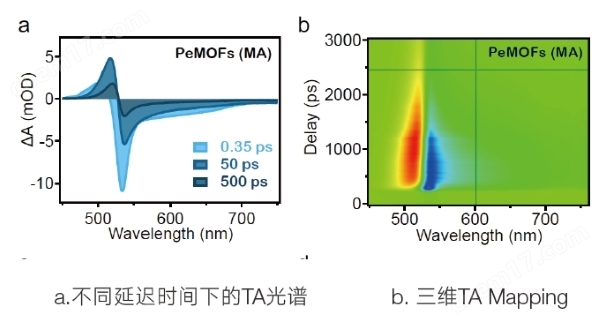
The organic metal framework in perovskite MOFs materials can improve the stability of perovskite nanocrystals, which can be applied to brighter and more stable LED devices. Transient absorption spectroscopy can detect their photophysical processes, thereby guiding material design and growth in the laboratory. The right figure shows the transient absorption spectrum of a MOF stabilized perovskite nanocrystal.
Charge recombination and triplet exciton interaction in organic solar cells (OSCs)
High performance organic photovoltaic devices adopt a bulk heterojunction structure, and the charge transfer states formed by numerous donor acceptor (D-A) heterojunctions facilitate the dissociation of exciton states. However, the spin characteristics of the charge transfer state generated by the recombination of photo generated carriers can lead to the formation of low-energy triplet excitons (T1) and trigger relaxation processes, resulting in the loss of photocurrent. Using femtosecond transient absorption spectroscopy to study the excited state spectra and dynamic processes of different material configurations, it was found that using donors and acceptors with weaker exciton binding strength can reduce the formation of triplet exciton states without sacrificing exciton dissociation efficiency. The potential impact of OSCs charge recombination and triplet exciton interaction mechanism on material design, device engineering, and photophysics was discussed, providing a comprehensive foundation for the full potential of organic photovoltaic devices in the future.

Transient absorption spectra and molecular dynamics simulation results of delocalized excitons in dimers of different materials

Transient absorption spectroscopy test results of organic solar cells with different material compositions
Technical Specifications
Center wavelength of femtosecond light source |
800±10nm |
1030±3nm |
|
Detection wavelength range (UV-Vis-NIR) |
300-700nm; 400-900nm; 450-1000nm; 900-1700nm; |
300-500nm; 380-600nm; 500-1000nm; 900-1600nm |
Pump light wavelength range |
240-480nm; 475-1160nm; 1160-1600nm; 1600nm-2600nm |
300-480nm; 600-900nm; 1200-2500nm |
Detection time window |
4ns/8ns |
|
temporal resolution |
1.5 times the pulse width of the laser |
|
sensitivity |
Wide spectrum 0.1 Δ mOD, single wavelength 0.01 Δ mOD |
|
test mode |
Reflection, transmission, back excitation |
|
Sample cavity |
Liquid, powder, film |
|
software |
Detection of light stability monitoring, spectral preview, spectral correction, spectral smoothing, data fitting |
|
Function Expansion |
Micro area spectroscopy |
|
Wide field transient absorption imaging | ||
Time related single photon counting module: minimum time interval of 2ps, minimum lifetime range of 100ps, wavelength resolution of 0.08nm | ||
Femtosecond Kerr Gate time-resolved fluorescence spectroscopy: spectral range of 400-900nm, laser pulse width of 50fs, sample lifetime measurement time window of 4ns | ||
sample data

Transient absorption spectroscopy test results of single crystal zinc oxide
References
[1]Jiang, K., Zhang, J., Zhong, C. et al. Suppressed recombination loss in organic photovoltaics adopting a planar–mixed heterojunction architecture. Nat Energy 7, 1076–1086 (2022).
[2]Gillett, A.J., Privitera, A., Dilmurat, R.et al.The role of charge recombination to triplet excitons in organic solar cells. Nature 597, 666–671 (2021).
[3]Krishnapriya, K.C., Roy, P., Puttaraju, B. et al. Spin density encodes intramolecular singlet exciton fission in pentacene dimers. Nat Commun 10, 33 (2019).
About Zhuo Li Han Guang
As a domestic brand deeply involved in the field of spectroscopy, Zhuoli Han Guang has always focused on researching and developing high-quality products, steadily advancing on the path of independent innovation in spectral detection equipment. From steady-state transient fluorescence spectrometers and steady-state fluorescence spectrometers that accurately capture the luminescent characteristics of substances, to grating spectrometers and Fourier transform infrared spectrometers that analyze the molecular structure of substances, every device embodies the research on technology and the commitment to quality.
We have launched spectral systems covering multiple scenarios to meet different research and application needs: transient absorption spectrometer and femtosecond transient absorption spectroscopy system can explore the ultrafast photophysical processes of substances; Fluorescence lifetime imaging and 3D fluorescence spectrometer can present subtle changes in fluorescence characteristics from the spatiotemporal dimension; The photoluminescence spectrometer provides strong support for the study of material optical properties; Laser induced fluorescence spectrometer demonstrates outstanding performance in the field of high-sensitivity detection.
In the future, Zhuoli Han Guang will continue to be driven by innovation and continuously optimize spectral detection technology, injecting more "Chinese strength" into scientific research breakthroughs and industrial upgrading with these high-quality spectral products, demonstrating the hard core strength of domestic brands in the field of hyperspectral equipment.