-
E-mail
haohuakun@163.com
-
Phone
13811623275
-
Address
6038, 6040, 6042, Building 3, China Agricultural University International Entrepreneurship Park, No. 10 Tianxiu Road, Haidian District, Beijing
Product Categories
Beijing BoPu Te Technology Co., Ltd
Non destructive rapid detection instrument for plant polyphenols and chlorophyll
NegotiableUpdate on 01/08
- Model
- Nature of the Manufacturer
- Producers
- Product Category
- Place of Origin
Overview
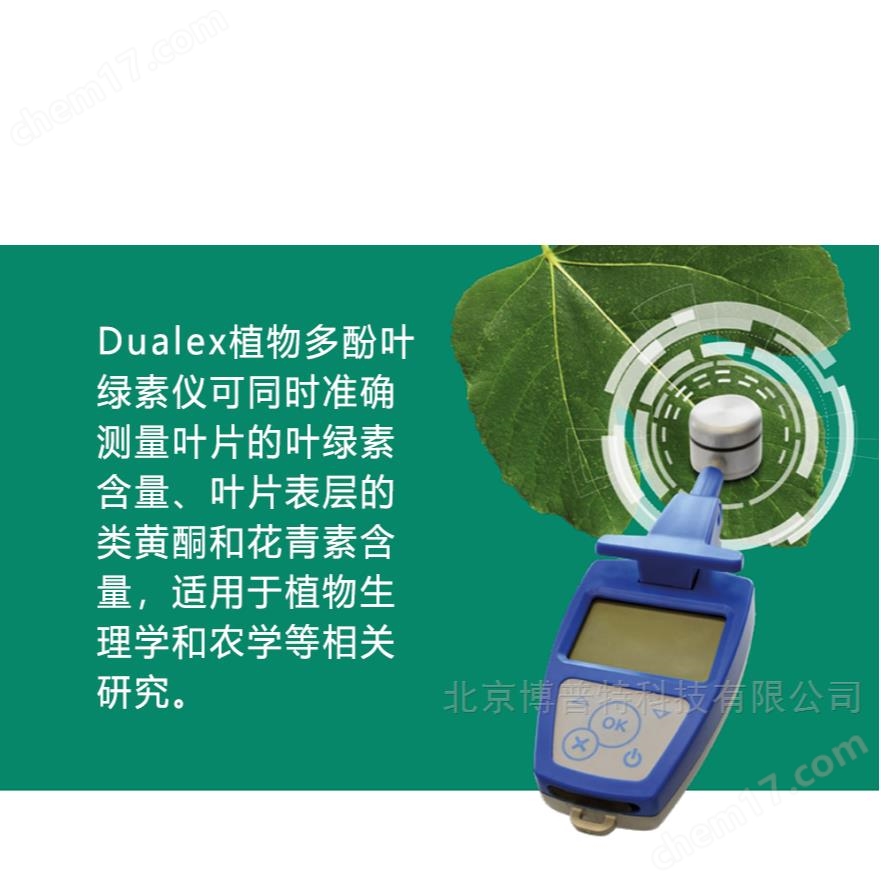
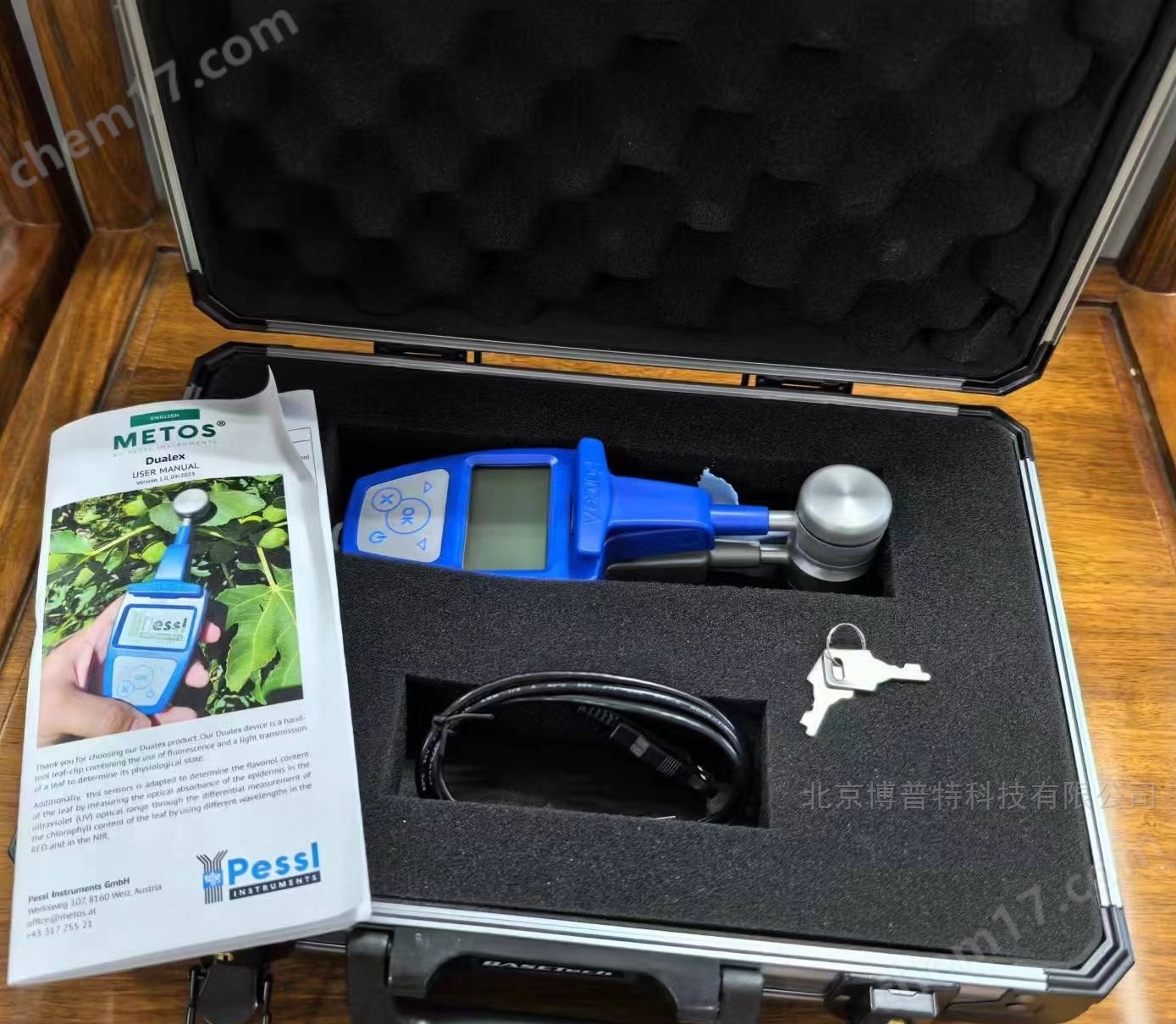
Dualex Plant Polyphenols and Chlorophyll Non destructive Rapid Detector | Portable handheld device for field crop monitoring. It is a portable multifunctional blade measuring instrument produced by PESSL company in Austria (formerly Force-A company in France) and developed based on technology from the French National Academy of Sciences (CNRS) and the University of Paris XI. It is designed specifically for research in plant physiology, agronomy, and ecology, and can measure key physiological and biochemical indicators of plant leaves without damage, quickly, and accurately. It is a powerful tool for field and laboratory research.
Product Details
DualexNon destructive rapid detection instrument for plant polyphenols and chlorophyll
Core measurement parameters and application value
Chlorophyll content µ g/cm ²:
Principle: Accurately measure chlorophyll absorption rate by analyzing the transmittance of specific near-infrared light. The system has undergone chemical calibration with a range of 5-80 µ g/cm ².
-
Meaning: Chlorophyll is the core pigment of photosynthesis, and its content directly reflects plant photosynthetic capacity, nitrogen status, stress level, and growth and development level. Accurate measurement of chlorophyll is crucial for evaluating crop nutrition and diagnosing stress.
Flavonoid content 0-3:
Principle: Measure by analyzing the "shielding effect" of flavonoids (mainly present in leaf epidermis) on chlorophyll fluorescence. Using ultraviolet light excitation, compare the difference between the infrared fluorescence generated and the reference excitation light.
Meaning: Flavonoids are important plant polyphenols involved in photoprotection, antioxidant defense, and signal transduction. Its content is a good indicator of plant light interaction history, antioxidant capacity, and nitrogen/carbon metabolism balance.
Principle: Similar to flavonoids, it is measured by analyzing the shielding effect of anthocyanins (mainly present in the leaf epidermis) on chlorophyll fluorescence, usually using green light as the measuring light.
-
Meaning: Anthocyanins are involved in plant responses to environmental stress (such as strong light, low temperature, drought), attracting pollinators, and other processes. Its accumulation is a sign of plant stress or specific developmental stages.
Nitrogen Balance Index (NBI) ®):
Principle:The sex index is calculated by combining chlorophyll content and flavonoid content (NBI=chlorophyll/flavonoid).
Meaning: NBI ® It is the core indicator factor of plant nitrogen nutrition status. It is highly correlated with the nitrogen content of plant leaves, and compared to a single chlorophyll indicator, it is less sensitive to changes in environmental conditions such as leaf age and thickness, and can more reliably reflect the actual nitrogen demand of plants.
Anthocyanin content 0-1.5:
Application examples of Dualex in scientific research
Application 1: Study on the mechanism of humic acid (HA) alleviating iron chlorosis in Poaceae plants (wheat)
Background: This study investigates the role of humic acid in improving iron nutrition in calcareous soils, particularly under iron deficiency stress in grasses such as wheat.
Method and findings: Wheat was treated with humic acid under conditions of iron deficiency and sufficiency. Research finds:
HA significantly improved the physiological status of iron deficient wheat and alleviated the harmful effects of iron deficiency on development.
HA enhances the ability of iron deficient wheat roots to secrete phytosiderophores.
The role of HA is related to increasing the iron activity pool in leaves, which may involve the interaction between HA and plant iron carriers to promote the mobilization of iron complexes.
HA may promote iron transport from roots to aboveground parts by increasing the concentration of trans zeaxanthin nucleoside (tZR) in leaves.
The function of Dualex is to non destructively and rapidly monitor the changes in chlorophyll content (reflecting the degree of iron chlorosis) and other related physiological indicators of wheat leaves under different treatments, providing key data support for mechanism research.
Application 2: Rhizosphere Microorganisms Relieve the Effects of Drought Stress on the Physiology and Biochemistry of Calendula Flower
Background: Evaluate the effects of different rhizosphere bacteria and algae on alleviating drought stress in medicinal plant Marigold.
Method: Different irrigation levels (normal K1, 50% K2, 25% K3) and microbial treatments (control B0, Lipoazospirillum B1, Bacillus subtilis B2, and Chlorella vulgaris B3) were set.
Discovery: The application of rhizosphere microorganisms has a positive effect on alleviating limited irrigation stress. The key indicators measured by Dualex are as follows:
Nitrogen Balance Index (NBI): 110.6-158.0mg/gTo reflect the actual measurement range
Other relevant indicators (not directly measured by Dualex, but collectively reflecting stress response):
Conclusion and significance: The results show that Calendula has commercial planting potential in arid and semi-arid areas (such as Türkiye), and rhizosphere microbial inoculation is an effective strategy to improve its drought resistance.
The function of Dualex is to efficiently and non destructively obtain chlorophyll and NBI under different irrigation and microbial treatment conditions in the field ® The core data provides real-time and reliable quantitative basis for evaluating the drought resistance physiological status and microbial treatment effect of marigold.
DualexNon destructive rapid detection instrument for plant polyphenols and chlorophyllCore advantages and technical parameters
Non destructive measurement: No damage to plant leaves, can be measured repeatedly.
Quick and convenient: Real time display of results without the need for sample preparation or chemical reagents.
Multi parameter synchronization: One capture, simultaneously obtaining chlorophyll, flavonoids, anthocyanins NBI ®。
portable and durable
Size: 205 mm x 65 mm x 55 mm
Weight: Only 220 grams (including battery)
Ergonomic design, suitable for measuring blades ranging from 0.5 to 16 centimeters wide.
Strong environmental adaptability: can be used under various temperature and natural lighting conditions.
Easy to operate
Automatic mode (automatically measuring and storing detected blades) or manual mode.
Simple data management: store>10000 pieces of data (including date, time, and group number).
Built in GPS (optional): Accurately locate measurement points (<2.5 meters CEP) for easy spatial analysis.
Data transfer: USB export as. csv file, compatible with various data processing software.
Long battery life: The rechargeable lithium battery supports up to 25000 measurements.
Measurement accuracy: accuracy of 5%, measuring area diameter of 5mm.
Wide applicability: monocotyledonous plants, dicotyledonous plants, and perennial plants can all be measured.
Why choose Dualex plant polyphenol chlorophyll rapid analyzer?
DualexThe combination of non-destructive optical sensing technology and user-friendly design provides researchers and agronomists with real-time understanding of plant physiological status, especially nitrogen nutrition status, in the field or laboratory ®、 A powerful tool for photosynthetic potential Chl and stress response Flav/Anth. It has irreplaceable value in plant nutrition (such as iron and nitrogen), abiotic stress (drought, salinity, strong light), biotic stress research, and precision agriculture management.
Keywords
Dualex, Plant polyphenol chlorophyll rapid analyzer, chlorophyll measuring instrument, non-destructive testing, leaf physiological indicators, nitrogen balance index, NBI, Flavonoids, anthocyanins, PESSL, Plant physiological instruments, agricultural research equipment, portable measuring instruments, plant stress diagnosis, plant nutrition diagnosis, humic acid, iron chlorosis, wheat nutrition, drought stress, marigold, rhizosphere microorganisms, GPS positioning, field measurement
Similar Product Recommend


