- Phone
-
Address
Building 2, No. 64 Tiancheng Road, Jianggan District, Hangzhou City, Zhejiang Province
Product Categories
Hangzhou Hangrui Electric Power Automation Co., Ltd
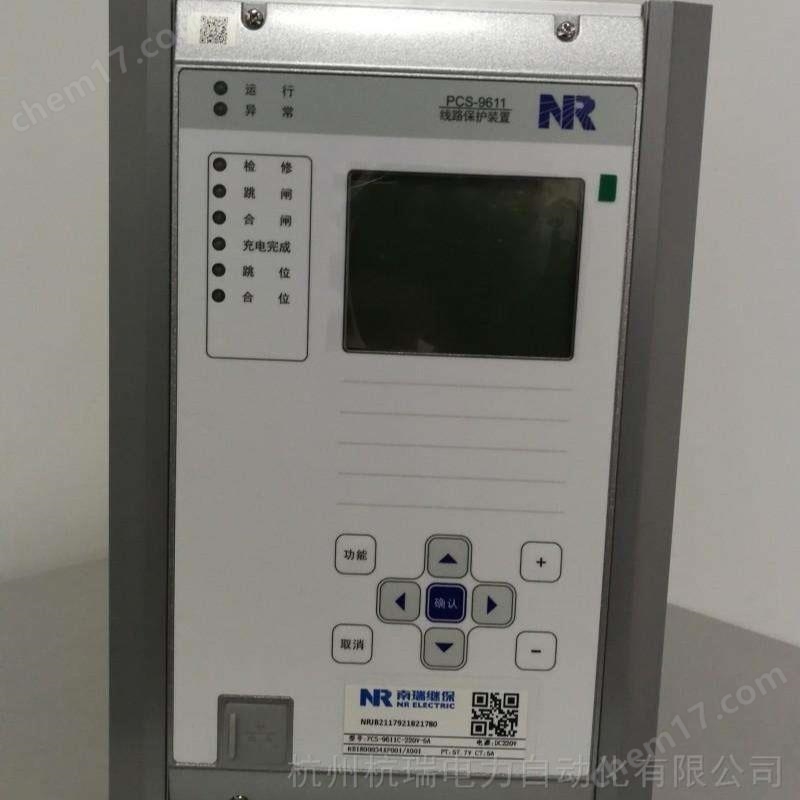


Nanrui Jibao PCS9613 optical differential protection device
NegotiableUpdate on 05/14
- Model
- Nature of the Manufacturer
- Producers
- Product Category
- Place of Origin
Overview
The Nanrui Jibao PCS9613 optical differential protection device $r $n uses one side of the devices on both sides of the line as the reference end (host side) and the other side as the synchronization end (slave side). Exchange information on both sides of $r $n synchronously, with a fixed sampling interval at the reference end, and send a fixed frame of information to the opposite side in each sampling interval. The synchronous end adjusts the $r $n sampling interval at any time to ensure that the sampling on both sides is in a synchronized state. The prerequisite for synchronous sampling on both sides of $r $n is: $r $n1, the maximum one-way transmission delay of the channel is ≤ 8ms. $r $n2, the transmission and reception routes of the channel are consistent (i.e., the transmission delays in both directions are equal).
Product Details
Nanrui Jibao PCS9613 optical differential protection device
1. Working principle of software
The main program receives sampling interrupts according to the given sampling period and enters the sampling program to perform analog acquisition and filtering in the sampling program,
The collection of switch values, hardware self-test of devices, inspection of external abnormalities, and calculation of start-up criteria are based on whether the start-up conditions are met
Enter the normal running program or fault calculation program.
Nanrui Jibao PCS9613 optical differential protection device
Differential jump relay
In order to prevent the near fault side protection from immediately starting when the exit of long-distance transmission lines is grounded through a high transition resistance, but due to the increased assistance
The impact may be that the remote fault side may not have a significant amount of fault and cannot be activated, and the differential protection cannot act quickly. In response to this situation, PCS-9613D
Equipped with differential tripping relay: any protective action element on this side (such as overcurrent protection, zero sequence protection, etc.) will immediately trigger the corresponding connection
Send a jump signal to the opposite side, and upon receiving the jump signal, activate the protection device and combine it with the differential permission signal to jump the corresponding phase.
Identification method of CT saturation
When an out of zone fault occurs, the CT may experience transient saturation. To prevent misoperation of the ratio differential protection, the device adopts the asynchronous method concept
Chapter 3 PCS-9613D Line Fiber Longitudinal Differential Protection Device
64 Nanjing Nanrui Jibao Electric Co., Ltd
The anti CT saturation criterion ensures that there will be no misoperation in severe transient saturation situations.
Identification of abnormal situations in differential circuits
The device categorizes abnormal situations in the differential circuit into three types: differential current abnormal alarm, instantaneous CT disconnection alarm, and delayed CT disconnection alarm.
Abnormal differential current alarm
When either of the following two conditions is met, the device will delay by 10 seconds and issue a differential current abnormal alarm signal, which also serves as a protective device
Set the self-test function of the AC sampling circuit.
1. Any differential current greater than the differential current alarm threshold
2. The negative sequence differential flow is greater than the threshold value (this criterion is not used when using two-phase CT on site), as shown in the following equation:
I d 2>a+b * I d _1st.max formula 1-7
among which
I d 2 is negative sequence differential current
I d_1st.max is the fundamental value in the three-phase differential current
A is a fixed threshold value, b is a certain proportional coefficient
The differential current alarm setting should avoid differential current caused by inconsistent CT characteristics during normal operation or other reasons that may occur during operation
The difference in quality.
Similar Product Recommend