-
E-mail
850422794@qq.com
-
Phone
18959266236
-
Address
No. 3087-103, Dianqian Community, Huli District, Xiamen
Product Categories
- Flame atomic absorption spectrometer
- Specific surface area meter
- Dual channel atomic fluorescence spectrometer
- Inductively Coupled Plasma Emission Spectrometer
- Nano particle size and Zeta potential analyzer
- Density densitometer
- Rapid moisture analyzer
- Solid content detector
- Rain Test Chamber
- Bidding funds for fully automatic wet laser particle size analyzer
- Precious metal spectrometer
- Fourier transform infrared spectrometer
Xiamen Boshi Testing Equipment Co., Ltd
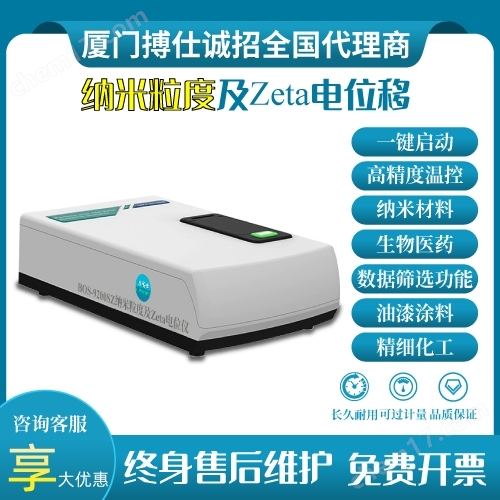
Nano particle size and Zeta potential analyzer
NegotiableUpdate on 01/16
- Model
- Nature of the Manufacturer
- Producers
- Product Category
- Place of Origin
Overview
The nanoparticle size and Zeta potential analyzer emits a laser beam to irradiate nanoparticles, and the Brownian motion of the particles causes fluctuations in scattered light intensity over time. Detector (such as avalanche photodiode) collects 90 Scattered light signals are analyzed by autocorrelation function to determine the frequency of light intensity fluctuations, and the diffusion coefficient of particles is derived. Then, the particle size distribution is calculated based on the Stokes Einstein equation.
Product Details
Nano particle size and Zeta potential analyzerBy emitting a laser beam to irradiate nanoparticles, the Brownian motion of the particles causes the scattered light intensity to fluctuate over time. Detector (such as avalanche photodiode) collects 90 ° scattered light signals, analyzes the frequency of light intensity fluctuations through autocorrelation function, derives the diffusion coefficient of particles, and then calculates the particle size distribution according to Stokes Einstein equation:
d=3πηDkT
among which,D is the particle size,K is the Boltzmann constant,T is the temperature,η is the viscosity of the solution,D is the diffusion coefficientSome instruments combine SLS technology to further verify particle size and molecular weight by measuring scattered light intensity at different angles.
2、 Principle of Zeta potential measurement
Nano particle size and Zeta potential analyzerUnder the action of an electric field, charged particles undergo electrophoretic migration. The instrument detects the migration speed of particles (usually using a 12 ° detector to collect scattered light signals), combines phase analysis light scattering technology (PALS) to calculate electrophoretic mobility, and then converts it to Zeta potential through the Henry equation.
The Zeta potential reflects the potential difference of the shear surface of particles, and its value is directly related to the stability of colloids: the higher the absolute value, the more stable the system.
A nanoparticle analyzer is an instrument used to measure particle size and distribution, typically using an optical microscope or electron microscope for image acquisition, and then analyzed using specialized software.
2. Usage steps
1) Place the sample into the analyzer and set the required parameters.
2) Perform image acquisition to obtain particle images of the sample.
3) Use software for particle size analysis to measure parameters such as particle size, shape, and distribution.
ζ=ε・f(α)not
among which,Zeta is the Zeta potential,μ is the electrophoretic mobility,ε is the dielectric constant,F (κ a) is the Henry function (related to particle shape and double-layer thickness).


Similar Product Recommend