- Phone
-
Address
No. 88 Kechuang 6th Street, Beijing Economic and Technological Development Zone
Product Categories
Beijing Baitai Paike Biotechnology Co., Ltd

How to use mass spectrometry for protein analysis - Biotec Biotech
NegotiableUpdate on 05/20
- Model
- Nature of the Manufacturer
- Producers
- Product Category
- Place of Origin
Overview
How to use mass spectrometry for d #224; nb #225; izh #236; Analysis - Baitai Paike Biotechnology Detection Technology Service: Mass spectrometry technology is a method of separation and detection based on the mass charge ratio (m/z) of ionized molecules, widely used in d #224; nb #225; izh #236; analysis. By ionizing the sample molecules and accelerating and deflecting them in an electric or magnetic field, separation is achieved based on the differences in ion mass and charge. The intensity and mass to charge ratio of the ions are then recorded by a detector to obtain the mass spectrum of the sample. This technology enables d #224; nb #225; izh #236; Analysis becomes more efficient and effective; #232; Can conduct in-depth research on d
Product Details
How to use mass spectrometry for protein analysis - Biotec BiotechIntroduction to Testing Technology Services Details
Mass spectrometry technology is a method for separation and detection based on the mass charge ratio (m/z) of ionized molecules, widely used in d à nb á izh ì analysis. By ionizing the sample molecules and accelerating and deflecting them in an electric or magnetic field, separation is achieved based on the differences in ion mass and charge. The intensity and mass to charge ratio of the ions are then recorded by a detector to obtain the mass spectrum of the sample. This technology makes d à nb á izh ì analysis more efficient and effective, enabling in-depth research on the structure, function, and interactions of d à nb á izh ì.
1、 Key steps of mass spectrometry for d à nb á izh ì analysis
1. Preparation of d à nb á izh ì samples: d à nb á izh ì samples can be simple d à nb á izh ì (such as purified d à nb á izh ì solution, purity>90%), or complex mixtures (such as cell lysate, tissue extract). In the preparation process, SDS-PAGE gel electrophoresis, affinity chromatography, gel filtration and other methods are often used for the separation and purification of d à nb á izh ì to ensure that the subsequent d à nb á izh ì analysis is more efficient.
2. Proteolysis: Proteolysis is an important step in d à nb á izh ì analysis. Due to the large molecular weight of intact d à nb á izh ì, direct analysis is difficult, and it is usually necessary to hydrolyze d d à nb á izh ì into smaller peptide segments before mass spectrometry analysis. The commonly used enzymes include y í d à nb á im é i (Trypsin), which can cleave lysine and arginine at d à nb á izh ì, producing peptides consisting of 6-40 amino acid residues.
3. Mass spectrometry analysis: The peptide segments after enzymatic hydrolysis are analyzed using a mass spectrometer. A mass spectrometer typically consists of three parts: an ion source, a mass analyzer, and a detector. Ion source is responsible for the ionization of peptide segments, and the common methods are electric spray ionization (ESI) and matrix assisted laser desorption/ionization (MALDI). Mass analyzers separate ions based on their mass to charge ratio, commonly used methods include ion traps, time-of-flight (TOF), quadrupole, and Orbitrap. The detector records the intensity and mass to charge ratio of ions, generates mass spectra, and provides data for subsequent d à nb á izh ì analysis.
4. Database retrieval and d à nb á izh ì qualitative analysis: The obtained mass spectrometry data needs to be compared with the d à nb á izh ì database. This step usually uses specialized software to match the actual mass spectrometry image with the theoretical mass spectrometry image (i.e. the predicted peptide mass spectrometry image after d à nb á izh ì enzymatic hydrolysis) through algorithms, and evaluate the reliability of the identification results in the form of scoring.
2、 Application of Mass Spectrometry in D à nb á izh ì Analysis
1. Sequencing of d à nb á izh ì: The amino acid sequence of d à nb á izh ì can be determined by mass spectrometry technology. Generally, after enzymatic hydrolysis of d à nb á izh ì, the molecular weight of each peptide segment is detected by mass spectrometry, and combined with database search, the sequence of d à nb á izh ì is inferred.
2. Post translational modification analysis of d à nb á izh ì: Mass spectrometry technology can detect post translational modifications of d à nb á izh ì, such as phosphorylation, acetylation, ubiquitination, etc. By analyzing the mass spectra of peptide segments near the modification site, the type and site of modification can be determined, revealing the effect of modification on the function of d à nb á izh ì.
3. Quantitative analysis of d à nb á izh ì: Mass spectrometry technology can also be used for quantitative analysis of d à nb á izh ì. By using isotope labeling (such as iTRAQ, TMT) or label free quantification (such as LFQ) methods, the mass spectrometry signal intensity of d à nb á izh ì or specific peptide segments can be measured to determine the relative or ju é du ì abundance of d à nb á izh ì. This enables d à nb á izh ì analysis to conduct in-depth research on the expression changes of d à nb á izh ì under different conditions.
4. Study on the interaction between d à nb á izh ì: Mass spectrometry technology combined with d à nb á izh ì interaction experiments (such as immunoprecipitation IP) can identify and analyze the interaction network between d à nb á izh ì. This helps to reveal the function and regulatory mechanism of d à nb á izh ì in cellular signaling pathways.
Mass spectrometry technology will continue to expand its application scope in the fields of life sciences and biomedicine, especially in the analysis of d à nb á izh ì, providing more efficient and effective analytical methods, and providing strong support for revealing the mysteries of d à nb á izh ì and solving major scientific problems.
Baitai Paike Biotechnology Characteristic Project
1、 Protein sequencing
Biotec Biotech uses Thermo's newly launched Obitrap Fusion Lumos mass spectrometer and Shimadzu's Edman degradation sequencing system to analyze the d à nb á izh ì sequence, providing mass spectrometry based protein sequencing analysis services, including amino acid composition analysis of d à nb á izh ì, Ndu ā nc è x ù, Cdu ā nc è x ù, and full sequence analysis, as well as d à nb á izh ì N-terminal sequence analysis services based on Edman degradation. For unknown theoretical sequences, we provide de novo sequencing services based on de novo sequencing to analyze protein sequences.
※ Service advantages:
1. Adopting the world's advanced mass spectrometer Obitrap Fusion Lumos;
2. It can achieve 100% coverage of the measured target protein sequence;
3. It can determine up to 70 amino acid sequences at the N-terminus of proteins;
4. Can measure various forms of samples: protein solution, PVDF protein bands;
5. Low sample usage: Protein samples only require 5-10ug to complete detection;
6. Sequencing is not affected by N-terminal modifications such as blocking, PEC, and glycosylation.
2、 D à nb á izh ì omics
Biotec Biotech uses Thermo Fisher's Orbitrap Fusion Lumos mass spectrometry platform combined with Nano LC to provide a variety of d à nb á izh ì omics analysis services, including quantitative d à nb á izh ì omics, targeted d à nb á izh ì omics, proteomics, post-translational modified proteomics, and more. In addition, Baitai Paike Biotechnology has launched a 4DD à nb á izh ì omics service based on timsTOF Pro, which helps with research in micro sample proteomics, large sample population medicine, and high-throughput modification genomics.
※ Service advantages:
1 . High throughput quantitative protein analysis: Large scale experimental analysis with multiple control groups, discovering new biomarkers;
2. Multiple in vitro and in vivo labeling methods are suitable for analyzing various samples such as tissues, cells, and blood;
3. High sensitivity of mass spectrometry analysis and high repeatability of experimental results;
4. Can detect low abundance proteins with a wide linear range;
5. Bioinformatics analysis is more systematic and accurate.
3、 Single cell mass spectrometry flow cytometry analysis
Baitai Paike Biotechnology uses the Fluidigm mass spectrometry flow cytometry system for single-cell mass spectrometry analysis. Metal element markers (usually metal element labeled specific antibodies) are used to label molecules on the surface and inside of cells. Then, individual cells are separated using flow cytometry principles, and the atomic mass spectrum of individual cells is analyzed using inductively coupled plasma mass spectrometry (ICP-MS). The atomic mass spectrum data is then converted into signal molecule expression levels on the cell surface and inside.
※ Service advantages:
1. Advanced technology, filling technological gaps
The use of metal labeled antibody technology avoids the problem of few and easily interacting channels in traditional flow cytometry fluorescence. At the single-cell level, multiple indicators can be characterized simultaneously, and Baitai Paike Biotechnology can detect 51 target proteins simultaneously.
2. Large analysis quantity and low cost
Single cell RNAseq is limited by factors such as cost, and the total number of analyzed cells for all samples is generally around 2x10 ^ 4. However, flow cytometry technology can analyze at least 10 ^ 5 cells in one sample, achieving an order of magnitude increase, and the cost is not higher than that of single-cell RNAseq.
3. Great application prospects
① The results of flow cytometry can provide changes in cell subpopulations, which have great research prospects in clinical diagnosis, disease mechanism research, and other fields;
② Combining metal tag technology with other technologies will lead to new application directions. In addition to conventional proteins, mass spectrometry flow cytometry technology can also be used for post-translational modification of proteins;
③ Can detect cell survival rate, cell size, mRNA transcript expression level, DNA synthesis rate, and protease activity.
4、 Immunopeptide omics analysis and novel antigen discovery based on high-precision mass spectrometry
The one-stop solution for high-precision mass spectrometry based immunopeptidomic analysis and new antigen discovery from Biotec Biotech includes our proprietary, highly sensitive immunopeptide enrichment and identification scheme. We can assist you in identifying and recognizing over 10000 type I peptides and over 10000 type II peptides. Through our optimized high-throughput immunopeptidomic analysis platform, immunopeptidomic analysis can be performed with reproducible identification and quantification from small sample materials. This service can be applied to large-scale research, aiming to assist researchers in finding solutions for cancer, immune diseases, and infectious diseases, and to explore unknown targets in depth.
5、 Characterization of Biopharmaceuticals
Baitai Parker is based on high-resolution mass spectrometry technology, MALDI TOF, High performance chromatography separation technology provides a range of biological drug analysis solutions, from amino acid composition and primary structure analysis of biological products such as d à nb á izh ì, peptides, antibodies, vaccines, to product variability and purity analysis. Intended to provide high-quality biopharmaceutical analysis services and assist biopharmaceutical manufacturers in improving the quality of biopharmaceuticals.
Baitai Paike Biotechnology's Seven Major Testing Platforms
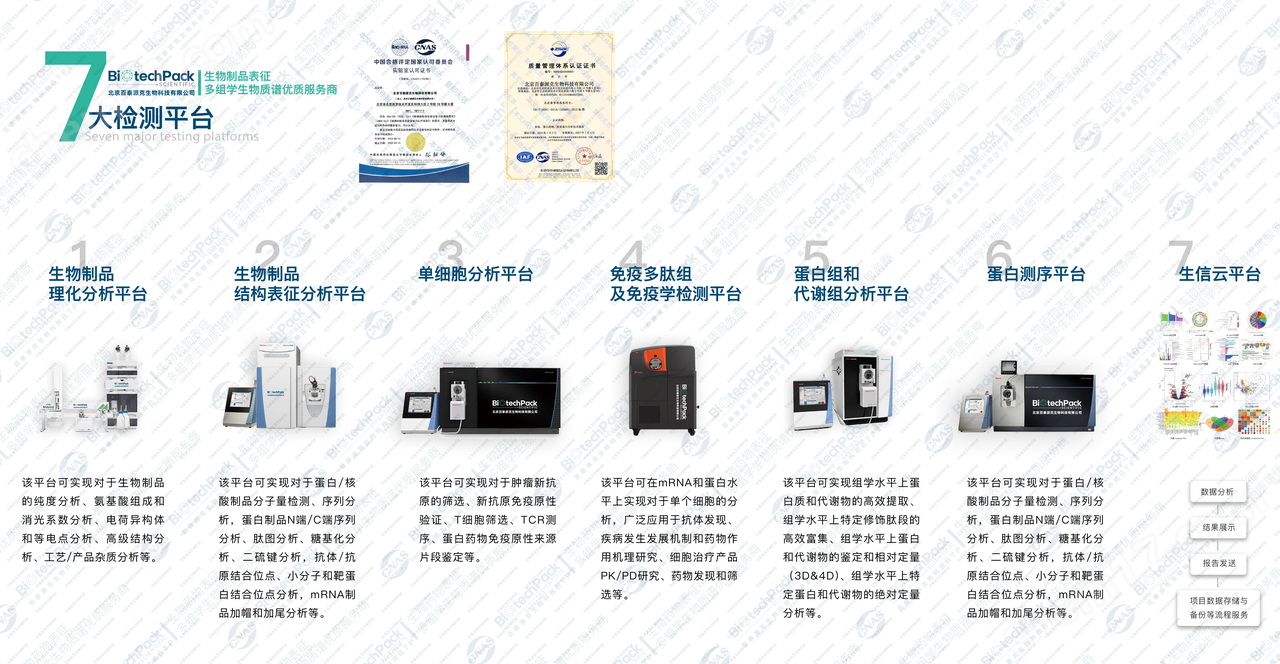
Baitai Paike Biotechnology - High quality service provider for characterization of biological products and multi omics of biological mass spectrometry
Beijing Baitai Paike Biotechnology Co., Ltd. is committed to providing quality control testing and project validation services for the biological/pharmaceutical and medical device industries. The company's laboratory follows regulations and guidelines such as NMPA, ICH, FDA, and EMA, and has obtained CNAS/ISO9001 dual quality system certification. It has established a complete quality system, including data cold and hot/remote backup, regular equipment measurement/periodic verification, software audit tracking, and provides customers with integrated solutions and technical services to support new drug research and development, drug application registration, and production release.
1. The company adopts the ISO9001 quality control system and provides CRO detection and analysis services based on mass spectrometry;
2. Recognized by the National CNAS Laboratory, we provide customers with drug quality research services that comply with global pharmaceutical regulations;
3. The business scope covers omics, proteomics, metabolomics, biopharmaceutical characterization, single-cell analysis, single-cell mass spectrometry flow cytometry, bioinformatics cloud analysis, and multi omics integrated analysis of biological mass spectrometry;
4. Seven major quality control testing platforms to meet your one-stop service needs;
5. Providing services to over 3000 enterprises and 10000+customers;
6. Committed to providing you with high-quality biological mass spectrometry analysis services!
How to use mass spectrometry for protein analysis - Biotec BiotechIntroduction to Testing Technology Services Details
Similar Product Recommend


