- Phone
-
Address
289 Fangcheng Avenue
Product Categories
Jiangsu Jiuming Special Steel Co., Ltd
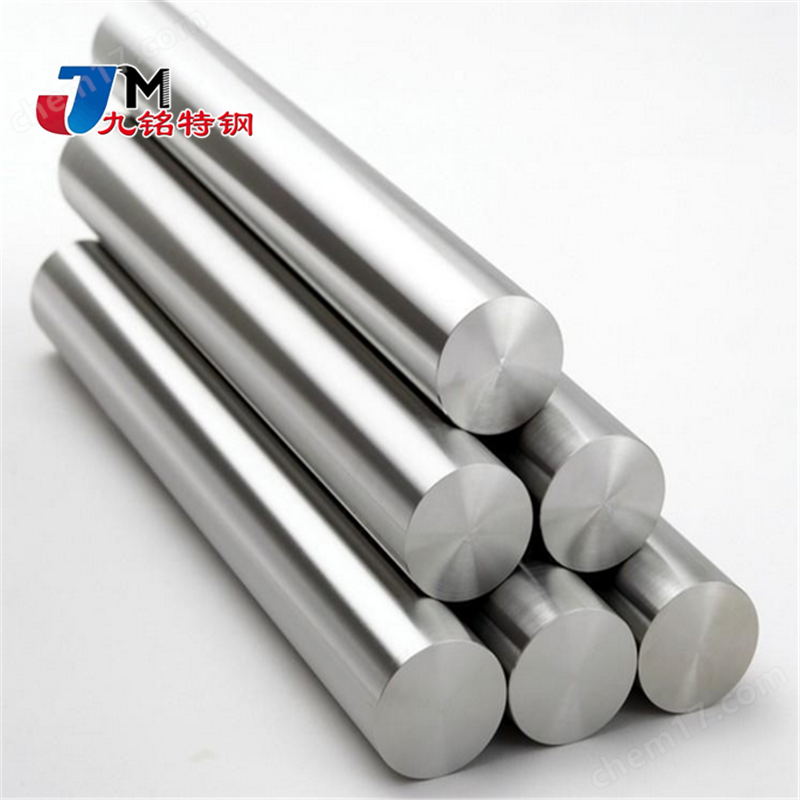


GH710 high-temperature alloy
NegotiableUpdate on 05/06
- Model
- Nature of the Manufacturer
- Producers
- Product Category
- Place of Origin
Overview
GH710 high-temperature alloy GH4710 is a Ni Cr Co based precipitation hardening deformation high-temperature alloy, which has excellent strength, sulfur corrosion resistance, oxidation resistance, and good structural stability at high temperatures. This alloy is widely used in aviation, aerospace, energy and other fields, especially in the manufacturing of high-temperature components for aircraft engines, such as turbine blades, combustion chambers, etc.
Product Details
GH710 high-temperature alloy
GH4710 Overview
GH4710 is a Ni Cr Co based precipitation hardening deformation high-temperature alloy, which can also be used as a casting alloy with a working temperature of up to 980 ℃. Alloys have high strength, high sulfur corrosion resistance, oxidation resistance, and good structural stability below 900 ℃. It can manufacture turbine rotor blades and discs, as well as integral gas turbine rotors. The main products include bars, forgings, disc forgings, and precision castings.
GH710 high-temperature alloyApplication Overview and Characteristics
Alloy has been used to manufacture integral turbine discs for turboshaft engines, applied in helicopters and oilfield generators.
After long-term aging, the high-temperature plasticity, room temperature tensile strength, and yield strength of the alloy all significantly decrease. The higher the aging temperature, the greater the decrease, but the change in high-temperature strength is relatively small. After long-term aging at 850 ℃ and 950 ℃, the cold and hot fatigue life of the alloy is significantly reduced due to the precipitation of needle like phases. After long-term aging at 850 ℃, the durability of the material can be restored to 90% and the durability plasticity can be restored to its original level after re heat treatment.
GH4710 Material Technical Standard
GB/T 14992 Classification and grades of high-temperature alloys and intermetallic compounds
Heat treatment process of HB/Z 140 aviation high-temperature alloy
HB 5423 aviation GH710 alloy billet forging
GH4710 Melting Process
The deformation alloy is melted using vacuum induction furnace+vacuum consumable remelting, or vacuum induction furnace+electroslag remelting process.
GH4710 Chemical Composition
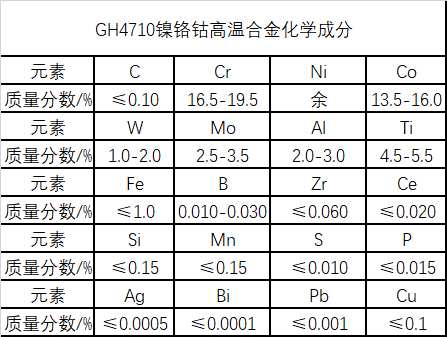
GH4710 Heat Treatment System
a) Plate forging: 1170 ℃± 10 ℃× 4h/AC+1080 ℃± 10 ℃× 4h/AC+845 ℃± 10 ℃× 24h/AC+760 ℃± 10 ℃× 16h/AC, HV ≥ 370;
b)精铸件, 1150℃±10℃×2h/AC+1065℃±10℃×4h/AC+760℃±10℃×16h/AC。
GH4710 density
ρ=8.08g/cm³
Performance specified in GH4710 technical standard
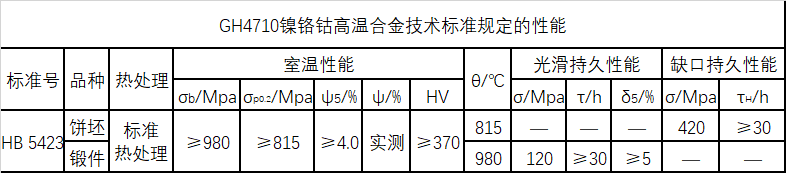
GH4710 heat treatment
(1) Due to the high content of C, AI, and Ti in GH4710 alloy, element segregation is prone to occur during the solidification process of the alloy ingot, especially the formation of large-sized MC carbides and a certain amount of eutectic of γ '+γ phase, which seriously affects the hot workability of GH4710 alloy.
(2) After undergoing 1140 ℃/30h+1190 ℃/40h and AC homogenization treatment, the eutectic phase of GH4710 alloy dissolves back, the size of MC carbides decreases, and it has good hot working plasticity.
