-
Phone
15921165535
-
Address
No. 418 Huajing Road, Shanzhong Science and Technology Park, Waigaoqiao Free Trade Zone, Pudong New Area, Shanghai
Product Categories
Duzhi Instrument (Shanghai) Co., Ltd

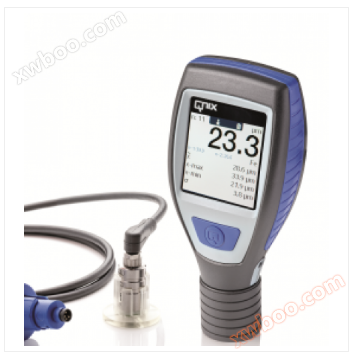
GE General Electric MIC 20 2-in-1 Hardness Tester
NegotiableUpdate on 01/11
- Model
- Nature of the Manufacturer
- Producers
- Product Category
- Place of Origin
Overview
MIC 20 is a multifunctional 2-in-1 detector that combines UCI (Ultrasonic Contact Impedance) method and rebound detection method (standardized according to ASTM A956, A 1038, and DIN 50156, 50159). The UCI method is used to detect small and complex shaped parts, including fine-grained metals, while the rebound method is preferred for larger, coarse-grained forgings and castings.
Product Details
product description
MIC 20 is a multifunctional 2-in-1 detector that combines UCI (Ultrasonic Contact Impedance) method and rebound detection method (standardized according to ASTM A956, A 1038, and DIN 50156, 50159). The UCI method is used to detect small and complex shaped parts, including fine-grained metals, while the rebound method is preferred for larger, coarse-grained forgings and castings.
Guided operation method, easy to operate:
You can directly see the measured values displayed on the large color LCD or color TFT monitor based on the selected hardness table. The graphical user interface displayed on the monitor is adapted to the well-known Windows standard and is visually appealing. You don't need any mouse operation, just touch the touch screen with a pen to set functions. Traditional buttons can also be used to set functions.You will quickly adapt to this operating concept: three main menus ensure easy access to important functions - so you cannot get lost in the menu maze!For example, MIC 20 makes calibration easy for you. Simply press a button or "click" in the corresponding application to archive and retrieve settings parameters.Direct storage enables convenient and organized storage and management of detection data. MIC 20 also has the functions you need for analysis: you can display your series of measurements as curves, histograms, or as tables (including statistical data). You can directly print data on the printer or transfer them to a PC through the UltraDAT application software. You can use standard applications such as Windows for further processing, evaluation, and statistics.


Combination hardness tester including quasi-static UCI hardness testing method (ASTM A1038) and dynamic hardness testing based on rebound method (ASTM A956)
mainFEATURES AND BENEFITS
UCI probes can be used to detect the hardness of fine-grained materials or heat-treated surfaces with different qualities and shapes
Rebound impact device is used to detect the hardness of large coarse-grained components, forgings, and casting materials
Automatic conversion of units into HV, HB, HRC, HRB, HS, HL, and N/mm2
Easy to input alphanumeric mixed data using buttons and/or integrated touch screen operation
Power supply: power adapter (100V-240V) or NiMH battery pack MIC 20-BAT (internal charging)
Internal data storage for approximately 5000 series measurements
Quick and easy calibration of various measuring materials. Save calibration data and make it available for retrieval
No need to input any correction factors when measuring in different testing directions
The large color TFT display immediately displays all necessary information during the measurement process, such as average values, single values, or statistical data
A clearly arranged data storage device stores measurement results in a simple and organized manner, allowing for the retrieval and editing of a series of measurement values.
Double benefit:
These two methods allow you to measure the hardness of the object being tested in seconds: place the probe or impact device on the object being tested, and then read the detection value on the display screen. Through this method, you can measure from anywhere and in any direction. We have adopted a signal processing technique that enables the rebound hardness method to have this advantage, just like the UCI method. Not only that, these two methods also have the following characteristics: convenient and fast calibration, and the ability to display measurement results according to commonly used hardness systems. Handle daily on-site inspections with ease with MIC 20.
 |
Application scenarios: UCI hardness testing: Assembled machine
Heat affected zone of welding points (such as pipelines)
Heat treated surface (such as tooth surface)
Coating (such as rotary concave printing drum)
Rebound hardness testing: Steel and cast aluminum alloy machine parts or motor devices
Large solid coarse-grained components with a rough surface as if in a rolled state
Large quantities of parts in production
Heavy forging |

|
|
Technical Parameter |
|
|
Testing method |
UCIMethod: According to the Vickers hardness testing method and the evaluation of dents under underload, use a hardness test indenter to test the hardness. Rebound method based onASTMstandard specificationA956Dynamic detection method, rebound(Rp)And with impact(Ip)Speed ratio, Leeb hardness outputHL = 1000 Rp/Ip |
|
range |
20 - 1740 HV |
|
Rebound impact device |
Choose according to the application scenario |
|
measuring range/transform(UCI) |
20-1740 HV / 76-618 HB / 41-105 HRB / 20.3-68.0 HRC / 255-2180 N/mm²(Only contains)98 N/10 kgfHandheld probe |
|
measuring range/Conversion (rebound) |
Depending on the material composition and impact device: |
|
monitor |
Color monitor or color displayTFTmonitor,1/4 VGA, 5.7”, 115.2 mm x 76.8 mm (4.5” x 3.0”) |
|
Dialogue language |
German, English (Other) |
|
convert |
Automatically based onDIN 50150、ASTM E 140 |
|
assessment |
The detection data is displayed in the form of a curve graph, histogram, or table; Calculate statistical data (such as mean, standard deviation, range) |
|
Automatic shutdown of the instrument |
After a certain period of time, the user can choose to automatically save the detection data and instrument settings |
|
keyboard |
Sealed membrane keyboard with integrated touch screen |
|
Operating time |
useNiMHbattery packMIC 20-BATContinuous operation approximately4hour |
|
Battery charging indicator |
Low battery indicator, the instrument automatically shuts down when the battery is low |
|
operating system |
WinCE |
|
interface |
two-wayRS-232, Ethernet10 Mbit |
|
operating environment |
Operation:0 °C ~ 50 °C (-32 °F ~ 122 °F) |
|
weight |
~1.4 kg / 3.1 lbs(includingMIC 20-BAT) |
|
size |
78 mmtallx 215 mmwidex 180 mmdeep(3.1'tallx 8.5'widex 7.1'deep) |
Similar Product Recommend