-
E-mail
742805758@qq.com
-
Phone
15216837090
-
Address
No. 601 Dongshe Road, Dongjing Town, Songjiang District, Shanghai
Product Categories
Shanghai Yuyang Science and Education Equipment Co., Ltd

Experimental device for photocatalytic removal of air pollutants and purification treatment
NegotiableUpdate on 01/06
- Model
- Nature of the Manufacturer
- Producers
- Product Category
- Place of Origin
Overview
Functional characteristics of the experimental device for photocatalytic removal and purification of air pollutants: The photocatalyst (currently widely used as TiO2) has a special energy band structure that is different from metals or insulating substances, that is, there is a bandgap between the valence band and the conduction band. When the photon energy is higher than the absorption threshold of the photocatalyst, the valence band electrons of the photocatalyst undergo interband transitions, that is, from the valence band to the conduction band, thereby generating photo induced electrons (e -) and holes (h+).
Product Details
YUY-HJ550Experimental device for photocatalytic removal of air pollutants and purification treatment
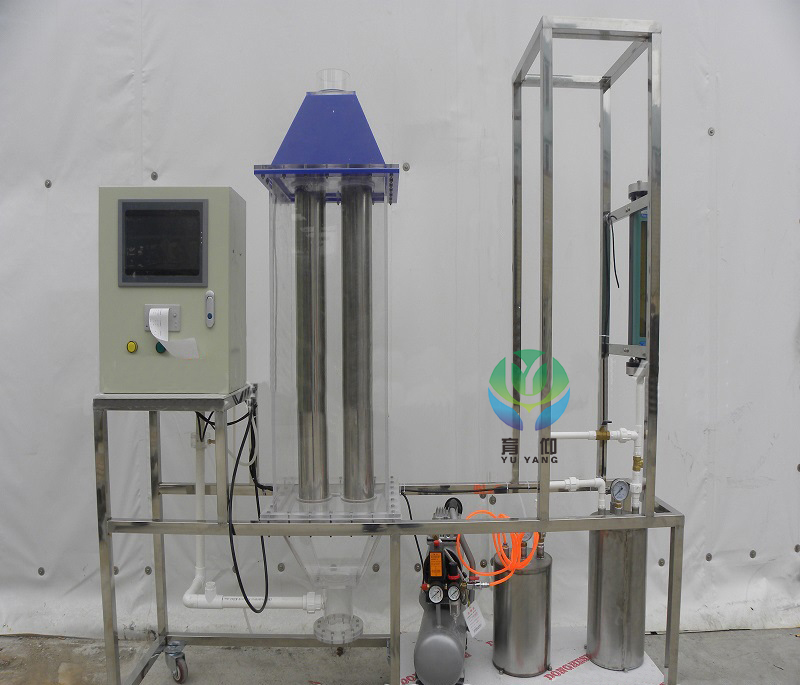
1Experimental device for photocatalytic removal of air pollutants and purification treatmentFeatures:
Photocatalysts (currently widely used as TiO2) have a unique energy band structure that distinguishes them from metals or insulating materials. There is a bandgap between the valence band and the conduction band. When light with photon energy higher than the absorption threshold of the photocatalyst is irradiated on the photocatalyst, the valence band electrons of the photocatalyst undergo interband transitions, that is, from the valence band to the conduction band, thereby generating photo induced electrons (e -) and holes (h+). At this time, the dissolved oxygen adsorbed on the surface of the photocatalyst (usually in the form of nanoparticles) captures electrons to form active oxygen ions, while the holes oxidize the hydroxide ions and water adsorbed on the catalyst surface into hydroxyl radicals. And reactive oxygen species and hydroxyl radicals have strong oxidizing properties, which can oxidize and destroy the vast majority of organic matter, and even decompose some inorganic substances, thereby degrading pollutants near the catalyst surface.
The gas-solid multiphase photocatalytic reaction process can be expressed as:
(1) The generation of photo induced electrons and holes;
(2) Adsorption of O2, H2O, and organic compounds on the catalyst surface;
(3) The generation of oxidants;
(4) Catalytic decomposition of organic compounds and other steps. The necessary conditions for photocatalytic conversion are the photocatalyst and a certain level of light exposure.
This experimental system is mainly used to demonstrate the process of photocatalytic conversion experiments.
2、 Main parameters:
1. Equipment processing capacity of 1-5m3/h
2. Photocatalytic reactor size: 350 × 350 × 800mm
3. Device dimensions: 1800 × 500 × 1700mm
4. Voltage: 220V, power 700W
3、 Equipment configuration:
1. Microcomputer methanol inlet
2. 1 set of concentration detection
3. 1 set of wind pressure detection
4. One set of 10.4-inch color LCD touch screen is used
5. 1 set of data processing and analysis system
6. 1 communication interface
7. 1 set of online temperature and humidity detection
8. 1 set of micro printer
9. 1 set of organic glass photocatalytic reaction column
10. 4 sets of photocatalytic reactors
11. 1 set of gas mixer
12. 1 set of activated carbon adsorption tank
13. 4 quartz tubes, 4 ultraviolet lamps
14. 1 barrel of nanomaterials
15. 1 fan
16. 2 gas flow meters
17. 1 set of methanol gas and steel cylinder (8L)
18. 1 electric control box
19. Leakage protection switch
20. Button switch
21. One batch of PVC connecting pipes
22. Composed of stainless steel brackets, etc.
Similar Product Recommend


