- Phone
-
Address
Room 726, Building 2, No. 55 Meisheng Road, Pudong New Area Pilot Free Trade Zone, Shanghai (Baozhou Innovation Center)
Product Categories
Shanghai Pumin Industrial Automation Equipment Co., Ltd

EBRO Pneumatic Butterfly Valve Z011-A Series Original Factory Stock
NegotiableUpdate on 05/14
- Model
- Nature of the Manufacturer
- Producers
- Product Category
- Place of Origin
Overview
The main advantages of EBRO pneumatic butterfly valve Z011-A series factory stock $r $n EBRO pneumatic butterfly valve are simple structure, small volume, light weight, and low cost. This feature is particularly prominent for EBRO pneumatic butterfly valve, which is installed in high-altitude dark passages and is easy to operate through a two position five way solenoid valve control. It can also adjust the flow medium. The fluid resistance is relatively small. When the EBRO pneumatic butterfly valve with a medium to large diameter is fully opened, the effective flow area is large, and the opening and closing are quick and effortless. The disc can be opened and closed by rotating the disc lever 90 degrees. Due to the nearly equal force of the medium on both sides of the rotating shaft, the torque direction generated is opposite,
Product Details
EBRO Pneumatic Butterfly Valve Z011-A Series Original Factory Stock
The main advantages of EBRO pneumatic butterfly valve are simple structure, small volume, light weight, and low cost. This feature is particularly significant for EBRO pneumatic butterfly valve, which is installed in high-altitude tunnels and is easy to operate through a two position five way solenoid valve control. It can also adjust the flow medium. The fluid resistance is small, and the EBRO pneumatic butterfly valve with a medium to large diameter has a large effective flow area when fully opened, making opening and closing quick and effortless. The disc can be rotated 90 degrees to complete the opening and closing. Due to the nearly equal force of the butterfly plate hand medium on both sides of the shaft, the torque direction is opposite, resulting in a small opening and closing torque. Good sealing can be achieved under low pressure. Butterfly valve sealing materials include nitrile rubber, fluororubber, edible rubber, and PTFE lining, so the sealing performance is good. Among them, the hard sealed butterfly valve is a soft hard laminated metal sheet with the advantages of metal hard sealing and elastic sealing. It has excellent sealing performance under low temperature conditions.
The EBRO pneumatic butterfly valve is composed of a pneumatic actuator and a butterfly valve. Pneumatic butterfly valve is a pneumatic valve that uses a circular butterfly plate that rotates with the valve stem for opening and closing, to achieve activation action. It is mainly used as a block valve, but can also be designed with the function of regulating or both. Butterfly valves are increasingly used in low-pressure large and medium diameter pipelines. Classification of Pneumatic Butterfly Valves: Stainless Steel Pneumatic Butterfly Valve, Hard Seal Pneumatic Butterfly Valve, Soft Seal Pneumatic Butterfly Valve, Carbon Steel Pneumatic Butterfly Valve. The main advantages of pneumatic butterfly valves are simple structure, small size, light weight, and low cost. This feature is particularly significant for pneumatic butterfly valves, which can be installed in high-altitude tunnels and controlled by a two position five way solenoid valve for easy operation. They can also adjust the flow medium.
Characteristics of EBRO pneumatic butterfly valve:
1. Compact and lightweight, easy to disassemble and repair, and can be installed in any position.
2. The structure is simple and compact, with low operating torque and quick opening of 90 ° rotation.
3. The flow characteristics tend towards a straight line, with good regulation performance.
4. The connection between the butterfly plate and the valve stem adopts a pin free structure, which overcomes the possible internal leakage points.
5. The outer circle of the butterfly plate adopts a spherical shape, which improves the sealing performance and extends the service life of the valve. It can be opened and closed under pressure for more than 50000 times and still maintain zero leakage.
6. The sealing components are replaceable and the sealing is reliable, achieving bidirectional sealing.
7. Butterfly plates can be coated with coatings such as nylon or polytetrafluoroethylene according to user requirements.
8. This valve can be designed for flange connection and clamp connection.
9. The driving mode can be selected as manual, electric or pneumatic.
EBRO Pneumatic Butterfly Valve Z011-A Series Original Factory Stock
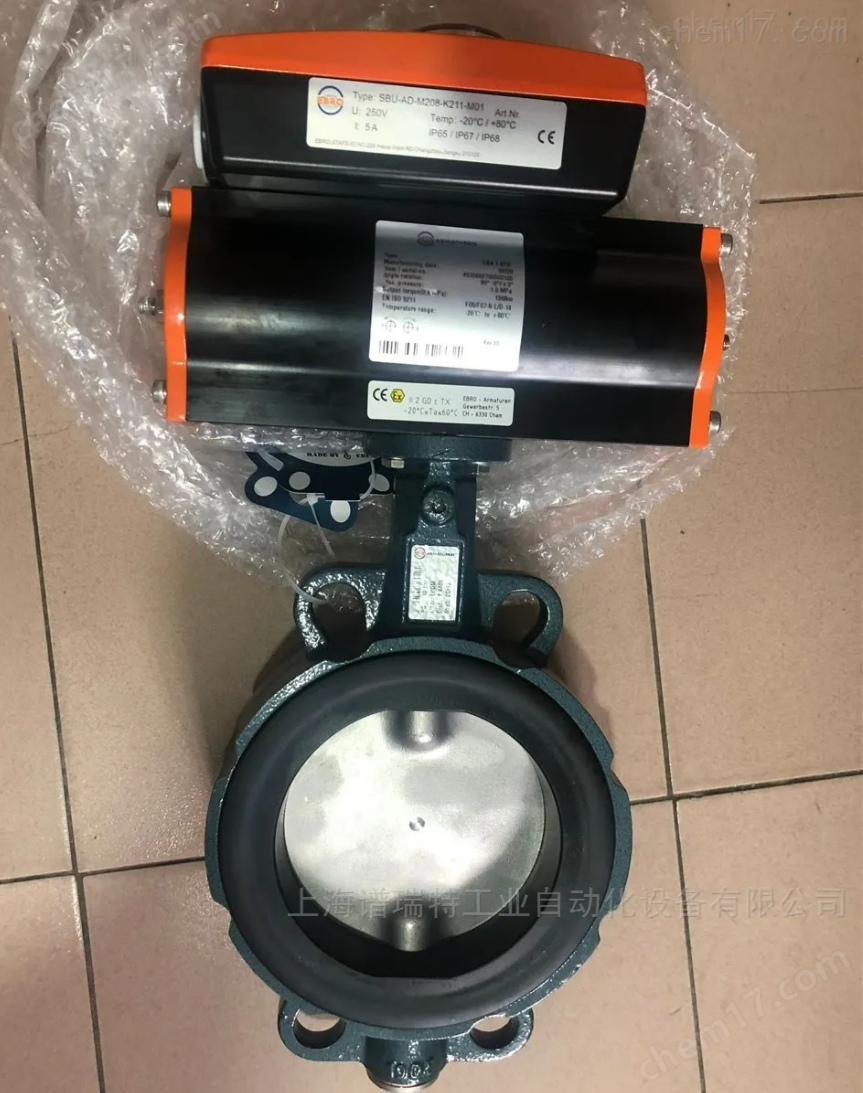
German EBRO E-Boluo Pneumatic Valve Z011-A Series Products
Yibuoluo Pneumatic Butterfly Valve Z011-A DN50
Yibuoluo Pneumatic Butterfly Valve Z011-A DN65
Yibuoluo Pneumatic Butterfly Valve Z011-A DN80
Yibuoluo Pneumatic Butterfly Valve Z011-A DN100
Yibuoluo Pneumatic Butterfly Valve Z011-A DN125
Yibuoluo Pneumatic Butterfly Valve Z011-A DN150
Yibuoluo Pneumatic Butterfly Valve Z011-A DN200
Yibuoluo Pneumatic Butterfly Valve Z011-A DN250
Yibuoluo Pneumatic Butterfly Valve Z011-A DN300
Yibuoluo Pneumatic Butterfly Valve Z011-A DN350
Full range of EBRO pneumatic actuators from Germany
German EBRO pneumatic actuator EB4.1SYD
EB5.1SYD pneumatic actuator EBRO, Germany
EBRO pneumatic actuator EB6.1SYD from Germany
German EBRO pneumatic actuator EB8.1SYD
EBRO pneumatic actuator EB10.1SYD from Germany
EB12.1SYD pneumatic actuator EBRO, Germany
EB265.1SYD pneumatic actuator EBRO, Germany
EB270.1SYD pneumatic actuator, EBRO, Germany
Working principle of EBRO pneumatic butterfly valve:
Pneumatic butterfly valve is a type of valve that uses a circular butterfly plate that rotates with the valve to achieve opening and closing, and is mainly used as a block valve to achieve activation. It can also be designed to have the function of regulating or regulating both section valves. Disc valves are increasingly used in low-pressure large and medium diameter pipelines.
Butterfly valves have a simple structure, small size, and light weight, consisting of only a few components. And it only needs to rotate 90 ° to quickly open and close, with simple operation. At the same time, this electric valve has good fluid control characteristics. When the butterfly valve is in the * open position, the thickness of the butterfly plate is the single resistance when the medium flows through the valve body, so the pressure drop generated by passing through the valve
It is very small, so it has good flow control characteristics. Butterfly valves have two sealing types: elastic sealing and metal sealing. Elastic sealing valve, the sealing ring can be embedded on the valve body or attached around the butterfly plate.
If butterfly valves are required for flow control, the main thing is to choose the correct size and type of valve. The structural principle of butterfly valves is particularly suitable for making large-diameter valves. Butterfly valves are not only widely used in general industries such as petroleum, gas, chemical, and water treatment, but also in the cooling water system of thermal power plants.
Installation requirements for EBRO pneumatic butterfly valve
1. Before installation, check that all parts of the pneumatic butterfly valve are intact, the model is correct, there are no debris in the valve body, and there are no blockages in the solenoid valve and muffler
2. Place both the valve and cylinder in the closed position.
3. Install the cylinder onto the valve (either parallel or perpendicular to the valve body), and check if the screw holes are aligned without significant deviation. If there is a slight deviation, rotate the cylinder block slightly and tighten the screws.
4. After installation, the pneumatic butterfly valve should be debugged (under normal circumstances, the gas supply pressure is 0.4~0.6MPa). During debugging and operation, the solenoid valve should be manually operated to open and close (manual operation can only be effective after the solenoid valve coil is de energized), and the opening and closing of the pneumatic butterfly valve should be observed. If it is found during the debugging process that the valve is struggling to open and close at the beginning, but then returns to normal, the cylinder stroke needs to be reduced (adjust the stroke adjustment screws at both ends of the cylinder inward at the same time, run the valve to the open position, and then turn off the air source before adjusting), until the valve opens and closes smoothly and without leakage. It should also be noted that the adjustable muffler can adjust the opening and closing speed of the valve, but it cannot be adjusted too small, otherwise it may cause the valve to not move.
5. Before installation, it should be kept dry and not stored outdoors
6. Before installing the butterfly valve, check the pipeline to ensure that there are no foreign objects such as welding slag inside the pipeline
7. The manual opening and closing resistance of the butterfly valve body is moderate, and the torque of the butterfly valve matches the torque of the selected actuator.
8. The flange specifications for butterfly valve connection are correct, and the pipeline clamp flange is consistent with the butterfly valve flange standard. It is recommended to use butterfly valve specific flanges and not flat welding flanges.
9. Confirm that the flange welding is correct. After the butterfly valve is installed, do not weld the flange again to avoid burning the rubber parts.
10. The installed pipeline flange should be aligned and aligned with the inserted butterfly valve.
11. Install all flange bolts and tighten them by hand to ensure that the butterfly valve is aligned with the flange. Then carefully open and close the butterfly valve to ensure flexible opening and closing.
12. Open the valve * and tighten the bolts diagonally with a wrench, without the need for washers. Do not tighten the bolts too tightly to prevent severe deformation of the valve ring and excessive opening and closing torque.
Similar Product Recommend


