-
E-mail
67843798@qq.com
-
Phone
13701492198
-
Address
Zhenglu Town Industrial Park, Tianning District, Changzhou City
Product Categories
Changzhou Jiaxiang Drying Granulation Equipment Co., Ltd
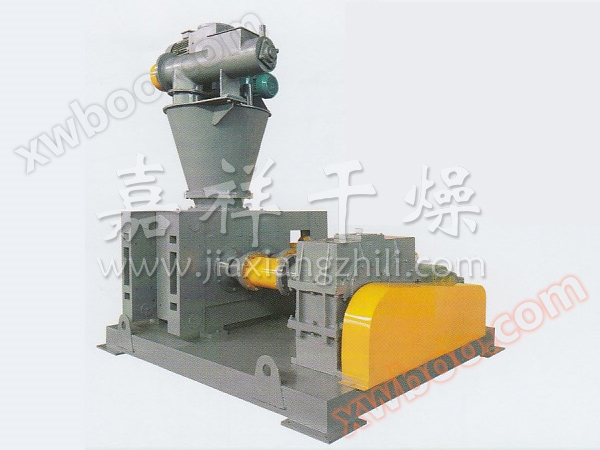
DH series dry granulation machine
NegotiableUpdate on 08/05
- Model
- Nature of the Manufacturer
- Producers
- Product Category
- Place of Origin
Overview
Product Overview: DH series dry rolling granulator adopts dry extrusion technology to compress powdered materials with a moisture content of 2% into flakes, and then through crushing, granulation, and screening processes, the flake like materials are transformed into granular materials that meet the requirements for use. Dry rolling granulation mainly relies on external pressure to force the material to pass through the gap between the two opposing rollers, compressing it into pieces. During the rolling process, the object
Product Details
Overview
The DH series dry rolling granulator adopts dry extrusion technology to compress powdered materials with a moisture content of less than 2% into pieces, and then goes through crushing, granulation, and screening processes to turn the block shaped materials into granular materials that meet the requirements for use.
Dry rolling granulation mainly relies on external pressure to force the material to pass through the gap between the two opposing rollers, compressing it into pieces. During the rolling process, the actual density of the material can increase by 1.5-3 times to meet certain requirements.
principle
Various dry powder materials are added from the top of the equipment, and after degassing and spiral preloading, they enter two equal rollers. The rollers rotate relative to each other, and the materials are forced into the gap between the two rollers. The rollers bite the materials into the gap and compress them. After passing through the compression zone, the surface tension and gravity of the materials naturally release them. The detached finger shaped agglomerates enter the crusher and are crushed by a rotating blade. The crushed material enters the granulator and is sieved by a rotary vibrating screen through a rolling blade. Qualified products are transported to the finished product warehouse through a conveyor. The powdered screened material is sent back to the raw material warehouse for secondary rolling through a conveyor, and the squeezing force can be adjusted by the pressure of the hydraulic cylinder according to the needs of the granulation operation. order
characteristic
The material is mechanically compressed and formed without the addition of any wetting agent, ensuring the purity of the product.
Directly producing dry powder without the need for subsequent drying processes is more conducive to the connection and transformation of existing production processes.
The particle strength is high, and the increase in bulk density is more significant than other granulation methods. Especially suitable for increasing the density of product stacking.
It can control environmental pollution, reduce powder waste and packaging costs, and improve product transportation capacity.
Compact structure, easy maintenance, simple operation, short process flow, low energy consumption, high efficiency, low failure rate, suitable for a wide range of raw materials, and roller pressure can be freely adjusted according to different materials.
The feeding and feeding device adopts variable frequency stepless adjustment control, with high degree of automation, capable of controlling multiple machines by one person, low labor intensity, and long-term continuous operation.
The main transmission components are made of high-quality alloy materials, stainless steel materials, titanium materials, chromium and other surface alloys, greatly improving wear resistance, corrosion resistance, high temperature resistance and pressure resistance, making the machine have a longer service life.
The DH series dry rolling granulator adopts dry extrusion technology to compress powdered materials with a moisture content of less than 2% into pieces, and then goes through crushing, granulation, and screening processes to turn the block shaped materials into granular materials that meet the requirements for use.
Dry rolling granulation mainly relies on external pressure to force the material to pass through the gap between the two opposing rollers, compressing it into pieces. During the rolling process, the actual density of the material can increase by 1.5-3 times to meet certain requirements.
principle
Various dry powder materials are added from the top of the equipment, and after degassing and spiral preloading, they enter two equal rollers. The rollers rotate relative to each other, and the materials are forced into the gap between the two rollers. The rollers bite the materials into the gap and compress them. After passing through the compression zone, the surface tension and gravity of the materials naturally release them. The detached finger shaped agglomerates enter the crusher and are crushed by a rotating blade. The crushed material enters the granulator and is sieved by a rotary vibrating screen through a rolling blade. Qualified products are transported to the finished product warehouse through a conveyor. The powdered screened material is sent back to the raw material warehouse for secondary rolling through a conveyor, and the squeezing force can be adjusted by the pressure of the hydraulic cylinder according to the needs of the granulation operation. order
By changing the groove form of the roller surface, sheet, strip, and flattened spherical materials can be obtained.
characteristic
The material is mechanically compressed and formed without the addition of any wetting agent, ensuring the purity of the product.
Directly producing dry powder without the need for subsequent drying processes is more conducive to the connection and transformation of existing production processes.
The particle strength is high, and the increase in bulk density is more significant than other granulation methods. Especially suitable for increasing the density of product stacking.
It can control environmental pollution, reduce powder waste and packaging costs, and improve product transportation capacity.
Compact structure, easy maintenance, simple operation, short process flow, low energy consumption, high efficiency, low failure rate, suitable for a wide range of raw materials, and roller pressure can be freely adjusted according to different materials.
The feeding and feeding device adopts variable frequency stepless adjustment control, with high degree of automation, capable of controlling multiple machines by one person, low labor intensity, and long-term continuous operation.
The main transmission components are made of high-quality alloy materials, stainless steel materials, titanium materials, chromium and other surface alloys, greatly improving wear resistance, corrosion resistance, high temperature resistance and pressure resistance, making the machine have a longer service life.


