-
E-mail
info@boyuesh.com
-
Phone
15921886097
-
Address
3A, Building 28, Songjiang High tech Park, Caohejing Development Zone, Lane 518, Shenzhuan Road, Songjiang District, Shanghai
Product Categories
Boyue Instrument (Shanghai) Co., Ltd


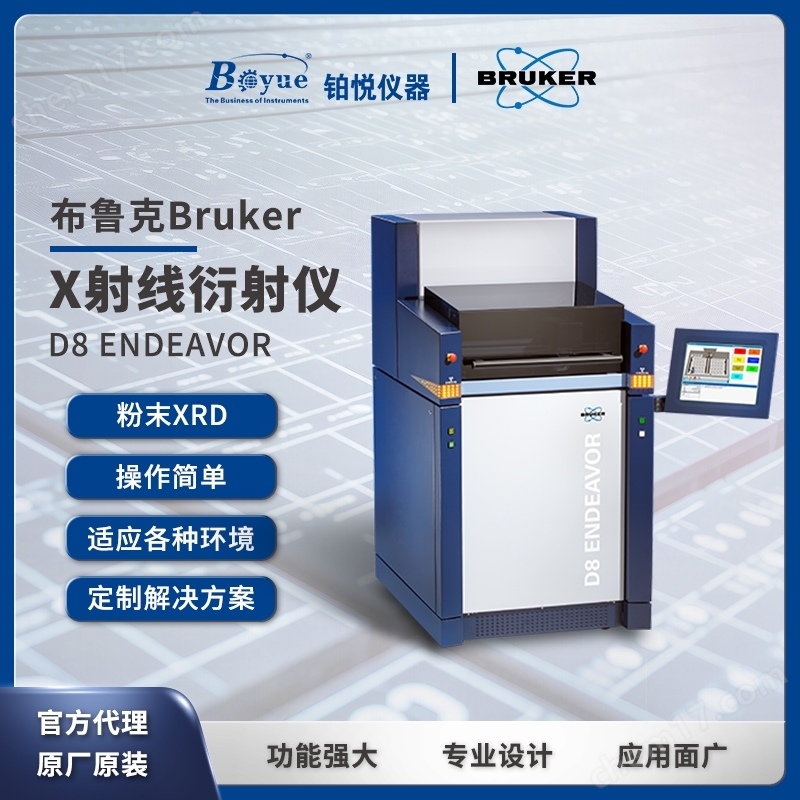
Brooke BRUKER X-ray diffractometer XRD D8
NegotiableUpdate on 02/11
- Model
- Nature of the Manufacturer
- Producers
- Product Category
- Place of Origin
Overview
The Brooke BRUKER X-ray diffractometer XRD D8 Discoverer is a flexible and versatile XRD solution that meets the research, development, and quality control requirements of both industry and academia.
Product Details
Brooke BRUKER X-ray diffractometer XRD
D8 DISCOVER

Brooke BRUKER X-ray diffractometer XRD D8 DiscovererIt is a flagship multifunctional X-ray diffractometer with better XRD performance, equipped with many cutting-edge technology components. It is designed for structural characterization of various materials, from powders, amorphous and polycrystalline materials to epitaxial multilayer films, under both environmental and non environmental conditions.
Photon/mm ² level high brightness X-ray sources with excellent brightness, such as I µ S microfocus X-ray source and HB-TXS high brightness Turbo X-ray source HB-TXS. The outer shell is spacious and can accommodate large samples with a diameter of 300 mm. The UMC sample stage can accommodate samples weighing 5 kg.
D8 Discoverer has a wide range of applications, including qualitative and quantitative phase analysis, structural determination and refinement, microstrain and microcrystal size analysis; X-ray reflection method, grazing incidence diffraction (GID), in-plane diffraction, high-resolution XRD, GISAXS, GI stress analysis, crystal orientation analysis; Residual stress analysis, texture and pole figure, micro area X-ray diffraction, wide-angle X-ray scattering (WAXS); Total scattering analysis: Bragg diffraction, distribution function (PDF), small angle X-ray scattering (SAXS), etc.

D8 DISCOVERFeatures - Micro Focus Source I µ S
The I µ S micro focus source equipped with MONTEL optical components can provide high-intensity small X-ray beams, which are very suitable for research on small ranges or samples.
· Millimeter sized beam: high brightness and ultra-low background
· Green and environmentally friendly design: low power consumption, no water consumption, extended service life
· MONTEL optical components can optimize beam shape and divergence
· Compatible with a large number of components, optical devices, and detectors from Bruker.

D8 DISCOVERFeatures - UMC Sample Stand
D8 Discoverer offers a variety of UMC platforms with better sample scanning and weight capacity, high modular performance, and can be selected or customized according to customer requirements.
· Can scan samples weighing up to 5 kg
· Large area mapping: 300mm sample
· UMC sample stage supporting high-throughput screening (HTS), capable of supporting three well plates.

D8 DISCOVERFeatures - Multi mode EIGER2 R detector
EIGER2 R 250K and 500K are 2D detectors that incorporate Synchrotron performance into laboratory X-ray diffraction.
· Excellent sensor design, including the second-generation revolutionary EIGER: 500000 pixels with a size of 75 x 75mm ², capable of achieving macro coverage with micro resolution.
· Ergonomic design: It is easy to adjust the position and direction of the detector according to application needs, including tool free switching between 0 °/90 °, continuous change of detector position, and support for automatic alignment.
· Panoramic optical components and accessories provide a wide field of view.
· 0D, 1D, and 2D operating modes: Supports snapshot, step, continuous, or high scan modes.
· Can be seamlessly integrated with DIFFRAC.SUITE.

D8 DISCOVERFeatures - TRIO Optics and PATHFINDER PLUS Optics
TRIO optical devices can automatically switch between three optical paths:
· Bragg Brentano focusing geometry for powders
· High intensity parallel beam K α 1,2 geometry for capillary, GID, and XRR analysis
· High resolution parallel beam K α 1 geometry for epitaxial thin films
The PATHFINDER Plus optical device comes with a linear automatic absorber to ensure the measured intensity and can switch between the following:
· Electric slit: used for high-throughput measurement
· Spectral crystal: used for high-resolution measurement
· Using the D8 Discoverer equipped with TRIO and PATHFINDER Plus, without the need for reconfiguration, all types including powders, block materials, fibers, sheets, and films (amorphous, polycrystalline, and epitaxial) can be mastered under environmental or non environmental conditions.

D8 DISCOVER -More features:
· SNAP-LOCK-When replacing optical components, there is no need for tools or aiming, so you can easily and quickly change the configuration.
· TRlo optics-Installed in front of a standard ceramic X-ray tube. It can automatically switch between up to 6 different beam geometries without human intervention.
· D8Angle measuring instrument-The D8 angle measuring instrument has excellent accuracy, laying the foundation for Brooke's collimation assurance.
· UMC-1516-The UMC sample stage has strong load-bearing capacity in terms of sample weight and size.
· LYNXEYE XE-T-Mainly used for 0D, 1D, and 2D data acquisition, it has excellent energy discrimination capability that is always effective, while not losing the signal of typical secondary monochromators.
· Turbo Xradiation source(TXS) - This X-ray source has a power of up to 6 kW, with an intensity five times that of standard ceramic X-ray tubes, and excellent performance in both online and point focus applications.
· MONTELoptical device-This X-ray source can provide a high brightness beam and is a reliable choice for studying mm sized samples or conducting micro area X-ray diffraction studies using μ m sized beams.
· TWIST-TUBE-It can easily switch from line focus to point focus within seconds, thereby expanding the application range to a greater extent and shortening the reconfiguration time to a greater extent.

 D8 DISCOVERSoftware Suite - Planning, Measuring, and Analyzing with DIFFRAC.SUITE
Brooke BRUKER X-ray diffractometer XRD D8 DiscovererSupport the use of multiple software and tools for data measurement and analysis, and have universal or specialized software packages for material research, powder analysis, or other different data measurement directions.
· DIFFRAC.COMMANDER - Instrument control, initiation of real-time measurements, execution of predefined methods, and real-time monitoring.
· DIFFRAC.WIZARD - Using a graphical interface to guide users in developing basic and advanced measurement methods.
· DIFFRAC.EVA - Analyze 1D and 2D datasets, including visualization, phase recognition basic statistics, and semi quantitative analysis.


Material research and analysis
· DIFFRAC.LEPTOS - Analyze the collected high-resolution and residual stress application data.
· DIFFRAC.FUTURE - Reduce and analyze texture data to determine orientation.
· DIFFRAC.LEPTOS X-ray diffraction thin film analysis.

Powder analysis
· DIFFRAC.TOPAS - an excellent XRPD data fitting software for quantitative and structural solutions.
· DIFFRAC.DQUANT - Use standard based correlation methods for quantification.
· DIFFRAC.SAXS - Qualitative and quantitative analysis of 1D and 2D small angle X-ray scattering data.

D8 DISCOVERApplication - Software Application
D8 Discoverer is suitable for various applications, including:
· Residual stress analysisIn DIFFRAC.LEPTOS, the sin2psi method is used to measure the residual stress of steel components using Cr radiation.
· μ XRD using 2D detectorUse DIFFRAC.EVA to determine the structural characteristics of small areas. Perform qualitative phase analysis and microstructure analysis by integrating 2D images and performing 1D scanning.
· Qualitative phase analysisCandidate Material Identification (PMI) is more common because it is highly sensitive to atomic structure, which cannot be achieved through elemental analysis techniques.
· High-throughput screening(HTS): Perform semi quantitative analysis in DIFFRAC.EVA to display the concentration of different phases on the well plate.
· Non environmental XRDConfigure the temperature curve in DIFFRAC.WIZARD and synchronize it with the measurement, and then display the results in DIFFRAC.EVA.
· Small angle X-ray scattering(SAXS): Particle size analysis was performed on NIST SRM 80119nm gold nanoparticles collected by 2D mode using EIGER2 R 500K in DIFFRAC.SAXS.
· Wide-angle X-ray scattering(WAXS): Perform WAXS measurement analysis on plastic films in DIFFRAC.EVA. Then the preferred orientation of plastic fibers becomes apparent.
· Texture analysisIn DIFFRAC.TEXTURE, spherical harmonics and component methods are used to generate polar plots, orientation distribution functions (ODFs), and volume quantification analysis.
· XRadiation reflectance measurement(XRR): Perform XRR analysis on the film thickness, interface roughness, and density of multi-layer samples in DIFFRAC.LEPTOS.
· High resolution X-ray diffraction(HRXRD): XRR analysis was performed on multi-layer samples in DIFFRAC.LEPTOS to determine their film thickness, lattice mismatch, and mixed crystal concentration.
· Chip and Area ScanningIn DIFFRAC.LEPTOS, perform chip analysis: analyze the uniformity of layer thickness and epitaxial layer concentration of the chip.
· Reverse space scanningWith RapidRSM technology, users will be able to measure large areas of reciprocal space in a shorter amount of time. You can perform reciprocal lattice conversion and analysis in DIFFRAC.LEPTOS.


D8 DISCOVERApplication - Thin Film Analysis
X-ray diffraction (XRD) and reflectivity are important methods for non-destructive characterization of thin layer structured samples. D8 Discover and DIFFRAC.SUITE software will help you easily perform thin film analysis using common XRD methods:
· Grazing incidence diffraction (GID): sensitive identification of crystal phase surfaces and determination of structural properties, including microcrystalline size and strain.
· X-ray Reflectance Measurement (XRR): Used to extract thickness, material density, and interface structure information of multi-layer samples ranging from simple substrates to highly complex superlattice structures.
· High resolution X-ray diffraction (HRXRD): used for analyzing epitaxial growth structures: layer thickness, strain, relaxation, embedding, and composition analysis of mixed crystals.
· Stress and texture (preferred orientation) analysis.

D8 DISCOVERApplication - Materials Research
XRD can be used to study the structure and physical properties of materials, and is one of the important materials research tools. D8 Discoverer is the flagship XRD instrument launched by Bruker for materials research. D8 Discoverer is equipped with technological components that provide users with better performance and full flexibility, while allowing researchers to perform detailed characterization of materials:
· Qualitative phase analysis and structural determination
· Analysis of Micro Strain and Microcrystalline Size
· Stress and texture analysis
· Determination of particle size and particle size distribution
· Local XRD analysis using micrometer sized X-ray beams
· Reverse space scanning

D8 DISCOVERApplication - Filtering and Large Area Scanning
When it comes to high-throughput screening (HTS) and large-scale scanning analysis, D8 Discoverer will be a better solution. With the support of the UMC sample stage, the D8 Discoverer's performance in terms of electric displacement and weight capacity has become more reliable
· High throughput screening (HTS) of orifice plates and sedimentary samples in reflection and transmission
· Support scanning of samples up to 300 mm in length
· Install and scan samples weighing no more than 5kg
· automated interface

D8 DISCOVERApplication - More Industry Applications
Automotive and Aerospace
One major advantage of D8 Discoverer equipped with UMC sample stage is its ability to perform residual stress and texture analysis, as well as characterization of residual austenite or high-temperature alloys on large mechanical parts.

Semiconductors and Microelectronics
From process development to quality control, D8 Discoverer can perform structural characterization on samples ranging from submillimeter to 300mm in size

Pharmaceutical industry screening
The determination of new structures and polycrystalline screening are key steps in drug development, for which D8 Discoverer has high-throughput screening capabilities.

Energy storage/battery
Using D8D, battery materials can be tested under in-situ cycling conditions to directly obtain information on the constantly changing crystal structure and phase composition of energy storage materials.

medicine
From drug discovery to drug production, D8 Discoverer provides support for the entire lifecycle of drugs, including structural determination, candidate material identification, formulation quantification, and non environmental stability testing.

geology
D8 Discoverer is an ideal choice for geological structure research. With the help of μ XRD, even qualitative phase analysis and structural determination of very small inclusions are not a problem.

metal
In common metal sample testing techniques, residual austenite, residual stress, and texture testing are only a small part of them, and the purpose of testing is to ensure that the product meets the needs of end users.

Thin film metrology
Samples ranging from micrometer thickness coatings to nanometer thickness epitaxial films benefit from a range of techniques used to evaluate crystal quality, film thickness, composition epitaxial arrangement, and strain relaxation.

Similar Product Recommend