- Phone
-
Address
1107-1108, 11th Floor, Building 1, Daxing Jiye, No.33 Renmin University North Road, Haidian District, Beijing
Product Categories
Beijing Century Chaoyang Technology Development Co., Ltd

Air pollution analyzer
NegotiableUpdate on 05/07
- Model
- Nature of the Manufacturer
- Producers
- Product Category
- Place of Origin
Overview
The Picarro G2308 air pollution analyzer can simultaneously measure N2O, methane (CH4), and water vapor (H2O) with a sensitivity of parts per billion (ppb). The drift generated by agricultural and soil science, ecology, and quantitative emission applications can be ignored.
Product Details
The Picarro G2301 air pollution analyzer is a multi-purpose greenhouse gas concentration analyzer that can simultaneously measure carbon dioxide (CO2) and methane (CH4), with a sensitivity of ppb (parts per billion) and negligible drift during several months of operation. At the same time, G2301 uses the Picarro algorithm to correct the dilution effect of water vapor and reports the dry mole fractions of CO2 and CH4.

Air pollution analyzer:
Pay attention to the storage environment, store in a cool, dry, ventilated, non corrosive gas environment, and avoid humidity and corrosion of circuits and components.
Perform instrument maintenance, including cleaning probes, replacing filters, checking power and batteries to ensure proper instrument operation.
Timely calibration should be carried out to ensure accuracy and reliability. For detectors that are unstable or contaminated, they should be calibrated and calibrated in a timely manner to confirm whether they are damaged or inaccurate.
1. Detailed introduction:
The Picarro G2301 gas concentration analyzer has the characteristics of continuous measurement of three components, field deployment, and long-term stable operation. It can also transmit data through the network, making remote control easy and meeting scientific research needs to the maximum extent. This makes G2301 a leading instrument in greenhouse gas measurementInstruments.
The Picarro G2301 multi-purpose gas concentration analyzer complies with the standards set by the World Meteorological Organization (WMO) and other international networks, such as the Integrated Carbon Observing System (ICOS) used for atmospheric monitoring stations. The based cavity ring down spectroscopy (CRDS) technology can achieve effective measurement lengths of over 20km in compact chambers (as small as 35mL), ensuring faster sample measurement turnover rates at lower flow rates and easy precise control of temperature (± 0.005 ℃) and pressure (± 0.0002atm). The ultra high precision wavelength detector used ensures clear coverage of the target wavelength position, resulting in high accuracy, sensitivity, and low drift despite the small size of the analysis.
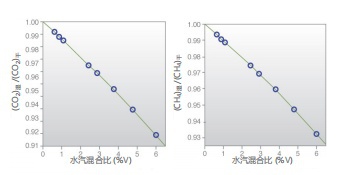
(CO2)Wet/(CO2)Quadratic fitting of dry mix ratio (left figure) and (CH)4)Wet/(CH4)Gan and H2Quadratic fitting of O mixture ratio (right figure). The mixing ratio of carbon dioxide and methane is only meaningful when extrapolated back to dry gas conditions. The Picarro G2301 analyzer is capable of directly measuring the dry gas mixture ratio of carbon dioxide and methane in wet gas streams. Only Picarro products include automatic moisture correction and have been independently validated by top laboratories such as NOAA, MPI, and LSCE.
2. Main features
-
Ppb level ultra-high sensitivity, accuracy, and precision without factual drift
-
Compliant with WMO data quality requirements, synchronously measuring CO2, CH., and H2O
-
Automatic moisture correction, samples do not need to be dried
-
Not sensitive to changes in environmental temperature
-
Durable and sturdy, each unit undergoes environmental, impact, and vibration tests
-
Quick and easy to install, the entire system configuration only takes a few minutes
3Technical parameters:
| Picarro G2301Environmental, impact, and vibration tests (conducted on each analyzer) | |||
|
Thermal temperature change test (whole instrument) | Test the working temperature step by step for more than 12 hours, from 5 ℃ to 40 ℃, and maintain it for 40 minutes after each 5 ℃ increase. Verify performance specifications throughout the entire testing scope. | ||
|
Long term thermal testing (entire instrument) | The working temperature is tested step by step for a week, from 30 ℃ to 40 ℃, and held for 40 minutes after each 5 ℃ increase. Verify performance specifications throughout the entire testing scope. | ||
| Storage testing (whole instrument) | Constant temperature storage (not working) at -10 oC and 50 oC+performance confirmation after testing | ||
| Vibration Test | Two axes, 25 Hz, 1gp-p acceleration, 15 minutes per axis | ||
|
Perform impact testing using MIL-STD 810F | Lift the analyzer to a height of 4 inches and then release it to drop it onto a hard surface (test bench). All 12 sides (x, y, z-axis) undergo this impact test, with each side tested twice | ||
| Power interruption test | At least 5 successful AC power outages and restarts | ||
|
Picarro G2301Ensure performance specifications (In the air) | CO2 | CH4 | H2O |
| Accuracy (1- σ: initial 5-second/5-minute average data) ensures accuracy under the following specified operating conditions | < 70 ppb / 25 ppb | < 0.5 ppb / 0.22 ppb | < 80 ppm / 30 ppm |
| Maximum drift under standard temperature and pressure (24 hours/month) *(The difference between the maximum values of the 50 minute average) Ensure drift under the following specified operating conditions |
< 120 ppb / 500 ppb |
< 1 ppb / 3 ppb | < 100 ppm ± 0.5% reading |
| Automatic determination of dry mole fraction | included | included | Not applicable |
| measurement range | 0 - 1000 ppm | 0 - 20 ppm | 0-7% v (39 ℃ dew point) under non condensing conditions |
|
Ensure accuracy range |
300 - 700 ppm |
1 - 3 ppm | 0-3% v (25 ℃ dew point) under non condensing conditions |
| Measurement interval (data acquisition rate) | <5 seconds | <5 seconds | <5 seconds |
| Gas response: rise/fall time (10 - 90% / 90 - 10%) | <3 seconds | <3 seconds | <3 seconds |
| Measurement pool control | Temperature:+/-0.005 ℃, Pressure:+/-0.0002 atmospheres | ||
*Picarro calculates drift by subtracting the minimum value from the maximum value of the 50 minute average data obtained during a 30 hour experiment.
| Picarro G2301Air pollution analyzerSystem indicators | |
| ambient temperature | +Operate between 10 ℃ and+35 ℃, store between -10 ℃ and+50 ℃ |
| ambient humidity | <99% relative humidity (under non condensing conditions) |
| Sample pressure | 300 to 1000 Torr (40 to 133 kPa) |
| Sample humidity | <99% relative humidity (under non condensing conditions) |
| sample temperature | -10 to 45 ℃ |
| Sample flow rate | <0.4 standard liters per minute (SLM), no filtration required at 760 Torr pressure |
| Overall dimensions | Analyzer: 17 "wide x 7" high x 17.5 "long (43.2 x 17.9 x 44.5 cm), excluding 0.5 inch legs, external pump: 7.5" wide x 4 "high x 11" long (19 x 10.2 x 28 cm) |
| weight | 60.4 pounds (27.4 kilograms), excluding external pump |
| Power requirements | 100-240 volts AC, 47-63 hertz (automatic detection), total power at startup<260 watts 110 watts (analyzer)+80 watts (pump) in steady state |
| Air inlet connector | 1/4 inch Swagelok ® |
● Includes accessories: external vacuum pump, vacuum pipeline and accessories, keyboard, mouse, LCD display, built-in 160 GB hard drive
Installation form: desktop (standard) or 19 inch rack installation (optional)
● Data output: RS-232, Ethernet USB、 Analog output (optional) 0-10 volts
● Optional accessories: seamlessly integrated with Picarro's 16 channel sampler, simplifying multi-point sampling
[Note] This product is not suitable for accurately locating methane sources during driving. Therefore, we do not support the use of this product for natural gas leak detection or other real-time methane emission applications during driving. Picarro SurveyorTM The system is the best product for conducting such research
4. Typical applications
Application case - Picarro series products have great potential in the field of environmental monitoring: Analysis of the application case of the multifunctional atmospheric environment monitoring mobile platform developed by the research team of the University of Michigan
Abstract: Accurately obtaining the spatiotemporal variation characteristics of air quality can reduce risk prediction errors in health impact and accountability research, and better determine the source of responsibility in allocation research. Due to the diverse and highly varying sources of pollutant emissions in urban and industrial areas, as well as constantly changing meteorological conditions, air quality exhibits significant spatiotemporal variations.
Traditional monitoring stations, usually established for regulatory purposes, can only measure a specific few pollutants and provide very little information about spatial changes. Remote sensing data is the use of satellite data to estimate pollutant concentrations and can be used for several pollutants, but provides column integration measurements with relatively coarse spatial resolution. The diffusion model can provide spatial and temporal information, but the gaps and other limitations in the source list increase the uncertainty of the method and may lead to significant errors.
The use of mobile platforms to measure spatial variations of air pollutants and detect peak or "hotspots" of air pollutants has become a supplementary monitoring method to fixed monitoring and remote sensing. In the past two decades, mobile monitoring has been used for various purposes, such as spatial distribution of air pollutants in specific environments, estimation of pollutant emissions caused by human activities, and drawing distribution maps. However, most outdoor activities using mobile platforms have a short duration (usually only a few days) and are mostly focused on one pollutant.
Based on the above research progress and unresolved issues, Xia Tian's team has developed a mobile air quality monitoring platform called the Michigan Pollution Assessment Laboratory (MPAL). This article emphasizes several important issues, such as potential deviations in PM measurements and the impact of vehicle speed, and provides practical techniques for evaluating and solving these problems.
Technical Report-High precision greenhouse gas analyzer
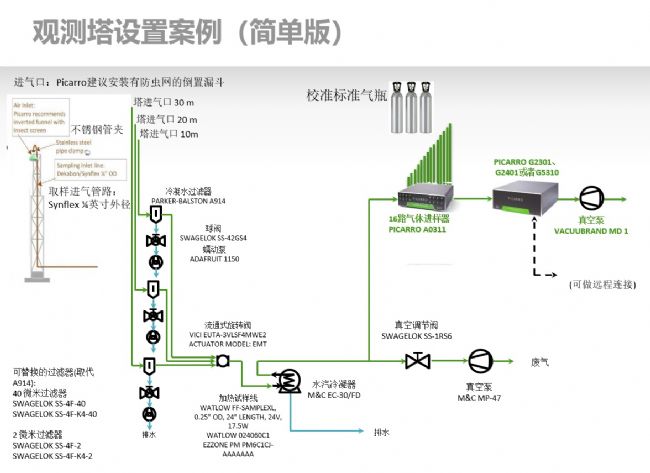
AbstractPicarro G2301 is an on-site deployable, real-time working environmental gas monitoring instrument that can measure with ppb level sensitivityThe levels of methane and carbon dioxide in the atmosphere are measured using ppm sensitivity to measure water vapor levels. It can adapt to constantly changing environmental conditionsMaintain high linearity, precision, and accuracy under the piece, with minimal need for calibration. Picarro G2301 is based on WS-CRDS technologyThe function and structural design of the technology complement each other, including providing high-precision wavelength monitors with anti-interference properties against interfering gases, and extremely precise temperature and pressure control.
5. Product series
-
Picarro G2301 Ultra High Precision Gas Analyzer (CO)2/CH4/H2O)
-
PicarroG2401 gas concentration analyzer (CO)2/CH4/CO/H2O)
-
PicarroG5310 gas concentration analyzer (N)2O/CO/H2O)
As a core partner of international brands such as Picarro and Thermo Fisher in China, Century Chaoyang has provided over 200 sets of professional equipment for projects such as the National Environmental Monitoring Station and Winter Olympics air quality assurance. The testing data has been certified by CNAS.
Cross border integration from optics to artificial intelligence
1. Laser scattering technology: particle size spectrum analysis of particulate matter
Dual wavelength laser source (780nm+635nm) penetrates through porous sol
90 ° Lateral Scattering+Forward Scattering Dual Detector Architecture
Real time output of PM1/PM2.5/PM10 mass concentration and particle size distribution
Technical advantages:
Distinguish 0.3 μ m particles (human cell size is about 10 μ m)
Flow stability ± 2% (industry average ± 5%)
2. Photoacoustic Spectroscopy Technology: Ultra trace Capture of VOCs
Photoacoustic pool design: resonance frequency of 9kHz, amplification of acoustic signal by 100 times
Multi band optical filtering: specific detection of formaldehyde (3.3 μ m) and benzene derivatives (9.6 μ m)
The detection limit reaches 0.1ppb (100 times higher than the national standard)
3. Intelligent compensation algorithm: the nemesis of environmental interference
Dynamic modeling of temperature and humidity: For every 10% increase in humidity, the formaldehyde reading is automatically compensated by 5%
Cross interference elimination: machine learning recognition of characteristic spectra of interfering substances such as ethanol
Drift self correction: Start zero calibration every 24 hours (± 1% accuracy)
Intelligent cloud platform
Digital twin system:
3D modeling restores the diffusion path of pollution
Predict concentration changes in the next 8 hours (accuracy>92%)
Warning mechanism:
Graded alarm (blue/yellow/red three color warning)
Automatically push governance suggestions (such as "suggest turning on the strong mode of the purifier")
Three major technological leaps in air monitoring
Sensor miniaturization:
MEMS chip technology reduces analyzer size to the size of a mobile phone
成本降低40%(2025年商用化)
Blockchain traceability:
Real time on chain monitoring data enhances the effectiveness of judicial evidence collection
Applied to carbon emissions trading audit
AI Predictive Governance:
Deep learning predicts pollution peak (accuracy rate of 85% 3 days in advance)
Automatic response of linked fresh air/purification equipment


