-
E-mail
ellen.huang@unicorn-tech.com
- Phone
-
Address
No. 1 Lide International, 1158 Zhangdong Road, Pudong New Area, Shanghai, 609V
Product Categories
Younikon Technology Co., Ltd
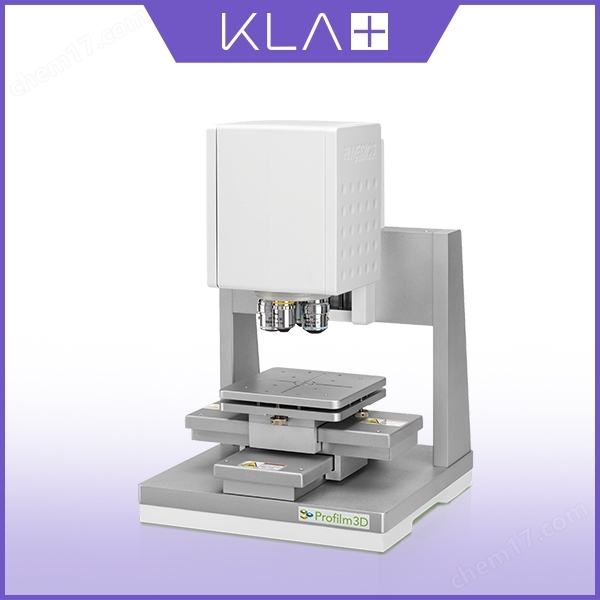


3D white light interference profilometer
NegotiableUpdate on 01/05
- Model
- Nature of the Manufacturer
- Producers
- Product Category
- Place of Origin
Overview
The 3D white light interference profilometer and KLA Profilm3D optical profilometer use vertical interference scanning (WLI) technology and phase interference (PSI) technology. Realize sub nanometer level surface morphology research at a lower price. Adopting the principle of white light interference without damaging the sample.
Product Details

Product Introduction
KLA Profilm3D is a3D white light interference profilometerThe KLA Profilm3D optical profiler uses vertical interference scanning (WLI) technology and phase interference (PSI) technology. Realize sub nanometer level surface morphology research at a lower price. Adopting the principle of white light interference without damaging the sample.
Product features and advantages:
Field of view range: Profilm3D provides a field of view range of up to 2mm with only a 10x objective lens, and its maximum 4x optical zoom function meets the need to switch multiple objectives for different applications. All of these further reduce the cost of procurement demand.
100mm automatic XY sample stage: Each Profilm3D optical profiler is equipped with a 100mm automatic XY sample stage, a 4-hole objective lens turntable, and a manual leveling device as standard configuration.
High cost-effectiveness: achieving sub nanometer level surface morphology research at a lower price.
Non contact high-precision measurement: The vertical resolution can reach sub nanometer level (<1nm), suitable for non-destructive testing of sensitive materials such as soft polymers and biological samples.
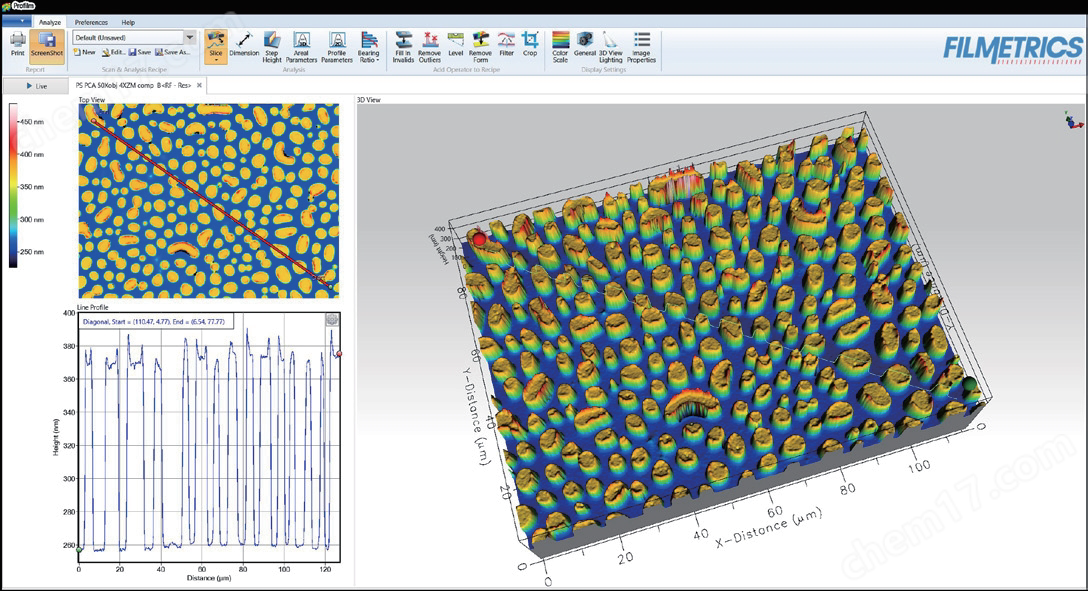
Simple measurement: The Profilm3D optical profilometer software can intuitively reflect measurements including surface roughness, shape, and step height. Within seconds, you can obtain measurements of all common roughness parameters on both flat and curved surfaces. You can also choose to upgrade the splicing function software to combine multiple images for large-area measurement.
Product measurement principle:
The KLA Profilm3D optical profiler uses white light as the light source and divides the beam into two paths through a beam splitter: one path illuminates the surface of the measured sample, and the other path projects onto the surface of the reference mirror. The two reflected beams form interference fringes on the CCD camera. The small height difference on the surface of the sample causes changes in the optical path difference. By analyzing the brightness distribution and positional shift of the interference fringes, the relative height of each point on the surface is calculated to generate three-dimensional morphology data.
Main applications:
step height |
texture |
appearance |
stress |
film thickness |
defect detection |
3D white light interference profilometerparameter
Thickness Range (WLI) |
50nm-10mm |
Thickness Range (PSI) |
0-3µm |
RMS repeatability (WLI): |
1.0nm |
RMS repeatability (PSI): |
0.1nm |
Step height accuracy: |
0.7% |
Step height accuracy: |
0.1% |
Sample reflectivity range: |
0.05%-100% |
ISO25178 compatibility: |
yes |
More parameters can be obtained by contacting us | |||
KLA Profilm3D Optical Profilometer Diagram:

Similar Product Recommend


