Polyacrylamide Manufacturer in China | Shouxin Advanced Polymer Sciences Co., Ltd.
Shouxin Advanced Polymer Sciences Co., Ltd. is a leading polyacrylamide (PAM) brand and global supplier based in China.09,18,2026 6 views


10,13,20250From:
Recently, a technical exchange meeting on the urban drainage pipe network water quality monitoring system developed by Shandong Tianhe Environmental Technology Co., Ltd. was held in Weifang. Many industry professionals and customer friends arrived at the scene at the meeting. After understanding, everyone highly affirmed and fully recognized the product. The urban drainage network water quality monitoring system is a core technology system that ensures the safety of urban water environment and improves the management efficiency of drainage system. Through the deep integration of Internet of Things, big data and artificial intelligence technology, it realizes real-time perception, accurate warning and scientific decision support of drainage network water quality. The urban drainage network water quality monitoring system adopts a modular layered architecture, consisting of a sensing layer, a transmission layer, a platform layer, and an application layer. Optical sensors are used for high-precision COD detection with strong anti-interference ability. By using radar water level gauges and Doppler ultrasonic flow meters, the water level height and flow velocity in the pipeline network are accurately measured, providing basic data for water quantity accounting and pollution tracing.
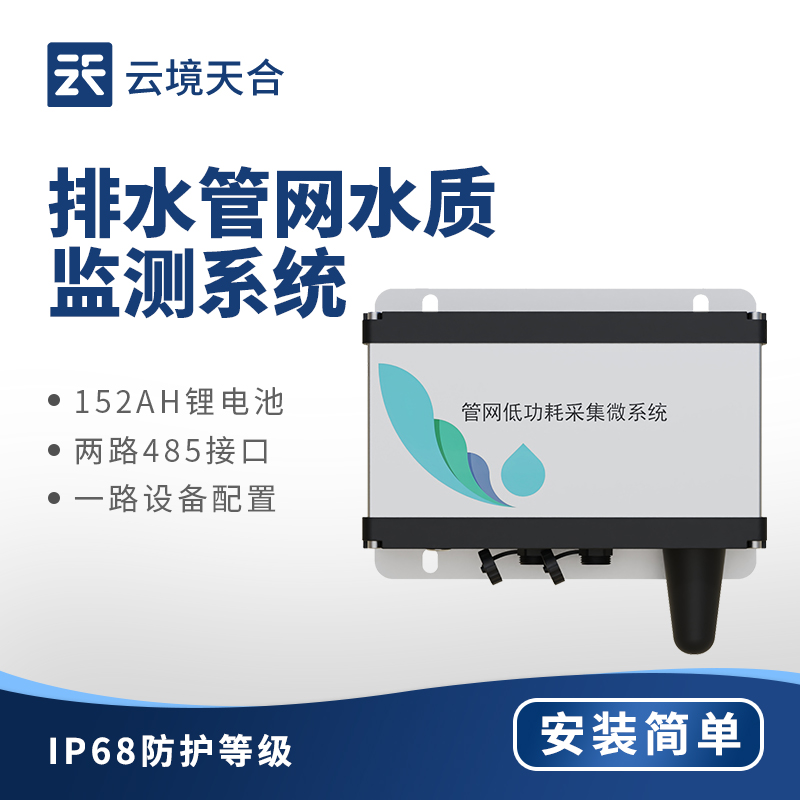
At the meeting, Manager Yu from Tianhe Environmental Technology Co., Ltd. introduced that the core function of the urban drainage network water quality monitoring system is to transform from passive monitoring to active governance through functional integration and technological innovation. Its core functions include real-time monitoring and abnormal alarm system to continuously monitor the water quality parameters of the network at the minute level. When indicators such as pH and dissolved oxygen exceed the preset range, an alarm mechanism is immediately triggered. By combining the topology structure of the pipeline network with the direction of water flow, the system can reverse calculate the source of pollution and confirm illegal discharge behavior through high-definition cameras. The pollution traceability and trend prediction system uses data analysis algorithms and models to perform reverse tracking and correlation analysis on monitoring data. For example, through water quality fingerprint recognition technology, the changing trends of water quality parameters at different monitoring points can be compared to determine the direction of pollutant sources; Based on flow data, determine whether there is a sudden change in flow caused by abnormal emissions, and then track the pipeline where the pollution source is located. Intelligent optimization and emergency response system are linked with drainage pump stations, gates and other equipment to achieve intelligent optimization of pipeline operation. For example, during a rainstorm, the system can dynamically adjust the operation strategy of the pump station according to the real-time monitoring data to prevent sewage from flowing back to the river; After the flood season, the system can complete the evaluation of emergency response processes and provide a knowledge base for subsequent flood prevention preparations.
applied value
The urban drainage pipe network water quality monitoring system plays an important role in urban water resource management, and its application value is reflected in the following aspects: ensuring urban water safety by real-time monitoring of the operation status of the drainage pipe network, timely detecting and treating problems such as waterlogging and sewage overflow, preventing pollutants from directly entering natural water bodies through the pipe network, and effectively preventing water pollution. Improving the efficiency of drainage system management through remote monitoring and data analysis functions enables managers to manage drainage systems more efficiently and reduce labor and material costs. For example, the system can provide key information such as the location of pollution sources, types of pollutants, and diffusion ranges, supporting management departments to quickly dispatch law enforcement personnel to the scene for disposal. The large amount of water quality data accumulated through long-term monitoring of optimized drainage system design and renovation is a valuable asset for diagnosing and planning the construction of drainage systems. Through in-depth analysis of historical data, the operational efficiency of the pipeline network can be evaluated, defects in the pipeline network can be identified, and solid data support can be provided for the repair and renovation, expansion and quality improvement of the pipeline network, as well as the comprehensive management planning of urban water environment. '
The exchange meeting was a complete success. We also welcome customers with such needs to come.
Previous111
NextThe technical exchange meeting for buoy water quality monitoring station was held in Weifang

Polyacrylamide Manufacturer in China | Shouxin Advanced Polymer Sciences Co., Ltd.
Shouxin Advanced Polymer Sciences Co., Ltd. is a leading polyacrylamide (PAM) brand and global supplier based in China.