The core detection indicators of Hydrogen Rich Water (HRW) areDissolved molecular hydrogen (H ₂) concentrationIn addition, it is necessary to pay attention to conventional water quality indicators such as pH value and microorganisms (which must meet the basic standards for drinking water). At present, the mainstream testing methods can be divided into two categories: "laboratory precision testing" and "on-site rapid testing". Different methods have significant differences in accuracy, operational complexity, and cost, and adaptation technologies need to be selected according to the testing purposes (such as product quality control, scientific research verification, and consumer verification). The following provides a detailed explanation of core indicator detection, routine indicator detection, and method comparison:
The detection of dissolved H ₂ should avoid confusion with other hydrogen containing substances in water (such as H ₂ O, H ⁺, HCO ∝⁻). The core is to specifically identify H ₂ molecules through "physical separation" or "chemical/electrochemical response". The mainstream methods are as follows:
This type of method has high accuracy (detection limit ≤ 0.01 mg/L), traceable results, and is used for factory inspection and national standard compliance verification of hydrogen rich aquatic products, mainly including gas chromatography and electrochemical sensor methods.
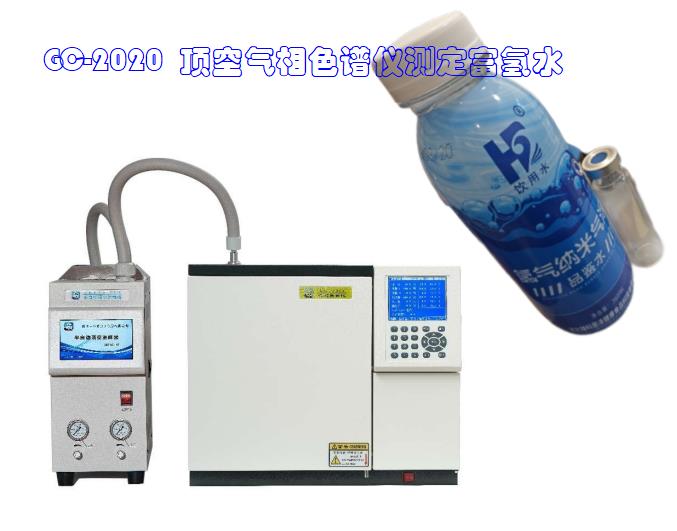
Referring to the principle of "dissolved gas detection" in the "Methods for Testing Drinking Natural Mineral Water" (GB/T 8538), H ₂ is separated by headspace extraction and quantified by gas chromatography, which is currently one of the detection methods.
-
principle:
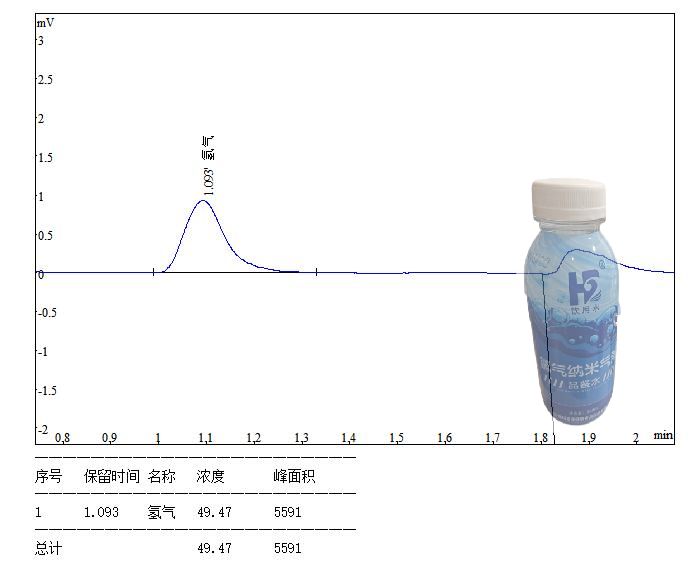
The hydrogen rich water sample is equilibrated at a constant temperature in a sealed headspace bottle, and the dissolved H ₂ diffuses into the gas phase layer. The headspace gas is extracted and injected into the gas chromatograph. The peak area of H ₂ is detected by a "thermal conductivity detector (TCD)" or "zirconia detector (ZD)", and the H ₂ concentration in the water is calculated based on the standard gas calibration curve (in accordance with Henry's law: the concentration of H ₂ in the gas phase is proportional to the concentration of dissolved H ₂ in the water).
operating procedure:
Chromatography column: 5 Å molecular sieve capillary column (30m × 0.25mm × 0.25 μ m, specific separation of H ₂, avoiding interference from O ₂ and N ₂);
Carrier gas: high-purity helium gas (≥ 99.999%, free of H ₂ impurities), flow rate 1.0 mL/min;
Detector: TCD (wide linear range for H ₂ response, suitable for conventional concentrations of 0.1-3.0 mg/L) or HDI (lower detection limit, suitable for trace H ₂ detection);
Column temperature: 40 ℃ constant temperature (to avoid peak broadening caused by programmed heating);
Sample preparationTake 20mL of hydrogen rich water (which needs to be sampled quickly to avoid H ₂ volatilization) and inject it into a 20mL headspace bottle. Immediately seal it (using a PTFE lined stopper) and add a magnetic stirrer (to accelerate equilibrium);
Headspace equilibriumSet the headspace analyzer temperature to 30 ℃ (room temperature is also acceptable, constant temperature is required) and the equilibrium time to 20 minutes to ensure that the gas-liquid two-phase H ₂ reaches distribution equilibrium;
instrumental analysis:
-
Quantitative calculation:
Prepare H ₂ standard gas (such as concentrations of 0.1, 0.5, 1.0, 2.0, 3.0 mg/L, which need to be prepared with pure water without H ₂), draw the "peak area concentration" standard curve, and calculate the sample concentration using the external standard method:\\(C {\ \ text {water}}=C {\ \ text {gas} \ \ times K \ \)
among which\\(C_{\ \ text {water} \ \)The concentration of H ₂ in water (mg/L);\\(C_{\ \ text {Qi} \ \)The concentration of H ₂ in the headspace gas phase (mg/L, obtained from the standard curve);KThe distribution coefficient of H ₂ in water is approximately 0.015 at 30 ℃, which can be determined experimentally or by referring to the Henry's law constant table.
-
Strengths and Limitations:
Advantages: High precision (RSD ≤ 2%), strong specificity (only responds to H ₂, not affected by other gases), traceable results (can use certified standard gases);
Limitations: Requires professional instruments (gas chromatograph+headspace sampler), complex operation (requires professional personnel), long detection cycle (1-2 hours/sample).