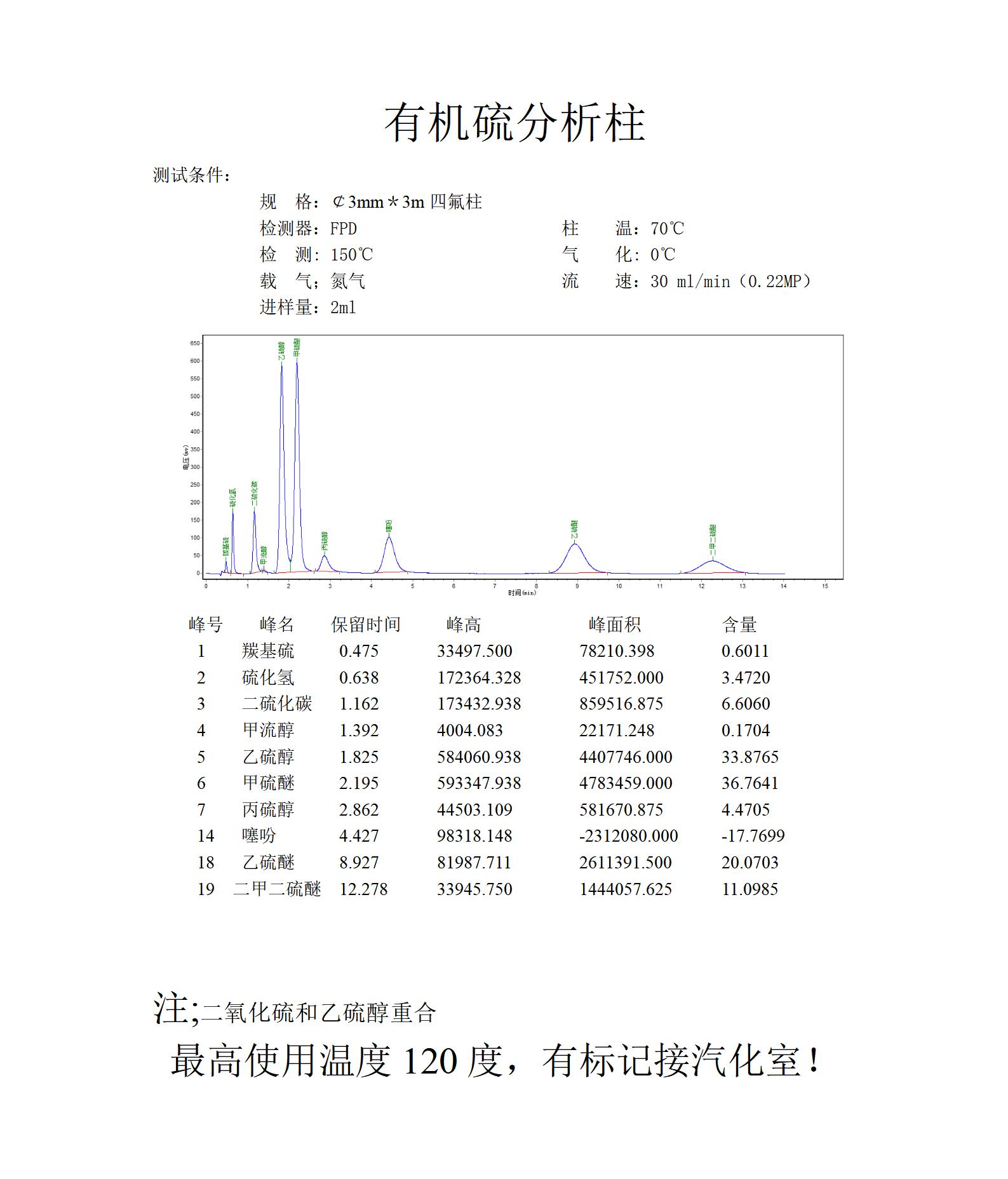
Organic sulfur packed columns, as specialized chromatographic columns in gas chromatography (GC) analysis, are mainly used for the separation and detection of organic sulfur compounds, and have irreplaceable application value in environmental protection, chemical industry, food and other fields. A comprehensive analysis will be conducted from four dimensions: core features, technical details, application scenarios, and practical points
Organic sulfur packed column is a chromatographic column that separates organic sulfur compounds such as methyl mercaptan, methyl sulfide, and carbon disulfide by filling a special stationary phase packing in a metal or glass column tube. Its core structure consists of two parts:
Column materialCommonly used are polytetrafluoroethylene (strong corrosion resistance, suitable for acidic environments containing sulfur-containing compounds) or stainless steel (high temperature resistance, with a maximum operating temperature of over 120 ℃), with a typical specification of 3m × 3mm (length × inner diameter).
Fixed phase systemUsing porous silica gel, polymer or modified adsorbent as the matrix, enhance the selective adsorption of organic sulfur by coating polar bonding phases (such as functional groups containing cyanide and amino groups). For example, some specialized columns use fluorinated end group tail sealing technology, which can reduce non-specific binding between sulfur compounds and active sites on the surface of fillers, and reduce peak tailing phenomenon.
Separation efficiencyBased on the theoretical number of trays (N) as the core indicator, the N value of a conventional organic sulfur packed column is about 1000-3000/m, which is lower than that of a capillary column (up to 10000/m). However, by optimizing the fixed matching ratio, baseline separation of more than 7 organic sulfur components (such as H ₂ S, CS ₂, methyl mercaptan, etc.) can be achieved.
detection limitWhen used in conjunction with a flame photometric detector (FPD), the detection limit of 1mL sample injected directly can reach 0.5-2 × 10 ⁻³ μ g, meeting the requirements of ppm level trace analysis.
Temperature toleranceThe maximum operating temperature for most products is 120 ℃, and the program heating rate should be strictly controlled (recommended ≤ 10 ℃/min) to avoid the loss of fixed phase and the decrease in column efficiency.
Carrier gas adaptabilityNitrogen is commonly used as the carrier gas, and the flow rate should be controlled at 5-10mL/min, which is higher than that of capillary columns (usually 1-3mL/min). A larger flow rate helps reduce the residual sulfur compounds in the column.
Organic sulfur packed columns are widely used for the detection of sulfur compounds in complex matrices due to their strong sample tolerance and low cost advantages
environmental protection fieldOdor gas monitoring, such as the analysis of components such as methyl sulfide and dimethyl disulfide in the exhaust gas from landfills and sewage treatment plants, can directly inject "dirty samples" without complex pretreatment.
chemical industryQuality control of organic sulfur impurities in natural gas and petroleum refining processes, such as using a pre concentration system in combination with GC-SCD (sulfur chemiluminescence detector), can achieve ultra trace detection of 0.002-0.004 nmol/mol.
food testingScreening of residual solvent No. 6 (containing trace sulfur compounds) in edible vegetable oils, and flavor traceability analysis of volatile sulfur compounds in alcoholic beverages and alcoholic beverages.
Loading and aging:
When filling, a vacuum pump is required to assist, and an electric massager is used to vibrate the column tube to ensure that the fixed phase is uniform and tight; After filling, let it age under nitrogen at 90 ℃ for 24 hours to remove residual solvents and impurities.
The laboratory can independently prepare fillers (such as modified silica gel) at a cost of only 1/5-1/3 of the finished capillary column, but it is necessary to strictly control the particle size distribution of the fillers (recommended 3-5 μ m) to ensure column efficiency.
Precautions for use:
Sample pretreatment: If the matrix contains a large amount of oil or particulate matter, it needs to be purified by solid-phase extraction (SPE) to avoid clogging the column bed;
Detector matching: Priority should be given to FPD or SCD. If FID is used, a dedicated small-diameter nozzle (inner diameter ≤ 0.2mm) should be replaced to reduce the risk of combustion residue blockage.
Maintenance and regeneration:
Pollution treatment: When the column efficiency decreases, high-purity nitrogen gas (flow rate 10mL/min) can be used to age at 100 ℃ for 12 hours, or the column tube can be backwashed (only for symmetrical structure columns);
Life assessment: When the theoretical number of trays drops below 70% of the initial value or the separation degree is lower than 1.2, the packing or entire column needs to be replaced.