Non methane hydrocarbons (NMHC) refer to all volatile hydrocarbons (mainly C ₂ - C ₁ ₂) except methane. As an important component of atmospheric volatile organic compounds (VOCs), they are ozone (O3) and PM ₂ The key precursors of ₅ need to be strictly controlled for emissions (such as the national standard GB 37822-2019, which requires NMHC emission limits of ≤ 80mg/m ³ for industries involving VOCs).Non methane total hydrocarbon analyzerIt is a specialized instrument used for quantitative detection of NMHC concentration in ambient air and fixed pollution source exhaust gas. Its core function is to achieve separate determination of methane (CH ₄) and non methane total hydrocarbons through the "separation detection" process, and then obtain the result through the calculation logic of "total hydrocarbons (THC) - methane (CH ₄)=non methane total hydrocarbons (NMHC)".
The working principle of non methane total hydrocarbon analyzer is based onGas chromatography (GC) separation technologyandHigh sensitivity detectorThe core of the combination is to use the retention difference between methane and other hydrocarbons on the stationary phase to achieve separation, and then convert the concentration signal into an electrical signal through a detector. The specific process is as follows:
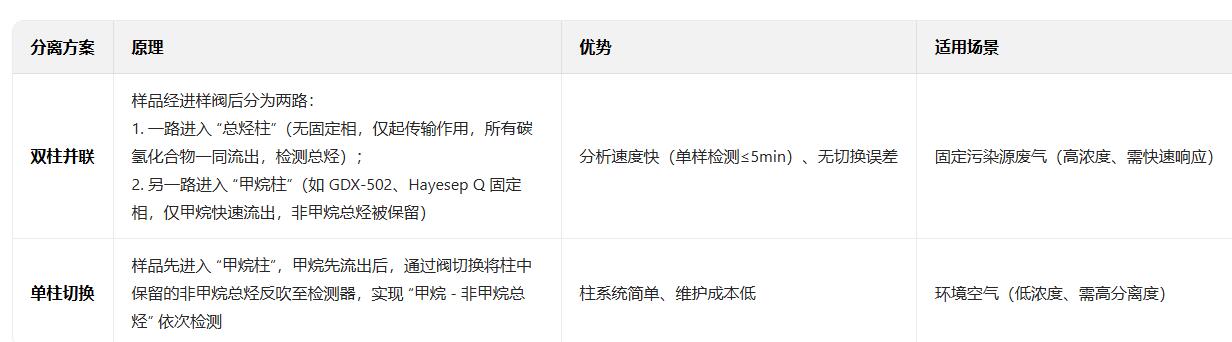
Comparison of two mainstream separation schemes for methane and non methane total hydrocarbons achieved through "dual column parallel" or "single column switching":
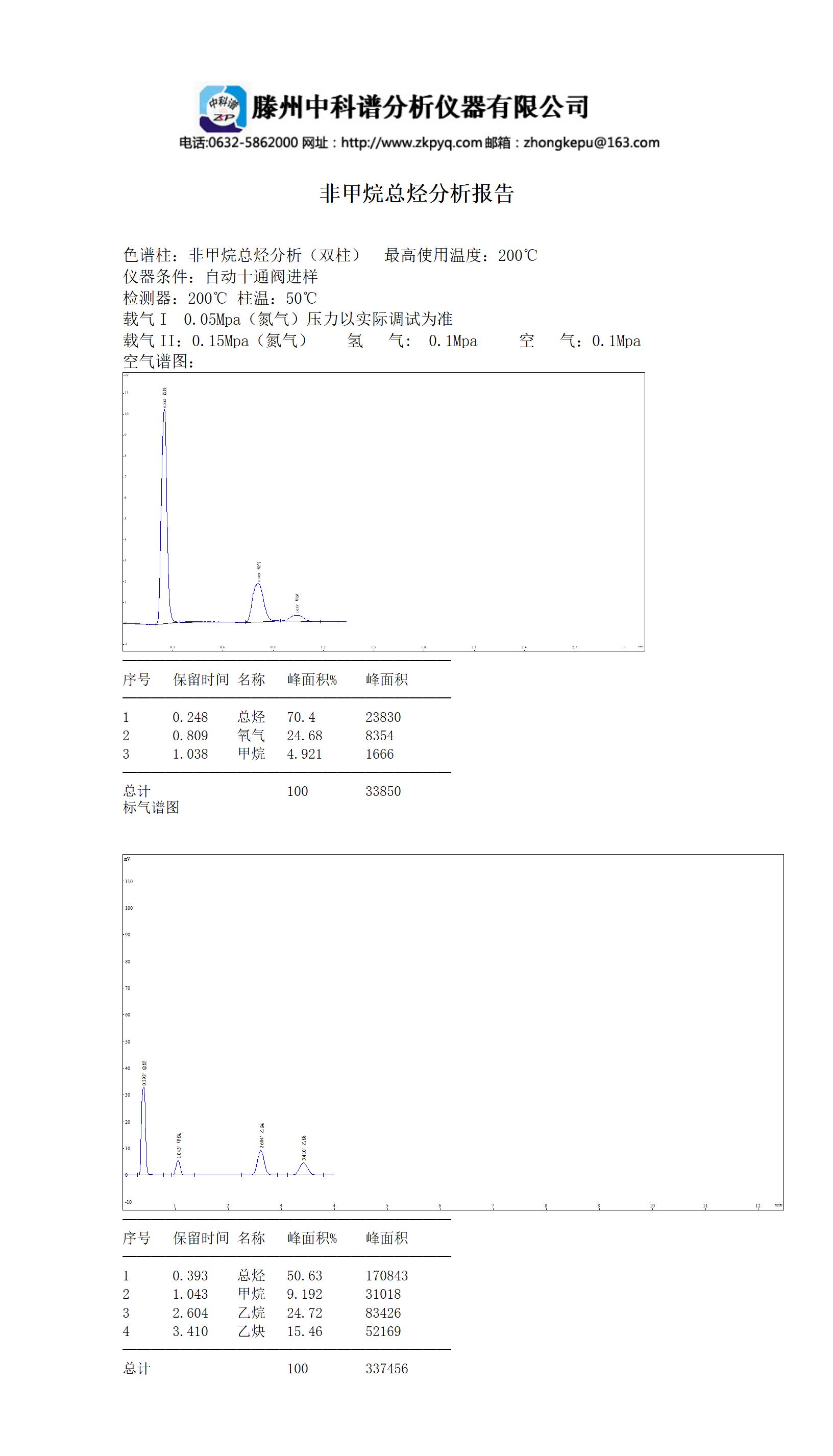
GC2020 Gas Chromatography Hydrogen Flame Detector (FID)
ZKP2000 dual channel (computer, printer self equipped)
Hydrogen air generator integrated machine
High purity nitrogen cylinder 40L nitrogen flow rate 300ml/min
Reagent: Methane standard gas, hydrocarbon removal air
Power on preheatingAfter starting up, introduce the carrier gas (nitrogen, purity ≥ 99.999%), hydrogen (purity ≥ 99.999%), and air, preheat the detector (FID needs to be ignited and the temperature rises to 200-250 ℃), and start analysis after the baseline is stable (noise ≤ 0.01mV);
calibrationPerform "zero point calibration" (by introducing zero gas, which is clean air that removes hydrocarbons) and "span calibration" (by introducing a standard gas of known concentration, such as NMHC 50mg/m ³) after daily startup to ensure that the calibration results are within the allowable error range;
sample analysisStart the automatic sampling program, and the instrument automatically completes sampling, separation, and detection, displaying and uploading data in real-time;
Shut downAfter the analysis is completed, first turn off the hydrogen and air, continue to supply the carrier gas for 30 minutes, and then turn off the carrier gas and power supply when the detector temperature drops below 50 ℃.
-
Detector maintenance:
The FID nozzle needs to be cleaned every 3-6 months (using ethanol ultrasonic cleaning to remove carbon deposits). If ignition difficulties or sensitivity decrease occur, the nozzle needs to be replaced (usually with an inner diameter of 0.2-0.3mm);
-
Column maintenance:
Aging the chromatography column every 6-12 months (aging for 2-4 hours under conditions of 20-30 ℃ above the operating temperature and with a carrier gas), removing residual high boiling impurities in the column. If the separation degree decreases (such as overlapping methane and ethane peaks), the chromatography column needs to be replaced;
-
Preprocessing system maintenance:
The sampling probe filter membrane of the online monitoring device needs to be replaced weekly (to avoid particle blockage), and the water removal device (such as Nafion tube) needs to be checked every 3 months. If the moisture absorption capacity decreases, it needs to be replaced;
-
Standard gas maintenance:
When the pressure of the standard gas cylinder is lower than 0.5 MPa, it needs to be replaced to avoid concentration deviation, and the standard gas should be used within its validity period (usually 1 year).
Environmental air monitoringLaboratory instruments are used for detecting the daily and hourly mean values of NMHC in urban environmental air automatic monitoring stations (such as national control stations) to evaluate the level of VOCs pollution in the area;
Unorganized emission monitoring at the factory boundaryPortable instruments are used for monitoring NMHC concentration around the enterprise boundary to ensure compliance with GB 37822-2019 "Unorganized Emission Control Standards for Volatile Organic Compounds" (NMHC limit ≤ 2.0mg/m ³ at the boundary, ≤ 1.0mg/m ³ during special periods).
Monitoring of exhaust pipes from fixed pollution sourcesOnline monitoring instruments are used for continuous monitoring of NMHC emissions from exhaust pipes in industries such as petrochemicals, chemical engineering, painting, printing, and pharmaceuticals, ensuring that the emission concentration meets industry standards (e.g. petrochemical industry limit ≤ 60mg/m ³, painting industry limit ≤ 40mg/m ³);
Process controlSome companies use portable instruments for NMHC concentration monitoring in production workshops to avoid safety accidents (such as explosions) caused by high concentrations.
emergency monitoringIn case of sudden VOCs leakage incidents (such as oil tanker leaks or chemical plant explosions), portable instruments can quickly measure the concentration of NMHC in the leakage area, providing data support for emergency response (such as evacuation range delineation);
scientific research experimentLaboratory instruments are used to study the migration and transformation laws of NMHC in the atmosphere (such as the mechanism of reacting with NO to generate O3), providing scientific basis for environmental policy formulation.