-
E-mail
infochina@biolinscientific.com
-
Phone
18612271669
-
Address
Room 1205, Building 1, Zhanxiang Plaza, Lane 2290, Zuchongzhi Road, Pudong New Area, Shanghai
Sweden Biolink Technology Co., Ltd
Zheng Da and Chen Weihua's team use QCM-D technology to help achieve new breakthroughs in the research of sodium ion battery electrolytes
Date: 2025-07-18Read: 0
User achievements|Chen Weihua's team from Zhengzhou University《Nature CommunicationsHow to translate
QSense QCM-DNew breakthroughs in electrolyte research for sodium ion batteries with technological assistanceIn the field of new energy, sodium ion batteries are considered an ideal choice for large-scale energy storage in the future due to their abundant resources and low cost. However, the stability of the electrolyte has always been one of the key factors restricting the development of sodium ion batteries. Recently, the team led by Chen Weihua from Zhengzhou University“Locking-chain electrolyte additive enabling moisture-tolerant electrolytes for sodium-ion batteries”Title, in《Nature Communications》Publish relevant research and use it innovatively
QSense QCM-DTechnology has deeply analyzed the mechanism by which new electrolyte additives improve the performance of sodium ion batteries, bringing new breakthroughs to this field.
Research background: ElectrolytePain pointsThe interface stability between the electrolyte and the electrode is crucial during the charging and discharging process of sodium ion batteries. However, traditional electrolytes contain trace amounts of moisture(H₂O)It is easy to cause electrolyte decomposition and electrode corrosion, leading to a rapid decline in battery performance. In addition, the solid electrolyte interface formed(
SEI
)Instability further exacerbates the aging problem of the battery. How to optimize the electrolyte to maintain stability in high humidity environments has become an urgent problem for researchers to solve.QSense QCM-D Technology: Unveiling the Electrolyte Electrode InterfaceIn this study, researchers designed a novel approach“chain”electrolyte additive agent——15PBS(15-crown-5)And apply it to the electrolyte of sodium ion batteries. In order to gain a deeper understanding of the mechanism of action of this additive, researchers adopted
QSense QCM-DTechnology is a powerful tool that can monitor interface interactions in real-time.QSense QCM-DTechnology measures the frequency of quartz crystals through measurement(Δf)And dissipation(ΔD)Changes can accurately detect the interaction between the electrolyte and the electrode surface. In the experiment, researchers utilizedQSense QCM-DReal time monitoring of electrolyte adsorption on electrode surface
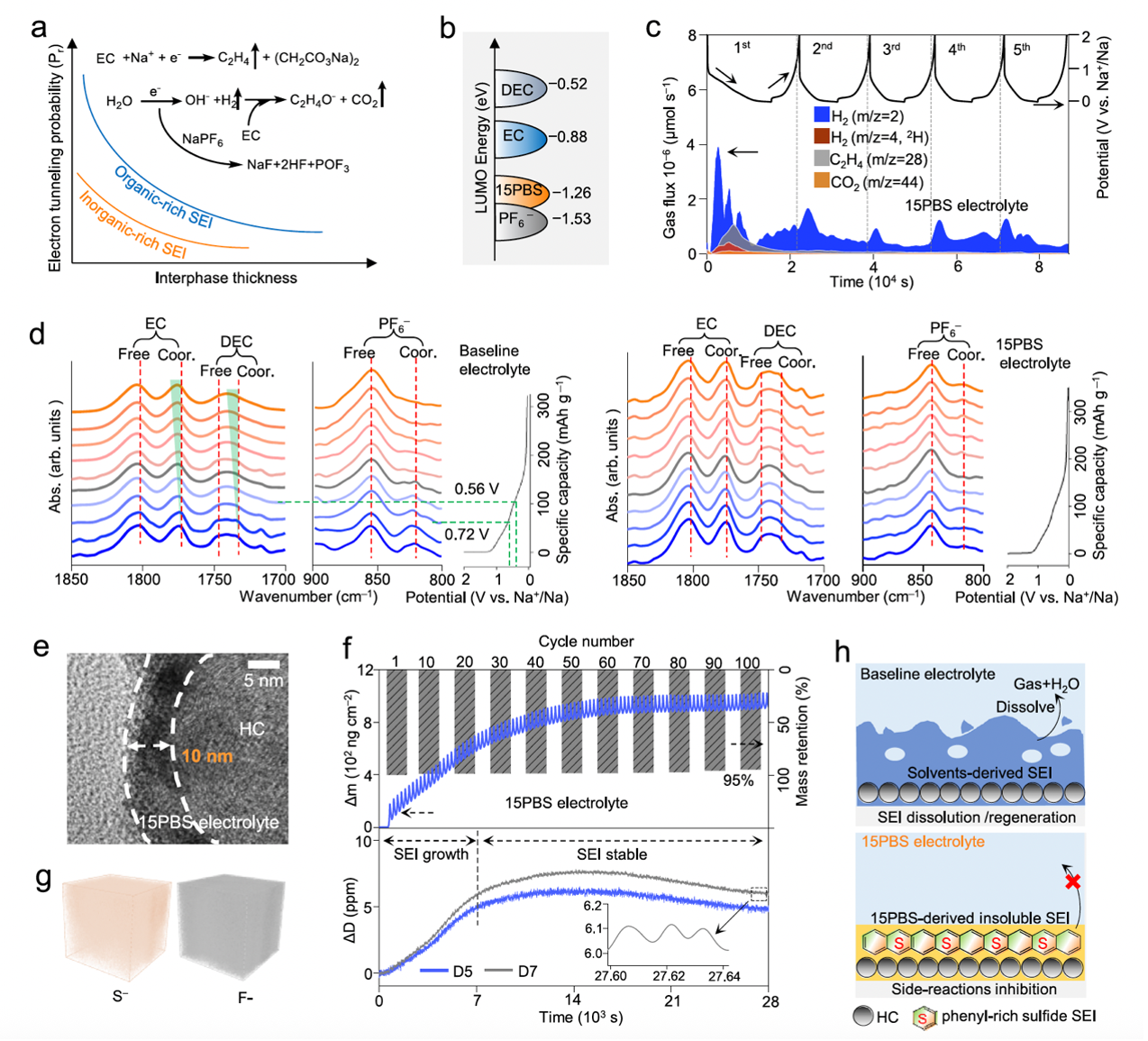
decomposeProcess.image1:Equipped with a locking chain15PBSElectrolyte additivesHCInsoluble on negative electrode
SEI.The experimental results show that when the electrolyte contains15PBSWhen, the frequency of the electrode surface(Δf)And dissipation(ΔD)The changes are significantly different from traditional electrolytes. Specifically,15PBSexistenceInhibit water catalysisElectrolyte on electrode surfaceThe decomposition, andparticipateForm a denser and more uniformRich in sulfidesSEILayer. This denseSEIThe layer effectively prevents direct contact between the electrolyte and the electrode, thereby suppressing the electrolyte'sexcessivedecomposeandSEI
Dissolution and regeneration
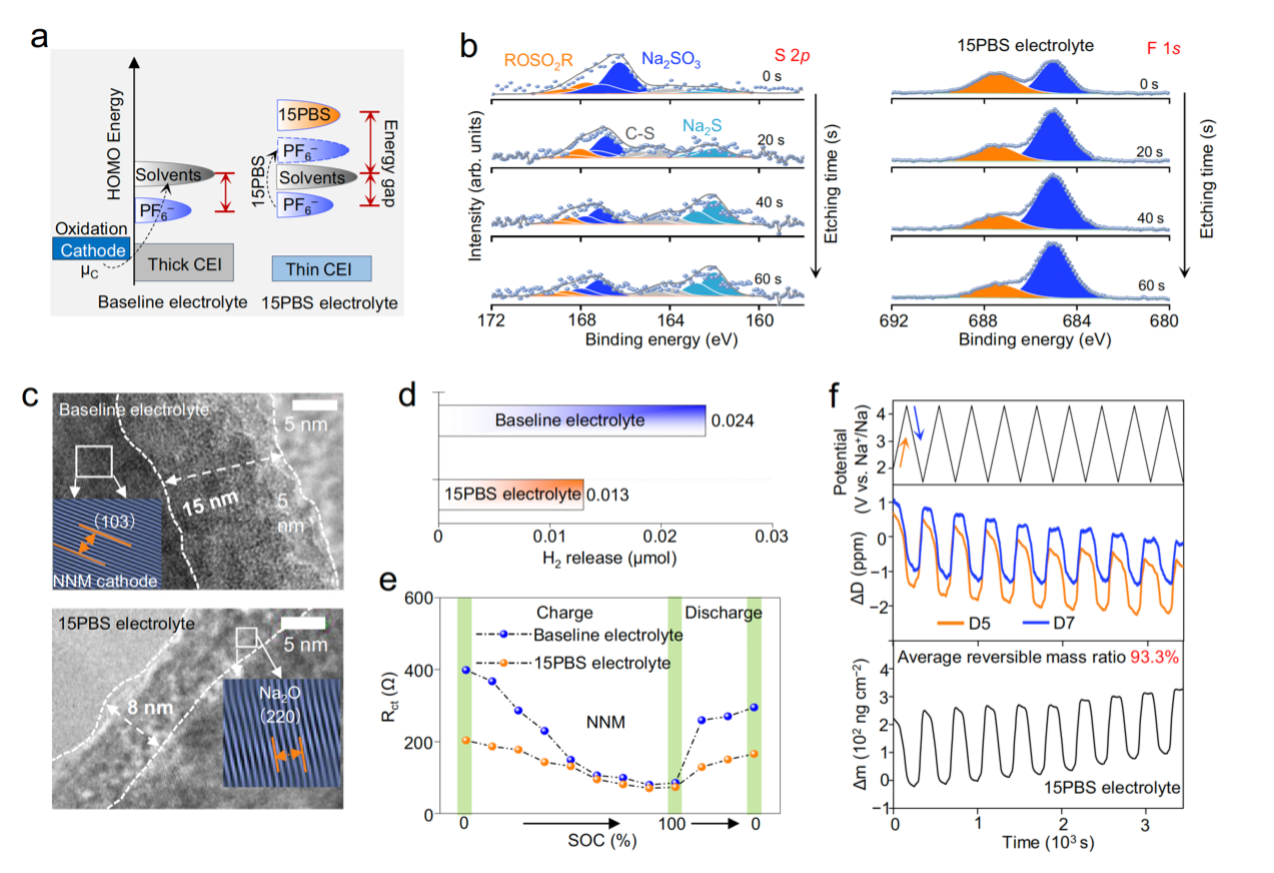
.2Experimental results: Significant improvement in performanceimage:NNMUse a locking chain on the positive electrode15PBS
Stability of electrolyte additivesCEIpassQSense QCM-DMonitoring technology, researchers discover, using
1. 15PBSThe sodium ion battery with electrolyte has achieved significant improvements in multiple key performance indicators:Significantly enhanced cycle stability: in500 mA g⁻¹Under the current density, use15PBSHard carbon in electrolyte.| Na₀₇₂.Ni₀₃₂.Mn₀₆₈ O 2000 ₂The entire battery can cycle stablySecondly, the capacity retention rate is as high as89.5%However, the capacity retention rate of traditional electrolyte batteries under the same conditions is only
2. 79.9%.Excellent high magnification performance: at high current densities (such as600 mA g⁻¹)Below, use15PBSPositive electrode material of electrolyte(NNM)Can still maintain a high discharge capacity(55.4 mAh g⁻
3. ¹)It is far superior to traditional electrolytes.Improved interface stability: throughQSense QCM-DTechnically monitoredSEIThe stability and uniformity of the layer indicate
15PBSElectrolyte can effectively suppress interface side reactions and prolong battery life.
summary andThe key role of QCM-D technologyIn summary, the author designed a locking chain15PBSAdditives are used to optimize the electrolyte from phase to interface.15PBS2Capture trace amountsHOTo prevent electrolyte corrosion and form a stableSEI/CEITo achieve sustainable high energy densitySIB.MDSimulation display,15PBSreducedNa⁺−In the solvation shell andECCoordination number, accelerationNa+Desolvation reduces solvent accumulation at the electrode interface. adsorbed onHCLocking chain on negative pole15PBSBy excludingEDLinEC/DEC2andHOTo suppress the growth of parasitic interfaces, which reduces the activity of molecules(ci)The local concentration is reduced, thereby mitigating the effects of highly polar solventsSEI(High)Pr)The formation. Therefore, the priority decomposition15PBSFormed a benzene rich substance/3硫化物成分(RSOR2The3NaSO2TheNaS)The thin(10 nmLow temperatureTEM)SEITo ensure high ionic conductivity and enhance kinetics.In situEQCMAnd in situDEMSConfirmed, mechanical toughnessSEIHas good electronic insulation and can effectively suppress even at high temperatures
SEIDissolution and regeneration during the cycling process. The reduction of electrolyte consumption and the suppression of gas release synergistically improve cycle life and safety.This study not only demonstrates15PBSThe enormous potential of electrolyte additives in improving the performance of sodium ion batteries is further highlightedQSense QCM-DTechnology is analyzing electrolytes
-The key role in electrode interface interaction. By monitoring the dynamic changes in the interface in real-time, researchers can gain a deeper understanding of the mechanism of action of additives and optimize electrolyte formulations accordingly, providing important theoretical support and practical guidance for the commercial application of sodium ion batteries.
QSense QCM-D
Technology, with its high sensitivity and real-time monitoring capabilities, provides powerful tools for the research of new energy materials, helping researchers continuously make new breakthroughs in the field of battery technology.Funding supportNational Natural Science Foundation of China(U24A20566, 22279121)YaoMountain Laboratory Open Project Plan(2024002)、National Key Research and Development Program(No. 2023YFB3809500)、Henan Province Science and Technology Research and Development Joint Fund(222301420009)、Key R&D Program of Henan Province(231111241400)、Zhengzhou University
wait
The fund project provided important financial support for this research.